Cosmos
The cosmos has followed at my heels all my life, and so literally, down to the geography of my moves, that joking it away as a metaphor stopped working long ago.
(For the Greeks kosmos meant order, the direct opposite of chaos — and the fact that the modern ear hears in the word “cosmos” simply “space” is a substitution everyone has got used to over the millennia, and one that noticeably robs the word. The Pythagoreans, who were the first to call the Universe by this word, meant order: behind its visible face, they held, stands mathematics — number, proportion, structure; Plato in the Timaeus took the same thought to its end, having the Demiurge assemble the world according to numerical proportions older than matter itself. And two and a half thousand years later Vazza and Feletti would show exactly the same thing, only statistically: the cosmic web and the cerebral cortex are described by one and the same mathematics. The vocabulary has changed more than once since then, but the thesis stands untouched — cosmos is order, and order is computable.)
I was a cadet at the Peter the Great Military Space Cadet Corps in Saint Petersburg — VKPVKK, founded in 1996 under the patronage of the Military Space Forces of the Ministry of Defense. Space stood right there in the name: literally, military-space — with uniforms, drills, regulations, and stars over the whole thing, real ones at that, not the ones on epaulettes. A cadet corps is molding, a system that takes a teenager and assembles something else out of him to a blueprint and an instruction. The first school, to use the terminology I hadn’t yet invented.
Then came Petersburg, where I got an apartment at the intersection of Korolev Street and Baikonurskaya — and once again it turned out to be a crossroads of two space names, which were, moreover, linked to each other: Sergei Pavlovich Korolev, the father of the Soviet space program, sent Gagarin up from the Baikonur whose name the cross street bears. It followed that I lived at the crossing of the man and the cosmodrome with which the first flight began.
In front of the building stood a swimming pool, and in front of the pool stood a plaque. The plaque appeared later, when I had long been living differently and looking at signs as someone else’s addresses in memory.
The plaque read: “Here a monument will be erected to those who dedicated their lives to the exploration of space.”
Specifically will be erected, not “is erected”: a promise, a pointer to the future, a pointer leading to a node that does not yet exist.
Coincidence, pointer aliasing, or data?
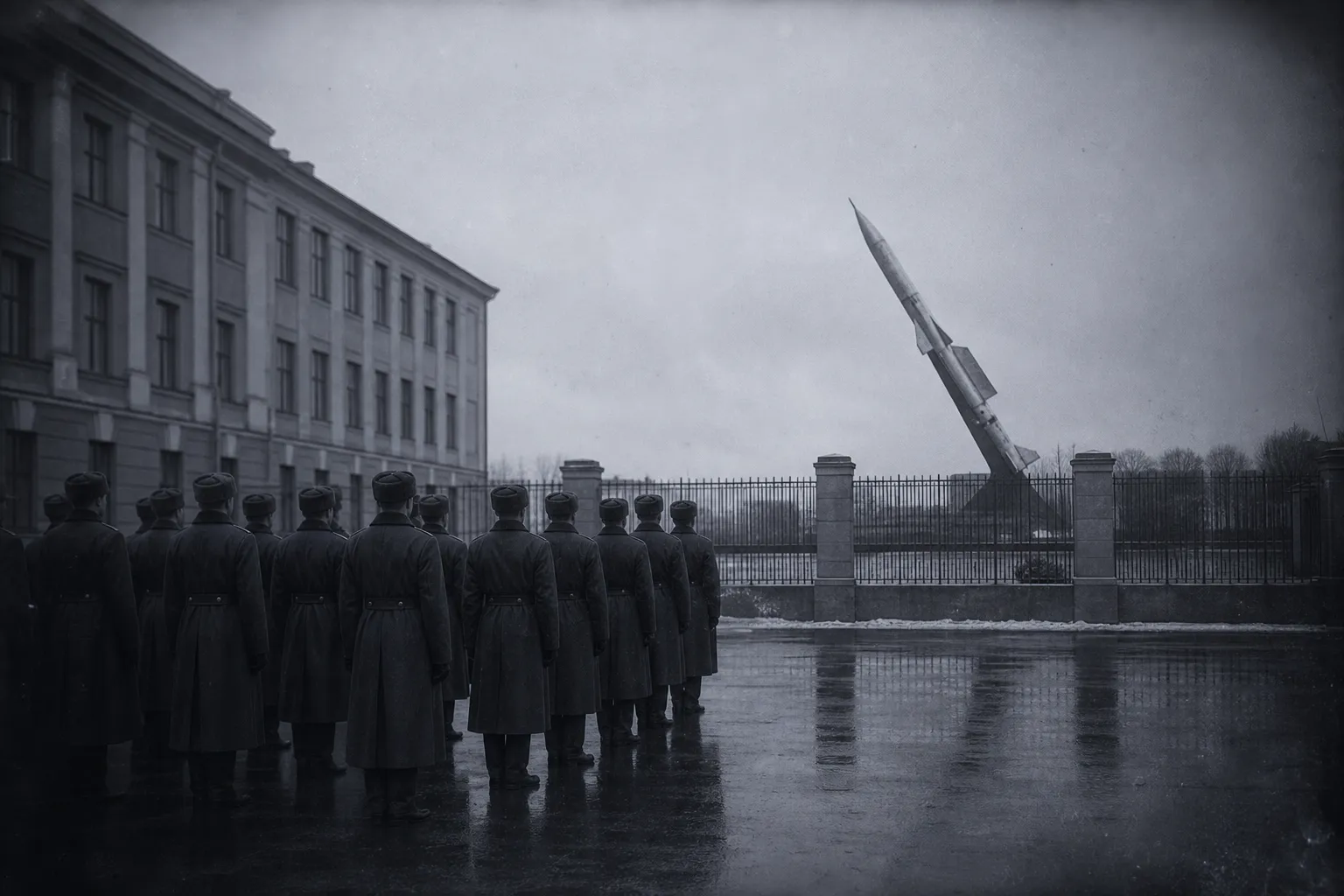
After cadet school I was supposed to go to Mozhayka — the Mozhaysky Military Space Academy in Saint Petersburg, the fifth department: space physics, geophysics, control of rocket and space objects. From a military-space cadet corps into a military-space academy, on the same blueprint, by the same instruction, in the same first school.
I didn’t go. I went to Bonch — SPbSUT named after Bonch-Bruevich, the computer security department, telecommunications, which, as I’ve already said, turned out to be wall-to-wall algebra and information theory. Communications, signals, Shannon.
The blueprint assumed that from a cadet they would make a space-forces officer with rockets, orbits, and trajectories — first school: control, hierarchy, command. I broke that blueprint out of the feeling that it wasn’t mine. My cosmos turned out to be inside: information flowing between nodes instead of rockets flying up; understanding of the device instead of conquest of territory.
A third school: my own way, around the blueprint and the pressure.
And, what’s funny, it was at Bonch, in a department that was supposed to teach computer security, that I got information theory: Shannon, entropy, communication channel, bandwidth. All the things that fifteen years later would become the foundation of my model of reality.
Mozhayka would have given me rockets. Bonch gave me the language in which one can explain why rockets aren’t necessary — and Tsiolkovsky, had he lived to see it, would most likely have appreciated this choice of apparatus over projectile.
Bonch gave me one more thing — Mogwais.
There’s a film, Gremlins, produced by Spielberg, directed by Joe Dante. In it there was a fuzzy creature named Mogwai: cute and harmless until you feed it after midnight. In my life three such Mogwais turned up, and each of them fed after midnight.
The first was named Oleg. I had rented an apartment on Bolshevikov Prospect, not far from Dybenko station, where Bonch’s main campus was located; the Romantsov brothers — Oleg and Kostya — lived in the building next door. The classic case of meeting each one separately and then, six months later, accidentally finding out that they’re brothers: two pointers to one node disguised as two different ones.
I met Oleg at a trance party — my second one in life, at the club “Truba” (“The Pipe”), at the launch of the psytrance.spb.ru community. I was there with Katya, a school crush, and her friend Vika, who later became Oleg’s wife and the mother of his child, though that evening we weren’t even acquainted. We found each other afterward in the photographs, when it had all already happened: standing next to each other in the same shot, not knowing each other, and not knowing that a few years later we’d be celebrating New Year’s in the same kitchen.
Oleg’s nickname was Mogwai. The first Mogwai of my life.
(Katya and I would later go to the first BOOM — 2006, Portugal, Ryanair to Faro for the price of lunch in the Bonch cafeteria. But BOOM gets a separate treatment, in “Remix.”)
Kostya and I later worked together at “Nienschantz” — a Petersburg IT company that built servers under the Favourite brand and was among the top 20 of Russian IT. The office stood on Pyatiletok Prospect, two blocks from Bonch: by day, work; by evening, classes; and in between we built Linux from source using the “Linux From Scratch” book — kernel, utilities, bootloader by hand, like a lab exercise on how an operating system is built. (If anyone considers programming an abstraction, let them try to compile themselves an OS from scratch: it becomes very quickly clear that each layer stands on the previous one, and remove one — and everything collapses. The stack. The stack to which chapter ten of this book is devoted.)
Kolya Tamodin came as head of the systems integration department two weeks after me — sharp, ambitious, the kind who grows fast and confidently. On his first day he called me in for a get-to-know-you formality and asked, “What do you want to become?” I thought and answered, “An architect.” Why that word, I don’t know: I was twenty-something, building Linux from source, and had only a rather vague idea of what architecture was. But the word flew out and apparently predetermined everything that came after: architect of systems, architect of ecosystems, architect of this book. From “Nienschantz,” Kolya grew into a commercial director, and from there into general director of “Voentelecom,” the telecom subsidiary of “Oboronservis”: Ministry of Defense communications, serious contracts, serious money — and then a serious sentence, six years. The “Oboronservis” case, the one in which Anatoly Serdyukov, former defense minister, son-in-law of Prime Minister Zubkov, “Taburetkin,” became famous for having traded in furniture before the Ministry of Defense; his mistress Yevgenia Vasilyeva ran the property relations department, which sold off military real estate at throwaway prices. The mistress got five years and was released after two and a half months; the minister never went to a penal colony and calmly moved on to “Rostec”; embezzlement was counted in the billions; Kolya got his six years — real ones.
Kolya turned out to be one of those who got ground up: he wasn’t listed among the principal figures or the organizers, just a link in the chain that turned out small enough to imprison and big enough not to forgive. The prime minister’s son-in-law stayed free, so did the mistress, and the department head from “Nienschantz” was sent to a penal colony. (This too is data — about the system itself, about how weights are distributed in a network where justice works as decoration, and the role of a loss function turns out to be beyond it.)
With the Pomorov brothers the same sibling story played out, only stretched over years.
Den was nicknamed behind his back six-oh-four, or simply 604. Anyone from the scene will get it instantly: flip the digits in your head, and the six becomes G, the zero becomes O, the four becomes A, yielding GOA. The goa-trance community has used this code since the nineties, ever since someone at a rave read the number on a mail sack not as digits but as letters. Since then 604 has been a password — like 420 for those who smoke, only for those who dance.
I met Den at the Romantsovs’ on Bolshevikov, and I bumped into Mikha Pomorov (Mikhailovich in the third generation) at BOOM in 2006, on the other end of Europe, in the Portuguese heat, among ten thousand people. About five years later it turned out they were brothers: for five years in my graph those two nodes existed as independent — Petersburg versus Portugal, kitchen versus rave, two different contexts — until somebody showed the edge between them.
(Twice the same pattern: you meet people separately, in different countries and phases of life, and it turns out they are connected, and not through you but through a shared source. Pointer Architecture formulates it like this: the link exists from the start, you just don’t see it yet, it is archived, and then it is activated.)
Then came Natasha — the classic case in which you stumble out of a club drunk, and a girl picks you up and takes you home with her. Natasha’s nickname was also Mogwai, and that already was the second Mogwai in my biography. Coincidence? Let’s say coincidence.
I celebrated New Year’s in the company of both Mogwais, and that was the most savage New Year of my biography (which, as you’ve gathered, is no stranger to savage). We started on December 31, and the first time I went to bed normally was after Christmas, on January 7 — eight days.
(If you have ever wondered what happens when two Mogwais are fed after midnight — that’s what happens, for eight days in a row.)
Then many years passed, I moved to Phangan, and met Dima there. Dima turned out to be the third Mogwai, met on the other end of the planet, in another phase of life, in another company — and with the same tag.
From Dima I heard about “Fomenko’s classification” — a typology of people by way of interaction with reality. By it, the two of us both fell into the constructors — the category of people who actively assemble the world out of available elements according to their own blueprint, and the usual “just live in a ready-made world” doesn’t suit them.
Three Mogwais, three phases of life, one tag. The tags here aren’t put by me, the network puts them, and my job is to notice. The way a researcher finds the same mineral in three geological layers and thinks: either chance, or a common source.
Coincidence? Three times?
In probability theory there is a rule: once is chance, twice is coincidence, three times is a pattern. In neural-network cosmology the same rule works, only more strictly: three coincidences are already data. Weak, unreproducible, and subjective — but still data.
And the last fragment of this puzzle, without which the whole story about Bonch, rockets, and Tsiolkovsky stays incomplete.
In those years I was doing projects for the FSB. The details are under non-disclosure, so don’t ask — but one story can be told.
It happened at lunch break, in a state-owned cafeteria with non-market prices and aluminum dishware. An officer from a military unit with an unmemorable number — we got talking over lunch.
Him: “Did you know Tsiolkovsky almost ended up in a madhouse at the end of his career?”
Me: “No. For what?”
Him: “For saying that rockets would become unnecessary. That people would travel between the stars by the power of thought.”
Tsiolkovsky, the father of rocketry, the man who invented the rocket, at the end of his life said that the rocket remains an intermediate stage, and that the real transport would turn out to be consciousness.
For this they wanted to commit him: well, of course — “by the power of thought,” obvious nonsense, antiscientific and unserious.
I sat in the state cafeteria with an aluminum spoon and thought: but Tsiolkovsky hadn’t used the word “magic.” He had said “the next stage,” just as the rocket itself had been the next stage after the airplane, and “travel by consciousness” becomes the next stage after the rocket.
Insanity, or a scale we’re not yet ready for?
The cosmos has been stalking me through different traces: the cadet corps, the corner of Korolev and Baikonurskaya, the monument that “will be,” Tsiolkovsky, whom they nearly committed.
All these pointers look in one direction: behind what we call “matter” lies information. If the model of the next chapter is correct, then Tsiolkovsky was most likely right in substance. The formulation “by the power of thought” is, of course, crude, but the direction is right: consciousness as a property of the computational graph.
This I can’t yet prove.