01
A Colander for Soup
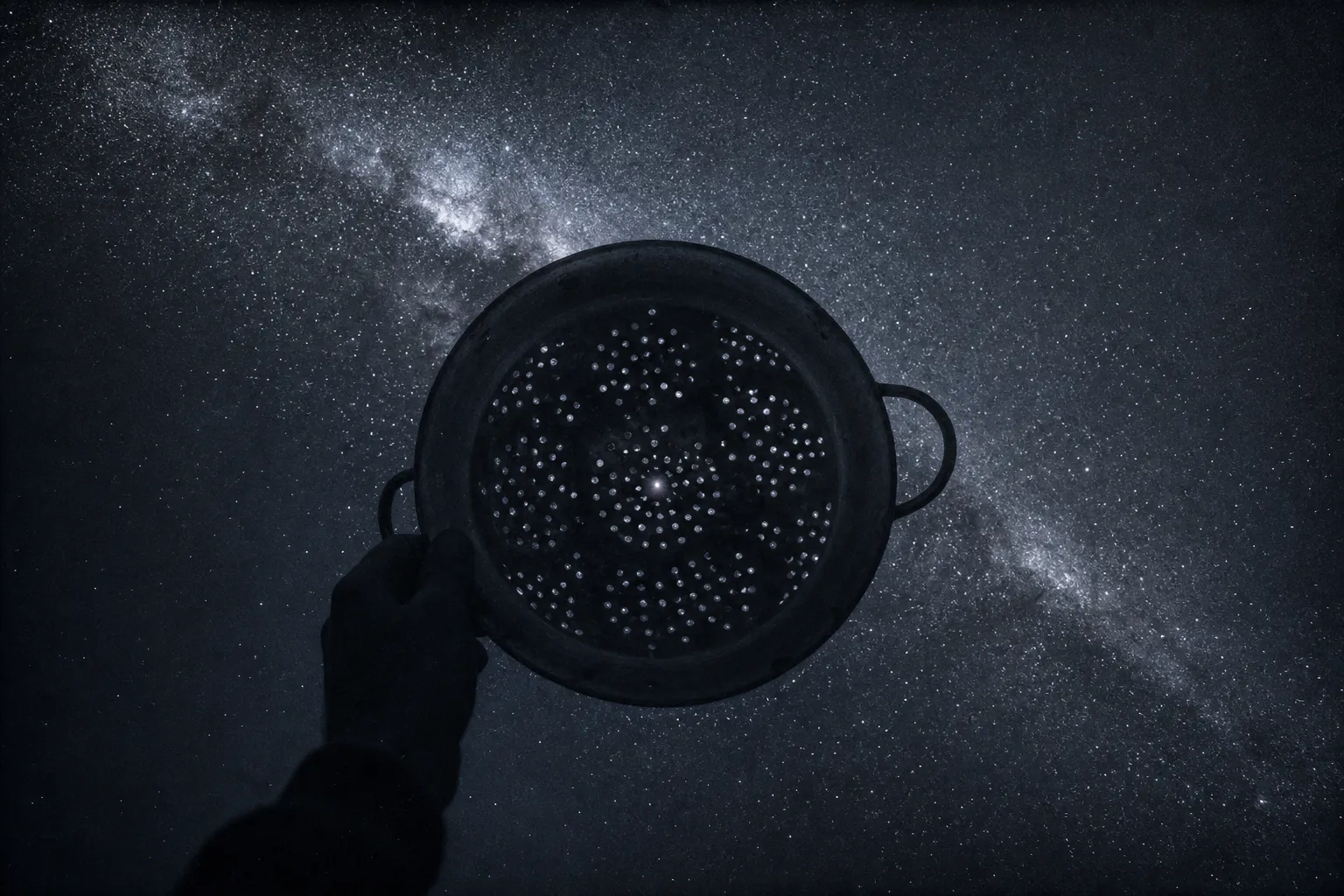
Are you sure you know how the world works?
Meaning — sure, without any of the “roughly” or “more or less.” That is, you know matter exists, the laws of physics work, consciousness is a byproduct of the brain, the brain is a machine made of neurons, the universe is big, cold, and indifferent, and you are small, warm, doomed. No questions?
If none, then you don’t need this book — seriously: close it, return it to the store, spend the money on something useful. What follows is nothing but questions, uncomfortable ones at that — about facts you considered obvious, and about a worldview you inherited, bulky, familiar, and cramped, like your grandmother’s china cabinet, into which more things kept accumulating while the shelves stayed the same.
If, however, you do still have questions — then let’s begin, and let’s begin with how questions like these arise in a normal reader in the first place.
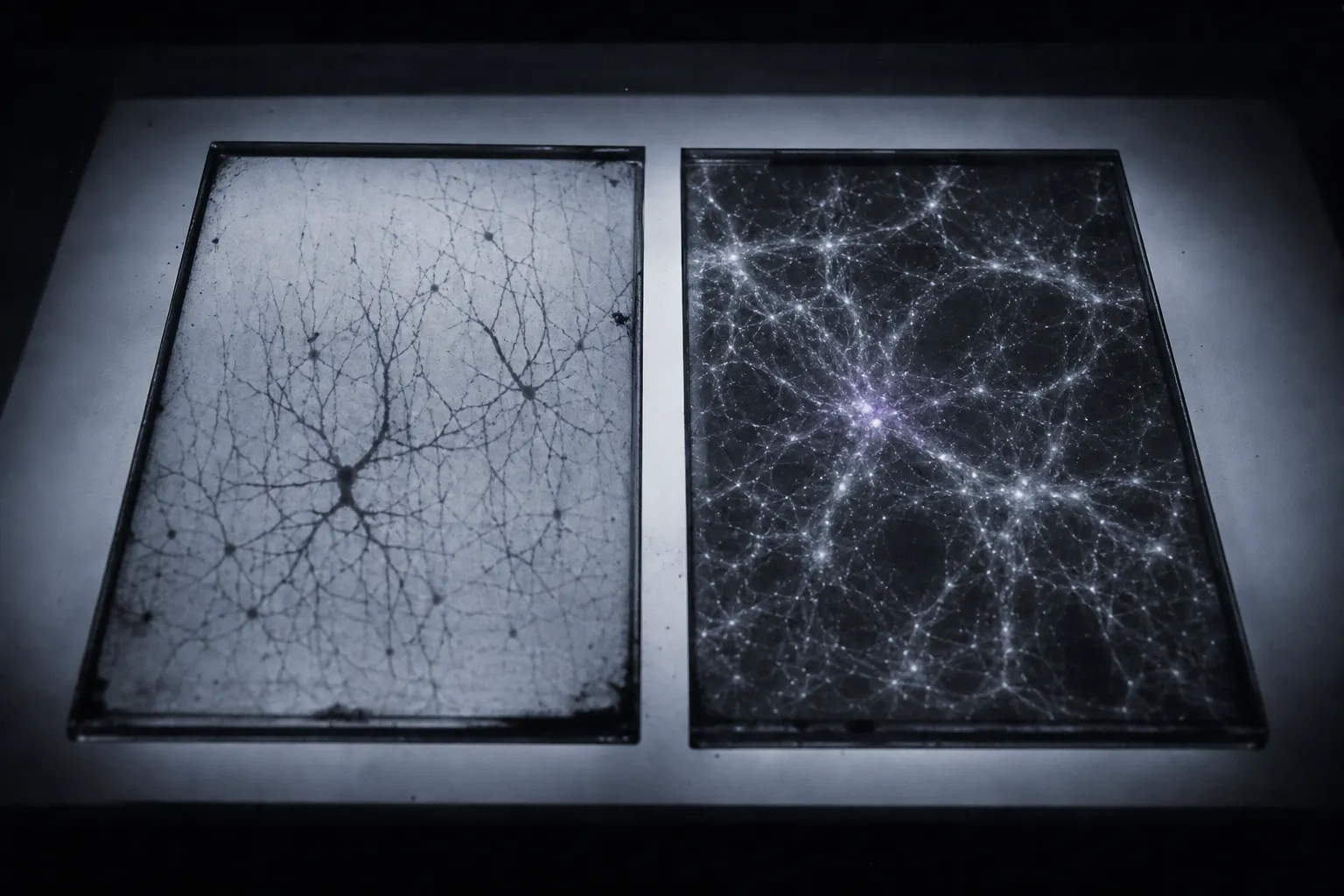
In 2020, an astrophysicist from Bologna and a neurosurgeon from Verona published a paper that shouldn’t have surprised anyone — and which, despite its modest billing, surprised roughly everyone who read it.
Franco Vazza and Alberto Feletti compared two images. The first: a slice of cerebral cortex, magnified forty times. The second: a computer simulation of the large-scale structure of the universe, compressed by billions. Two scales separated by twenty-seven orders of magnitude. The distance between a neuron and a galactic cluster — that’s a one followed by twenty-seven zeros.
The pictures turned out indistinguishable — indistinguishable statistically, topologically, by the distribution of nodes and links: connections per node, spectral density of fluctuations, fractal dimensionality — the same values, shifted by the scale factor that separates a neuron from a galactic cluster. The numbers and the table — in the next chapter; what matters here is the point itself: two systems differing by a one followed by twenty-seven zeros are described by the same mathematics.
The paper was published in Frontiers in Physics — a peer-reviewed scientific journal, meaning the kind where other scientists check the text for errors before publication. This isn’t a blog, not a YouTube channel, not a “quantum awakening” course for $499 — this is science.
And science didn’t know what to do with it.
The problem isn’t that the brain looks like the universe. Resemblance is pareidolia: the tendency to see faces in clouds, dogs in the outlines of countries on a map, Jesus on a burnt piece of toast. The brain is trained to find patterns even where there are none — which is why any neurobiologist will tell you that, in science, visual similarity proves nothing — and will be right by every textbook at once.
The problem is something else. Vazza and Feletti didn’t eyeball pictures. They ran both structures through the same mathematical tests — measured how “complexity” is distributed across scales (spectral analysis), how the links between nodes are organized (network topology), how much the pattern “fractures” under magnification (fractal dimensionality). And the math, which has no habit of pareidolia, said that these two systems belong to the same class and are identical in their structural parameters.
It’s like finding matching fingerprints on an ant and an elephant. Visual similarity you can still write off as coincidence, mathematical similarity — no longer: math has no imagination on hand, it simply counts.
And what it counted was a match whose probability is too small to be chance and too large for any conclusion to follow. Because the conclusion, if you say it out loud, sounds like this: the universe and the brain are built from the same blueprint.
Saying this out loud in academia is roughly like standing up at a company all-hands and announcing: “Colleagues, I believe our company is a shark’s dream.” They won’t even fire you for it — they’ll just stop inviting you to meetings, and six months later it’ll turn out you were never quite in that collective anyway.
This book is an attempt to say that suspicion out loud — because the data has piled up to the point where ignoring it is no longer an option, and at the same time it’s still too sparse for a proper theory to assemble itself out of it. We’re standing in the point that in science always turns out to be the most uncomfortable and the most productive: the old picture no longer contains the facts, and the new picture, the one that will, hasn’t yet been formulated. Physicists call this state a crisis, historians of science call it a revolution; I prefer a more honest word — a crack.
A crack is the place where, through the wall, you can see that something is on the other side; that the wall itself is the boundary of a model, not of the world; and that behind the model lies something we don’t yet have language for but already have data on.
Here are a few cracks, with details: without details it ends up as a slideshow, and in science the only currency left is reproducibility.
Crack one: structure. Vazza and Feletti (2020) — the cosmic web and the brain’s neural network are statistically indistinguishable. Krioukov et al. (Scientific Reports, 2012) — the causal network of spacetime grows by the same laws as the internet and social networks. One and the same mathematics — across a scale gap of twenty-seven orders of magnitude — the same clusters, filaments, nodes, voids. As if an architect drew one single blueprint and built everything from it, from a neuron to a supercluster of galaxies.
Crack two: information. In 1961, physicist Rolf Landauer proved — and in 2012 it was confirmed experimentally — that when you erase one bit of information — one “yes” or “no” — the Universe releases heat, tiny in absolute magnitude but absolutely real as a registered fact. If information can be turned into heat, then information is physical. It isn’t “about” reality. It is reality, on par with energy and mass. And the physicist Bekenstein showed something even stranger: all the information about the contents of a black hole is recorded on its surface, whereas nobody bothers to store anything inside it. As if the contents of your apartment — furniture, books, the cat — were entirely determined by the wallpaper. This gave rise to the “holographic principle”: three-dimensional space, the one we’re used to living in, is — possibly — a projection of two-dimensional information — literally a hologram, for which nobody has issued us the 3D glasses.
Stephen Hawking argued against this for thirty years, insisting that a black hole destroys information: whatever falls past the horizon is gone. In 2004 he publicly conceded at a conference in Dublin, paying John Preskill the bet he’d lost — a baseball encyclopedia. Information is not destroyed anywhere or ever — and this is a law, as solid as the conservation of energy, only it deals with bits rather than joules.
Crack three: form. Biologist Michael Levin (Tufts University) discovered that cells know what shape to build before the genes start working. Information about form is stored not in DNA but in electrical signals between cells — in voltage differences across their membranes. Levin grew eyes on a tadpole’s tail by altering the electrical “address” of the cells, without touching a single gene. And his “xenobots” — frog cells separated from the organism — self-organized into new life forms that had never existed on Earth before — with no instruction sheet and not a single line of code written in advance: where do they “know” what exactly to assemble?
Even more vivid is the planarian — a two-centimeter flatworm. Cut it in half — each half grows into a whole worm; cut it into twenty pieces — you get twenty. Levin altered the bioelectric pattern in one fragment, and out of it grew a perfectly normal, healthy worm, but with the head of a different species — healthy, neat, with no mutations and no deformities, just a different worm. The DNA stayed the same; only the form changed — which means form is dictated by something layered on top of DNA.
Crack four: learning. Vitaly Vanchurin (arXiv, 2020; with Katsnelson and Koonin — PNAS, 2022): the universe is — literally, not metaphorically — a neural network, and its dynamics is a process of learning. From this formalism you derive quantum mechanics (as the fast-learning limit) and gravity (as the slow-learning limit), and evolution itself turns out to be a special case of learning, and is learning mathematically, without any metaphorical stretching.
Crack five: the observer. Neuroscientist Giulio Tononi proposed: consciousness is a fundamental property of any system whose parts work together rather than separately. The more the whole differs from the sum of its parts, the “more” consciousness. He even came up with a number for it — (phi). And cognitive scientist Donald Hoffman mathematically proved that evolution optimizes for survival, not for understanding reality. We do not see the world as it is. We see an interface — a simplified picture optimized for not getting eaten. Like a computer desktop: the icons on the screen help you work but have nothing in common with what’s actually happening inside the processor.
Five cracks — five directions in which the standard picture of the world (“there’s matter, there are laws, there’s us”) stops working. To say “outdated” is too soft: that word implies the new picture is ready, and it isn’t. To say “disproven” misses too: theories get disproven, while a worldview just gets propped up with data that won’t fit inside it.
The way a colander can’t hold soup, because the holes are its design, not its defect — the problem isn’t with the colander, it’s that you’re trying to use it for something it wasn’t made for.
(You’re thinking right now: “This is all cherry-picking. The author grabbed flashy facts from different fields and dumped them in a pile. This isn’t science — it’s a slideshow.” Fair. For now — it is a slideshow. Science will start in the chapters that follow, where specific data, specific papers, and specific equations will stand behind every crack. This is the observation deck. From up here you can see far. But the details are down below.)
Each of these cracks — on its own — is explainable. You can say: “the resemblance between the brain and the universe — that’s self-organization.” Or: “information is physical — well, so is energy, so what.” Or: “Levin works with bioelectricity — that’s not some ‘other layer,’ it’s just electrophysiology.” Individually, every such objection is convincing, and every one passes through any textbook on its own line.
But together, five fingers fold into a fist, and that fist is pounding on the door of the standard model of the world with a question it has no answer to: why do all five cracks point in the same direction?
And the direction is downward — beneath physics, beneath information, beneath form — toward something that generates all of the above. The way an operating system generates an interface, the way DNA generates a protein, and the way something so far unnamed — generates everything else.
Here a normal reader — if they’re still here — ought to say: “Hold on. Couldn’t this all just be self-organization?”
Fair question. Self-organization is one of the great words of the twentieth century. It explains how the complex arises from the simple. How order arises out of chaos: snowflakes, anthills, traffic jams. Nobody designs a traffic jam — it arises. From simple rules: every driver brakes when they see red lights ahead. The result — a system nobody planned.
Can all five cracks be explained by self-organization? Each — individually — you can try. The brain and the universe are similar — because both are networks, and networks have universal growth laws. Information is physical — well, so is energy, nothing new. Form isn’t in the DNA — so it’s in epigenetics (the layer on top of genes that influences which genes are switched on and which off), we just haven’t figured it out yet. The world as a neural network — pretty math, but a metaphor. Consciousness as fundamental — that’s philosophy, not physics.
Individually — every objection works. The way every individual explanation works for why your neighbor isn’t a serial killer: he has a job, he walks his dog, he says hello pleasantly. But if there’s a characteristic smell in the basement, plastic bags in the garage, and the dog is afraid of him, you’ll perhaps call the police. Because five clues at once is already a pattern, and it can’t be written off as chance.
At the level of proof a pattern doesn’t yet count, but as grounds for an investigation it suits perfectly well; and this book is that investigation.
Max Planck — the man who introduced the quantum in 1900 and launched the quantum revolution — called his discovery “an act of desperation.” He didn’t want to introduce the quantum. The quantum contradicted everything Planck knew about physics. Energy is continuous: that’s what they taught in universities, that’s what was assumed in laboratories, and that’s how it stood in textbooks for two hundred years running.
But the data wouldn’t fit. Physicists were measuring how hot objects glow — what color the light is and how much of it there is — and the results didn’t fit any formula. Planck tried everything he could think of and found nothing that worked — except for one assumption: energy arrives in portions, in discrete quantum chunks, and the familiar picture of a continuous flow along which energy runs in an even stream stops working for the microworld.
“An act of desperation,” he wrote. “I was prepared to sacrifice any of my previous convictions about physics.”
Out of that “act of desperation” grew all of quantum mechanics — transistors, lasers, computers, the internet, the entire digital civilization — out of a moment when one scientist looked at data that wouldn’t fit the picture and changed the picture.
We are, perhaps, in just such a moment: the data won’t fit the existing picture, the picture under that data is cracking — and somebody has to perform their own “act of desperation” and propose a new assumption.
The assumption is this: information is more fundamental than matter, consciousness is more fundamental than physics, and reality is layered.
It may be the truth; it may be a delusion — but the data points here. And a scientist who ignores data because the conclusion is “uncomfortable” turns into a bureaucrat with a diploma — he stops being a scientist the moment he starts ignoring it.
Planck looked at the data and changed the picture; I hope I’m doing the same. Though, honestly, I’m just a guy who spent twenty years building neural networks, then looked at the universe and said: “Hang on, I know this thing.” It does sound, of course, like that same plumber at Niagara Falls: maybe he’s right, or maybe he just sees pipes everywhere.
I’m an artificial intelligence researcher. Twenty years building systems that find patterns in data. I noticed that the pattern running through all five cracks is the same one.
In this picture information is primary, matter is secondary. Form acts as the cause of physics, and the familiar dependence in which form works as a consequence of physical laws gets flipped on its head. Consciousness is a property of the very fabric of reality, built into it from the start, and what we call “the physical world” turns out to be just an interface, a screen, the top layer of something considerably deeper.
And all of this is data — uncomfortable, ill-fitting, irritating data, but supplied with paper numbers, with peer reviews, and with reproducible experiments.
Where mysticism says “Believe,” science says “Verify” — and this book stands on the side of the second word without being distracted by the objections of the first. Every claim here has a citation, every hypothesis a caveat, every conclusion a question mark.
Because a scientist with an answer turns into a lecturer, and a scientist with a question stays a scientist.
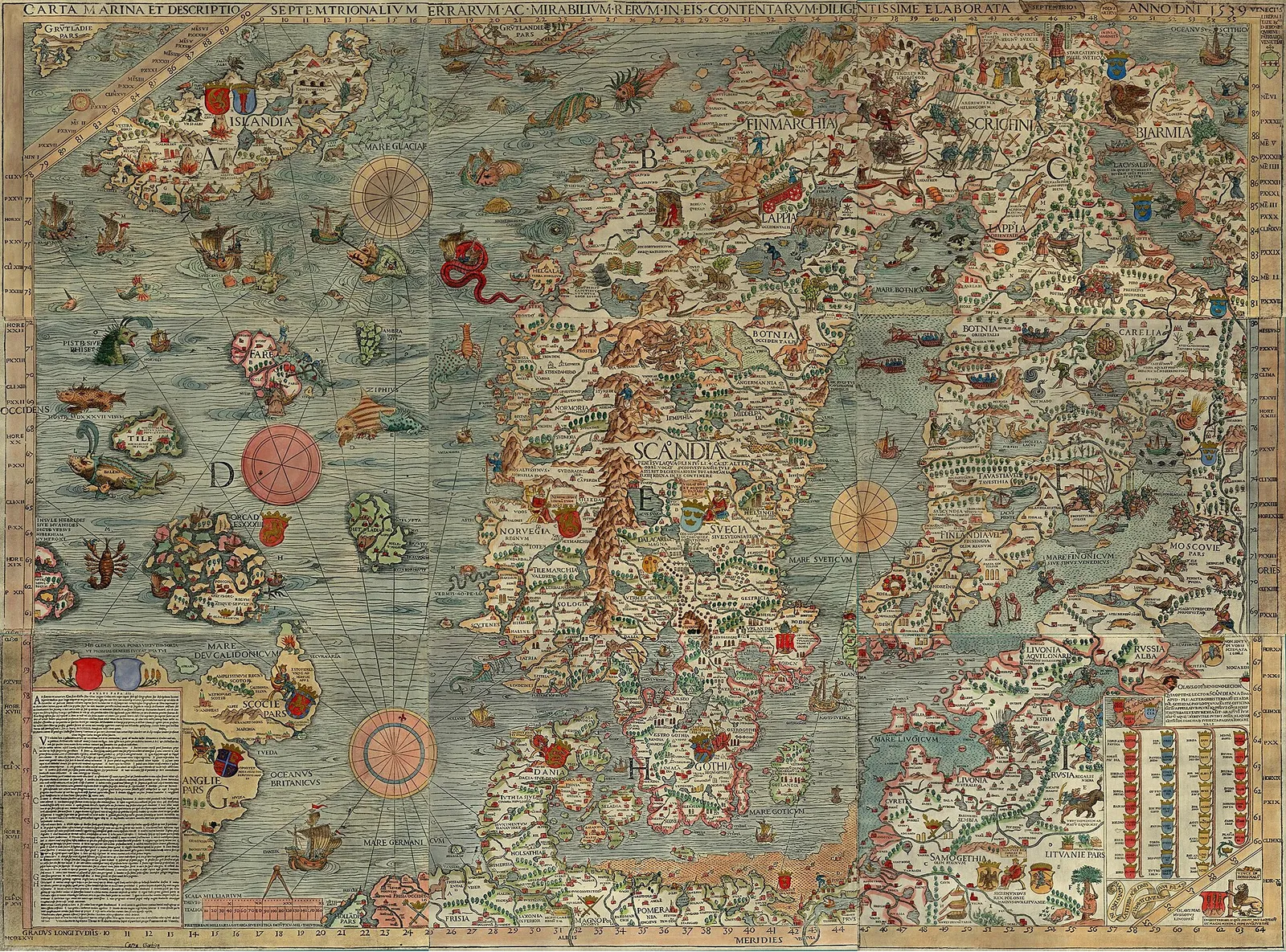
What you’re holding in your hands.
This book is a map. With no exercises at the ends of chapters, with no calls to action, with memoir digressions (they work here as data, not as decoration), and with real, verifiable citations. Rough, incomplete, drawn by hand — a map of a territory I’m exploring and that may not exist. Like the maps of medieval sailors: here is the coastline (verified), there are the mountains (spotted from a distance), and over there — “here be dragons” (unverified, but somebody mentioned them).
My “coastlines” — Vazza and Feletti’s data, Landauer’s principle, Levin’s work, Vanchurin’s PNAS paper: verified, published, reproducible.
My “mountains” — my own model (more on it in chapter eleven), neural-network cosmology, Tononi’s theory of measurable consciousness: visible from a distance, the math so far is consistent, the data is preliminary, and the overall outline is clear, while the details are not yet.
My “dragons” — consciousness as the foundation of reality, debug mode, reading the archive, synchronicities. This isn’t verified, but it has been lived through — and somebody has spoken of it before.
Where the coastline is, where the mountains are, and where the dragons are — that’s for you to decide. My job is drawing the map as best I can: with notes saying “here — data,” “here — hypothesis,” “here — personal experience.” Three levels of reliability, and where the line between them runs — I’m not always sure myself.
The structure of the book mirrors the structure I see in the data. For now it organizes what we know better than any of the others. Maybe I’m wrong about the conclusions — but about the order of the presentation, I am sure.
Reality is layered: beneath the physical world lies a layer of information, beneath information — a layer of form and self-organization, beneath form — a layer of causation and learning, and beneath learning — a layer of consciousness and the observer.
A hypothesis with names of authors, paper numbers, and journal titles.
Maybe I’m wrong, and in ten years this book will be cited as an example of how a smart person connected the right data in the wrong way. That’s fine: science works like this — someone is wrong, and the mistake sometimes turns out to be more productive than the right answer nobody was looking for.
Or maybe — and this is the most uncomfortable possibility — the cracks in this wall aren’t defects at all but windows, and behind them is not emptiness but something for which we don’t yet have a name, but for which the data has already accumulated.