02
Twenty-Seven Zeros
Let’s start with an uncomfortable question: why does the Universe look like a brain?
Indeed looks like — with all the statistical rigor that modern science can muster.
Vazza and Feletti were far from the first to notice. The visual resemblance between microphotographs of neural networks and computer models of the Universe’s large-scale structure had been floating around the internet for years, as a meme, a curiosity, and a pretty poster for the office of a physicist with a sense of humor. But until 2020, nobody had actually run the numbers on it.
Vazza and Feletti did run the numbers — and here’s what came out. But first a bit of context, without which any numbers remain merely numbers.
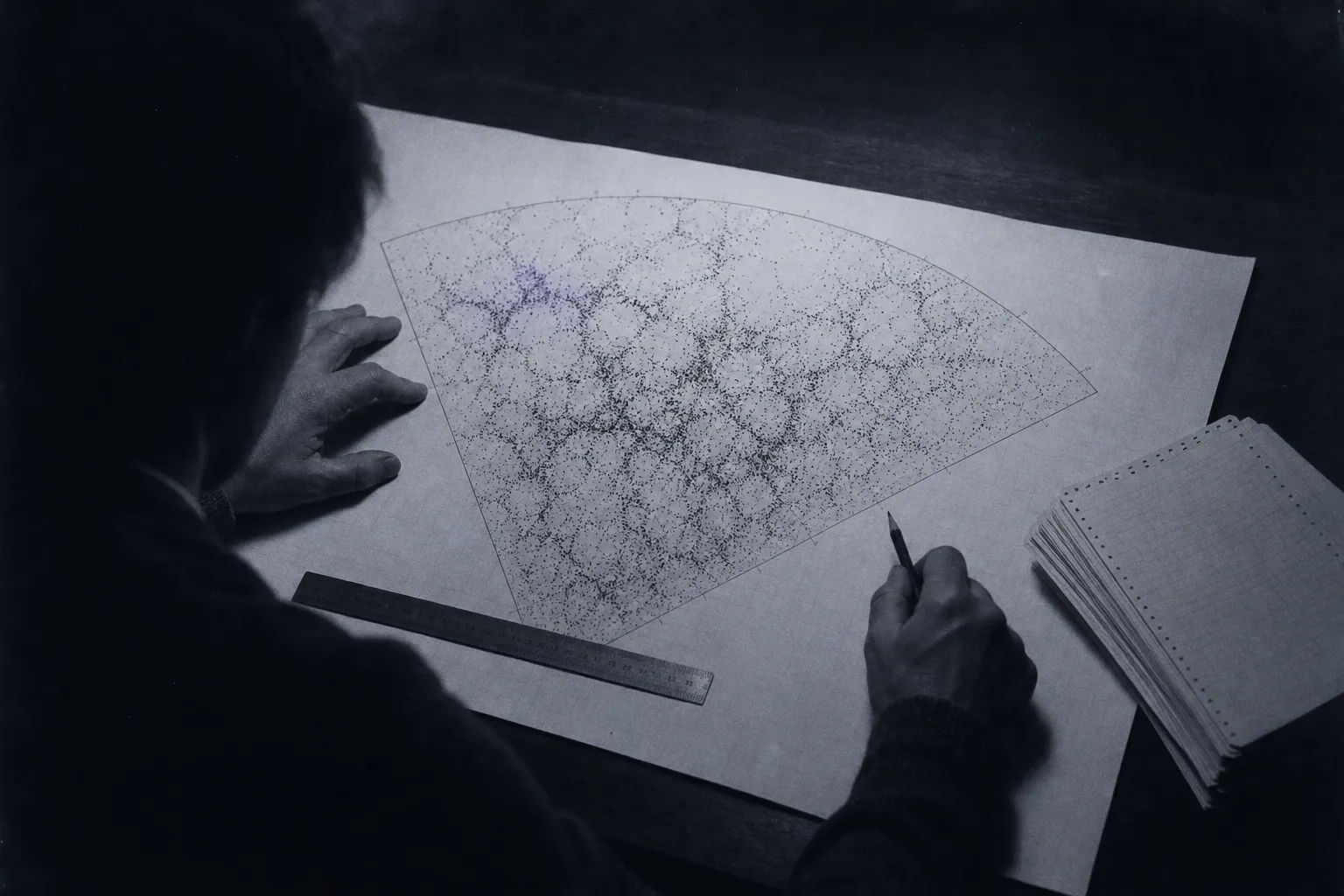
How we found out the Universe is a web.
Until the 1980s, cosmologists assumed galaxies were distributed across the Universe more or less evenly — like raisins in dough, randomly, but uniformly on average. Then came redshift surveys — systematic three-dimensional maps of galaxy positions: the CfA Redshift Survey of 1986, the Sloan Digital Sky Survey in the 2000s. And the dough turned out to be a sponge.
Galaxies are scattered nothing like evenly: they are concentrated along filaments — long, thin structures stretched across the void — and the filaments converge at nodes, massive clusters that contain anywhere from hundreds to thousands of galaxies apiece. Between the filaments lie the voids, bubbles of emptiness in which there is almost nothing at all: the diameter of an average void runs from one hundred to three hundred million light-years, and its volume runs into trillions of cubic light-years.
This whole construction is the cosmic web — the largest structure in the observable Universe, so large that light needs billions of years to cross it from end to end, and so beautiful that in 2020 researchers at UC Santa Cruz tried modeling it with an algorithm inspired by the slime mold Physarum polycephalum — and got a near-perfect match with observations. A slime mold — a single-celled plasmodium with no nervous system (literally one giant cell with millions of nuclei) — builds transport networks mathematically identical to the large-scale structure of the Universe.
(This is where you should stop: a slime mold without any brain builds a network like the Universe — and at that point, are you really sure that “consciousness” is required to create structure, or might rules alone be enough?)
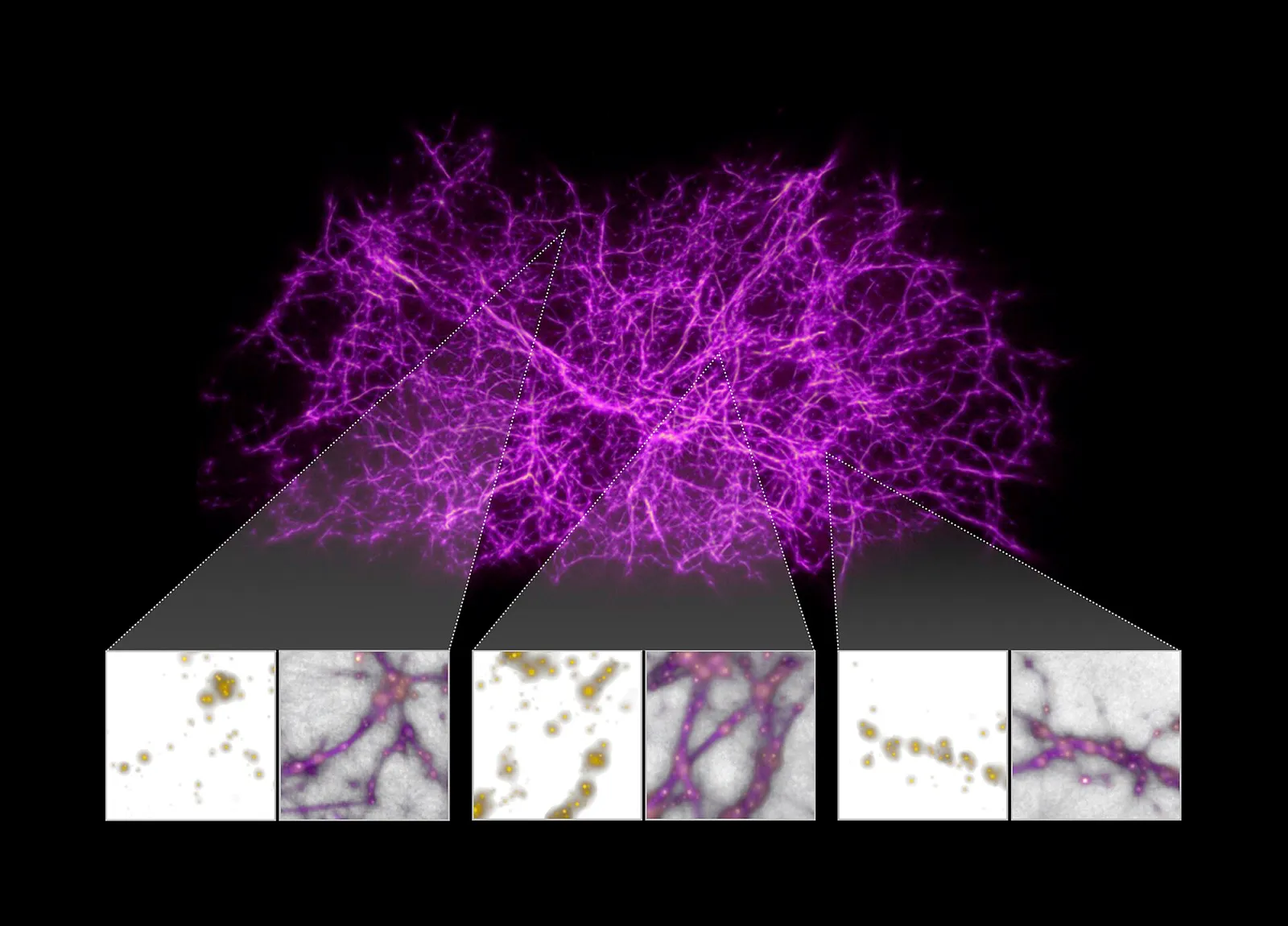
The cosmic web is the large-scale structure of the Universe: connections between galaxies (galaxies are nodes): filaments of dark matter and gas stretched across the void, tens and hundreds of megaparsecs long. Between the filaments — voids, bubbles of emptiness hundreds of millions of light-years across. The entire observable Universe is a foam of filaments and voids, and if you could somehow look at it from outside (from where, exactly?), you’d see — a web.
A web in the literal sense — a three-dimensional network of filament-like structures connected by nodes, with a characteristic cell scale and a power-law distribution of connections.
The brain’s neural network is, roughly speaking, the same thing: a hundred billion nodes (neurons) connected by a hundred trillion links (synapses), organized into layers, columns, and modules. Between dense clusters of neurons — there are “voids” too: regions of white matter where only axons run — long “wires” connecting distant regions.
Vazza and Feletti took both datasets — cosmological simulations and microphotographs of brain slices — and applied the same analytical tools.
The results of four tests look like this.
Test one: distribution of complexity. Imagine you’re listening to music and want to know how much bass there is, how much midrange, how much treble. There’s a mathematical technique for this — it breaks any signal into “layers” by scale. Physicists call it spectral analysis; all that matters for us is that it works like an X-ray: it reveals internal structure invisible to the eye.
Vazza and Feletti ran both systems through this “X-ray” — the cosmic web and the brain. The result: an identical spectrum, in which the same “frequencies” dominate and the same ones are suppressed; the curves on the graphs are parallel and shifted by the scale factor that separates a neuron from a galaxy cluster.
How exactly they did it. Vazza took a computer model of the Universe — a simulation in which a computer calculates the motion of billions of particles under gravity. Feletti took photographs of brain slices under an electron microscope — so detailed you can see every individual neuron. Both datasets are three-dimensional. Both contain points and connections between them. And both were processed by the same program: one code, two worlds, one result.
This matters. Comparing pictures by eye gives you pareidolia (the brain sees what it wants to see), whereas one and the same mathematical test on two datasets no longer involves the eye at all. The eye can be fooled, mathematics cannot.
Test two: how connections are arranged. Vazza and Feletti drew both systems as diagrams: points (nodes) and lines between them (connections). And counted how the points are connected. How many connections per node? In the cosmos — on average 3.8–4.1, in the brain — 4.6–5.4; for comparison, in New York City’s road network it comes out to about 3 (intersections), and on the internet — 2 to 7. The brain and the Universe sit in the same narrow corridor. Like two cities built from the same master plan on different continents.
Test three: clustering. In both systems, nodes are gathered into dense groups connected by long “bridges.” This arrangement is called a “small-world network” — you may have heard that any two people on Earth are separated by no more than six handshakes. That’s it. The brain is built as a “small world,” and the Universe is too, and the internet is too, only with different numbers in the formula.
Test four: how much fits. Vazza estimated the information capacity of both systems — how many “yes/no” answers can be encoded in them. The observable Universe stores roughly 4.3 petabytes (a petabyte is a million gigabytes, roughly two hundred thousand HD movies). The human brain — 2.5 petabytes. The difference — less than twofold. Even though the difference in size — twenty-seven orders of magnitude.
From the press release accompanying the paper, the authors themselves summarize. Feletti: “The connectivity within the two networks probably evolves following similar physical principles, despite the striking difference between the physical powers regulating galaxies and neurons.”
Read that sentence again, slowly — it’s worth reading through to the period and then going back to the start.
You just thought one of two things: either “so what, the numbers are similar, it means nothing,” or “wait — does that mean the Universe remembers?” Both reactions are reasonable: the first is safe, the second is terrifying — terrifying because if it’s true, then every galaxy becomes a record, every void — a pause between records, and what we habitually call “the observable Universe” turns out to be memory fifty-eight billion light-years across, while the old picture of “space with objects in it” collapses right in your hands. Whose memory exactly — that’s a separate question.
Now — the honest part. Without it, everything before would be propaganda dressed up as science.
What this does not prove.
There’s another parallel floating around the internet that deserves an honest look. Seventy percent of the Universe’s mass-energy is dark energy — a “passive” component accelerating expansion. Seventy percent of the brain’s mass is water. The remaining thirty percent is “active” structure: galaxies (cosmos) and neurons (brain).
The numerical match is striking, but superficial. Water in the brain actively participates in biochemistry: ion transport, osmosis, protein folding. Dark energy accelerates the expansion of the Universe. The functions are fundamentally different. This is a numerical coincidence, nothing more — pretty for a poster in the corridor, but useless for serious science.
I’m telling you this because honesty matters here more than any “wow factor”: in this book there will be plenty of real “wows” even without the fakes.
What this also doesn’t prove.
This still doesn’t prove the Universe is a brain, or that it “thinks,” “feels,” or “is aware.” Structural similarity and functional similarity are different things: the circulatory system, a tree’s root system, the Moscow Metro are also networks, and far from everything that’s built like a neural network is a neural network.
Counterargument — and it’s a serious one. Physicists Barabási and Albert showed in 1999: many complex networks — from the internet to protein interactions inside cells — are built according to the same law. Most nodes have few connections, but some have a lot. Like in school: most kids have five or six friends, but one kid knows a hundred people. This is a property of self-organization as such, and assuming any unified “mind” behind it is not at all required. Maybe the brain and the Universe look alike simply because both are products of self-organization. The way snowflakes resemble stars — because the physics of symmetry is one and the same.
The answer — and it’s also serious. Vazza and Feletti compared the brain and the Universe not only to each other, but also to other networks — clouds, tree branches, water flows. The brain and the Universe turned out to be more similar to each other than to any of those systems. If it were just about universal laws of network growth, the similarity would be the same across all of them. It isn’t. The brain and the Universe are a special case.
Krioukov et al. (Scientific Reports, 2012) went even further. They showed that the way our expanding Universe grows, and the way complex networks grow (the internet, social networks), are described by the same equations. Literally: plug in one set of numbers — you get the internet; plug in another — you get spacetime; one and the same formula describes two worlds that have nothing in common.
This already goes beyond pareidolia and hints that self-organization itself needs explaining: it turns out to be part of the mystery, and is in no position to serve as its solution.

There’s one more result, so strange I don’t know what category to put it in. In 2020, researchers at UC Santa Cruz used a slime mold Physarum polycephalum — a plasmodium with no nervous system, whose entire endowment consists of yellow slime, millions of nuclei in a shared cytoplasm, and an astonishing ability to build optimal transport networks — to map the cosmic web.
The slime mold — in a lab — builds a network. It minimizes path length and maximizes connectivity. This is an optimal network, the best possible one given the constraints.
The researchers created a Monte Carlo Physarum Machine — an algorithm inspired by the slime mold’s behavior — and applied it to data on 450,000 dark matter halos from cosmological simulations. The result: a “near-perfect match” with the observed cosmic web.
A slime mold without a brain builds the same network as the Universe.
Let that sink in: a slime mold with no nervous system and the observable Universe are solving the same optimization problem with the same answer, across scales that differ by a factor of .
The argument here is about something else: the rules of optimization are the same everywhere, at every scale, from slime mold to supercluster — simply because no other optimum exists in principle, and the mathematics of that optimization is one and the same, in no way dependent on the substrate.
If in Japan — where Physarum polycephalum, by the way, was used to optimize the Tokyo rail network (Tero et al., Science, 2010) — you told the scientists, “Your slime mold is designing the cosmos” — they’d probably laugh. And they’d be wrong to.
Beyond this point lies territory where most scientists prefer to stop, because there things get uncomfortable: science is there, of course, but it requires asking uncomfortable questions for which no career dividends are ever issued.
If the Universe and the brain belong to the same class of systems, the class needs a name. Saying “self-organization” is to say nothing: that word describes how exactly order assembles itself, whereas it doesn’t even get to the question of what exactly is being assembled. How is it that self-organization at the scale of a neuron and at the scale of a galaxy supercluster produces the same result?
Let’s gather the coincidences in one place. In a table. So it’s not a “feeling” — it’s data.
| Parameter | Brain | Universe |
|---|---|---|
| Nodes | neurons | galaxies |
| Connections per node | 4.6–5.4 | 3.8–4.1 |
| Information | 2.5 petabytes | 4.3 petabytes |
| “Passive” component | 75% (water) | 68% (dark energy) |
| Architecture | small-world | small-world |
| Fractal dimension | 2.0 | 2.2 |
A hundred billion neurons and a hundred billion galaxies — the same number. Four to five connections per node — the same topology. Two and a half versus four-and-change petabytes — the same order of magnitude.
Any one of these parameters alone is explainable; two coincidences make an “interesting coincidence”; three — “worth a closer look”; six is already a pattern, and from there we are left with two options for explaining that pattern.
Option one — coincidence: six unrelated coincidences; statistically unlikely, but not impossible. Six heads in a row — probability , unlikely but it happens: the math allows it, science accepts it, life goes on.
Option two — a common principle: something deeper than the physics of neurons and the physics of galaxies determines the architecture of both; something that works the same way at any scale and that we can’t name yet, but can already measure.
Option one is safe by career standards, option two is interesting by substantive ones; in science, as in poker, the safe bet brings in little, while the interesting one can bring in everything or nothing — but it’s worth playing, and this book is about the second.
What happened after Vazza and Feletti published? Simultaneously nothing and everything.
“Nothing” — because nobody refuted the paper, nobody found errors in the calculations, and nobody proposed an alternative explanation that closed the question. The paper came out, racked up citations, made it into pop science — and just hung there, as a fact nobody knows what to do with; as a piece of evidence nobody has matched to a crime.
“Everything” — because Vazza didn’t stop. In 2022, he published an extended study in which he applied even more sophisticated mathematical tools to the same data — tools that can find structure where the eye sees only chaos. The result was the same: the brain and the Universe — one class.
In 2023, another group of scientists — Pavlos et al. — applied chaos-system analysis to the same data and found: both systems exist at the edge of chaos. Physicists call this “self-organized criticality” — a state in which a system balances on the boundary between order and disorder. Like a tightrope walker: one step left — it falls into chaos, one step right — it freezes into stillness. In the middle — maximum complexity, maximum sensitivity, maximum possibility. The brain operates at this edge — neuroscientists have known it since the 2000s. Turns out — so does the Universe.
So what does any of this mean for you personally?
Seriously: suppose the Universe and the brain belong to the same class; suppose the math is the same. What does that have to do with you — a person who pays a mortgage, sits in traffic, and wonders what’s for dinner?
Here’s what. If self-organization works the same way at every scale — from neuron to supercluster — then scale doesn’t matter. The same process that assembles galaxies into filaments assembles your thoughts into ideas. The same rules that determine how the cosmic web distributes matter determine how your brain distributes attention. One math. Literally.
This means: you are the same structure, at a different scale, with the same rules, the same topology, the same small-world architecture.
Two and a half petabytes of information in your head and four-and-change in the Universe — a difference of one order of magnitude, which against twenty-seven orders of magnitude of size difference looks like nothing. Informationally you are nearly equal to the Universe — keep this in mind the next time you feel insignificant.
In the next chapter we’ll talk about what that “something” might be. And we’ll start with the most radical candidate: information — a physical substance as real as energy, mass, and spacetime.
John Archibald Wheeler — one of the greatest physicists of the twentieth century, co-author of the theory of nuclear fission, Richard Feynman’s teacher, the man who coined the term “black hole” — said three words in 1990 that physics is still digesting:
It from bit.
Everything that is comes from information, and we’ll get to that next, in the chapter that follows.