A Boy from Stavropol
Stavropol is a city in which nothing happens. The capital of Stavropol Krai, three hundred thousand inhabitants, the North Caucasus, steppe, heat, minibuses. The one fact people outside Stavropol know about it is this: this is where Gorbachev is from. The Marked One. The man who dismantled the USSR — or, if you’re the type who thinks the Union fell apart on its own, the man who didn’t get in the way.
I went to School Number Five; before me, Gorbachev’s daughter went there. I started first grade when the USSR had only just ended, and that should be taken literally: I began school in one country and finished it in another. The empire fell apart while I was mastering the alphabet, and the map of the world was redrawn in the years when I was drawing a house with a fence.
(There you go, “folds in reality” on a civilizational scale: a country that “was” and “isn’t” — without a war, without a bomb, through nothing but a reassembly. A rewrite over two hundred and eighty million nodes, with the loss of a significant portion of the archive.)
Out of this Stavropol school, along whose corridors the daughter of the man who dismantled an empire had once walked, this boy would, thirty years later, set about building a model of reality as a computational graph of pointers, links, and archives. Perhaps all of neural cosmology is an attempt to explain in formal language what I lived through as a child: the world comes apart and reassembles, and I say this from direct experience, with all the literalness of the claim.
But even before Pointer Architecture, before the institute, and before the pointers themselves, there was Brest in my biography — and without it none of the subsequent logic comes together.
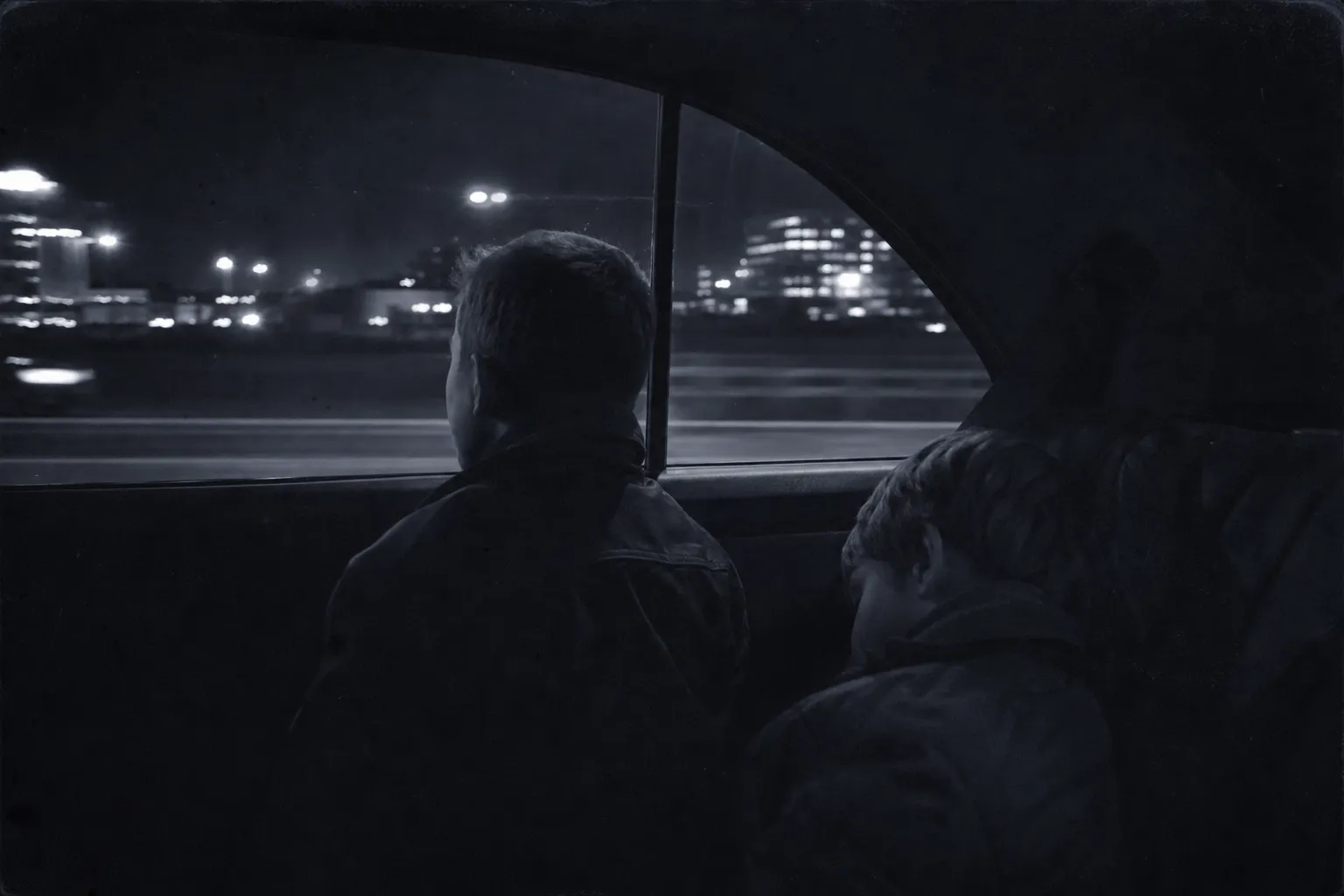
I was nine. Third grade. The parents of my classmate Daniil decided to do a Euro trip and proposed to take me along so their little boy wouldn’t be bored. The route: Nevinnomyssk — Brest — Warsaw — Berlin — Paris.
A Euro trip. The early nineties. For those who missed it: across all of Russia to Brest, by train, twenty-four hours in third class. The clack of wheels, steppe, then forests, then steppe again. Stops at stations smelling of coal, cabbage pies, and stale linens. A nine-year-old boy on the top bunk looks out the window and doesn’t understand that this trip is going to rewrite him.
In Brest there was a transfer to a double-decker bus, and for a child from Stavropol a double-decker bus is in itself an event. I sat up top, by the window, and from there, from the height of the second floor, for the first time saw a border not on a map but in real life: a barrier, people in uniforms, stamps in passports. Beyond the barrier lay the same earth, the same trees, the same sky — and at the same time everything was different. What exactly, I didn’t know, but I felt it.
Night. The bus hums. Outside the window pass streetlights that look different, road signs in a non-Russian language, signs to cities with unpronounceable names. This is Europe, for the first time in my life, at nine years old.
The first stop happened at a gas station somewhere outside Warsaw. I timidly got out.
Everything there was different. The light was white, even, fluorescent, in contrast to the yellow back home. The smell was coffee from a machine, gasoline, something piny from an air freshener. The floor was clean, and the shelves were packed with goods in unfamiliar wrappers, chocolate bars with unreadable names. The world was the same and at the same time entirely different.
I went to the bathroom. Opened the door. And heard:
“A sho vam?”
Polish, on top of which lay Ukrainian, on top of which lay some third language unknown to me. Three layers, three realities in one phrase: I didn’t understand the words, but I clearly heard the structure — the world turned out to be not one, but layered, and between the layers were gaps, folds, places where one render ended and another began.
I was nine. The word “render” I didn’t know, and didn’t suspect that twenty-five years later I’d be building a formal model of multi-layered reality. I knew one thing: at a gas station outside Warsaw, the world was different. Just different, like a remix: the elements the same, the assembly other; the scale “better-worse” didn’t apply here.
The first fold: at a gas station, at nine, on the road to Paris.
The European Union didn’t exist yet. The Maastricht Treaty was signed in 1992, but the euro wouldn’t appear for another seven years. Every country had its own money: zlotys in Poland, marks in Germany, francs in France; at every border, an exchange booth; on every banknote, its own faces, its own buildings, its own colors. For a nine-year-old boy this worked as proof: the world is not one, and on one side of the barrier is one reality, on the other a different one, and the difference is material — it lies in your pocket, crinkles, smells of printer’s ink and foreign copper. Money turned out to be the most tangible fold, one you can hold in your hands.
(Six years later they introduced the euro, and these folds were plastered over: one currency, one zone, one render. Convenient and efficient, but poorer. Because folds here carry information, and to plaster them over is to lose that information.)
On the bus, Mylène Farmer was playing on repeat — “Ainsi soit je.” I didn’t know a word of French. I didn’t know that the title was a reworking of “amen”: “Ainsi soit-il” — “so be it” — only instead of “il” (He, God) is “je” (I). “So be I.” A prayer turned from God toward oneself. A woman’s voice, sad and hypnotic, kept repeating something that sounded like liturgy and felt like a wound. I didn’t understand the words, but I remembered the melody for life. To this day I don’t know what it’s about. And maybe that’s why I remember it.
From Warsaw to Berlin the road runs along the famous concrete highway: concrete slabs laid down for tanks — gray-white, cracked, with black asphalt patches, joints every four meters. On a bus this works as a metronome — thunk-thunk-thunk-thunk, into the spine, through the seat, steady and monotonous, for hours. Over this metronome played Mylène Farmer; concrete with liturgy, tanks with prayer — a Europe flat as a table, the North European Plain with fields, birches, and brick farmsteads under orange roofs. Poland in the early nineties looked tired: peeling facades, sparse gas stations, gray sky.
At the border a queue, passport control, a barrier — and on the other side the road goes quiet. Not all at once: first the rhythm softens, then becomes quieter, then asphalt appears under the wheels. The silence after hours of thunk-thunk-thunk feels like deafening. Germany — with clean lane markings, signs, and autobahn; you enter a different world through the quality of the road surface.
Berlin I barely remembered — nine-year-old boys remember cities poorly; they remember frames. My frame: an intersection, a black lacquered S-Class Mercedes the size of a Stavropol minibus, and at the wheel an ancient old woman with a cigar in her mouth. Precisely a cigar, not a cigarette. Small, wrinkled, in glasses, with a hairstyle that had survived two world wars, and in absolutely no hurry: stopped at a red light, smoking, perfectly calm, as if this city, this car, and this cigar belonged to her by right of birth.
For a nine-year-old Soviet schoolboy from Stavropol, this was a parallel reality — precisely parallel, with no evaluative dimension on the “better-worse” scale: a world in which old women drive S-Class Mercedeses with a cigar, and a world in which old women stand in line for milk — two different renders, one planet, two servers. And the fold between them runs not along the map but along a crossroads.
Berlin felt big and recently broken. The Wall had fallen three years earlier — I didn’t know it, but felt: something had been here and had not yet healed.
Berlin I remember in fragments, but Paris I remembered whole, down to the smells of the metro.
The Centre Pompidou — a building turned inside out. All the guts on the outside: blue pipes for air, green for water, yellow for electricity, red for escalators. The escalator is a transparent tube crawling along the facade; you ride up, and Paris unfolds below like a map someone has spread out on the table. For a boy from Stavropol, where the tallest building is a nine-story block, this was a different view, and not so much of the city itself as of the structure of the world. A building that shows how it is built, putting its pipes on display without any shame. (Twenty years later I would do the same — only with reality.)
In the square in front of the Pompidou: fire-eaters, a living statue in silver paint, African drums, caricaturists. Nearby, the Stravinsky Fountain: the fat colorful sculptures of Niki de Saint Phalle spraying water — lips, a snake, a treble clef. For a Soviet child the shock lay in the permissibility of what was going on: nobody chasing anyone off, nobody checking — legal chaos, and the beauty here had almost nothing to do with it. (In Stavropol, for such tricks in the square the precinct cop would have shown up.)
The Eiffel Tower and Montmartre were there, of course, but most of all I remembered Disneyland.
Euro Disney — it was still called Euro Disney back then, before the 1994 renaming — was half-empty. It had opened the year before, was drowning in debt, and the French press called it a “cultural Chernobyl.” The rides were without queues. Sleeping Beauty’s castle — pink, blue, unreal — stood under a gray Parisian sky like a hallucination that hadn’t fully developed. And that was ideal. An empty Disneyland is like a dream from which everyone has been driven out except you. A whole world built for millions, and you almost alone in it.
Space Mountain — the only version in the world with inversions: three of them (sidewinder, corkscrew, cutback). No other Disneyland has it — only the Parisian one. An electromagnetic start — a shot from a cannon — and you fly in darkness, among the stars, upside down. I rode with my eyes closed. And, until 2011, when I ended up in the same place again, I dreamed of trying again with my eyes open.
But before Disneyland came the water park. Aquaboulevard — huge, tropical, with palm trees and waves indoors. For a boy who hadn’t known what a water park was, this was the discovery of a genre. The slides were closed tubes that went outside the building, and you rushed through a transparent tunnel above the street. They said the steepest slide came out straight into the Seine. (Not true — the Seine is far away. But at nine you believe. And belief is more important than geography.)
Daniil’s dad had taken a video camera on the trip — the kind with big cassettes. Later I learned that the big cassettes are called VHS, and there are smaller ones — Sony’s Video8, which fit in your palm. Back then I just thought: too bad I don’t have a small camera. Too bad Daniil’s dad couldn’t film Disneyland on the small one. Later I got a small camera myself, and everything I shot on it — as well as the trip footage shot by Daniil’s dad — I think only my mom ever rewatched.
But here, before I tell more about Disneyland and the water park, I want to note something separate.
Have you tried, in the age of UHD televisions, watching an old movie on a tube TV? Or playing Doom — the original 320 by 200 pixels, which in 1993 seemed the peak of computer graphics? Star Wars, the sixth episode, I watched for the first time on a small black-and-white TV. And Endor was real, and the stormtroopers were scary, and it was enough.
Now try rewatching all that on a modern monitor and with modern eyes. Doom turns into a mosaic, VHS into mush, black-and-white Endor into gray patches. Everything that seemed real turns out to be a render — a render on the hardware that was available and at the resolution they could then manage.
And back then it really worked, in the strictest sense of the word, far more strictly than “seemed normal.” The brain accepted 320 by 200 as a complete picture of the world because it filled in the missing parts on its own, and there was no stupidity of the brains of that time in this; they were simply good at filling in the gaps. The consistency filter () of that version accepted such a render as sufficient; and when the resolution rose, the filter recalibrated, and the old render stopped passing through it.
It seems to me that earlier the render of reality was simply of another version — with a different resolution, simply different, without any ranking on the “better-worse” scale. Each era renders the world on the hardware available to it, while consciousness draws in the rest: a CRT television physically blurred the pixels, the brain filled in the gaps, the world looked whole. Because wholeness, here, turns out to be a property of the filter, and there is simply no separate “wholeness” characteristic of the world itself.
I can’t yet prove this. But the data exists. And it is from my own childhood.
A boy from a country that had just ceased to exist stood in the middle of an artificial kingdom that hadn’t yet really begun to exist. Two worlds, both unreal, both assembled and rendered — and if one can be taken apart (the USSR) and the other can be put together (Disneyland), then the world is a construction set, the construction set has an architect, and the render has a resolution.
(Nine-year-old Misha didn’t have those words; he had a sensation. The same one: the world is assembled, and it can be reassembled, at a different resolution.)
I was twelve, and I was memorizing a hundred words in a row.
Genius had nothing to do with it — I had been taught. In Stavropol, at the “Poisk” (Search) school, a center for gifted children, where I had ended up not because of giftedness but because my mom decided that if the kid was weird, let him be weird among his own.
The technique is simple. You take a list: apple, tank, cloud, scissors, whale, light bulb, piano…— a hundred such words written out without logic, without any mutual connection, and without order. And you build a story: an apple falls on a tank, the tank shoots at a cloud, scissors rain down from the cloud, the scissors cut a whale…— an absurd, impossible, visually vivid story in which each element is linked to the previous and the next.
And it worked: a hundred words, two hundred, three hundred — practically any volume. My memory stayed the same; I had simply learned to use it differently, as a constructor for assembling links instead of a storehouse for the mechanical filing of words. The data was the same, a hundred random words; the links were mine, and on the links everything depends.
I was twelve. I didn’t know that in twenty years I’d be building a formal model in which reality is a graph of references, and that content is determined not by the nodes but by the links between them. I was just memorizing words. And I didn’t understand why it worked.
Now, it seems, I understand — or rather, I think I do.
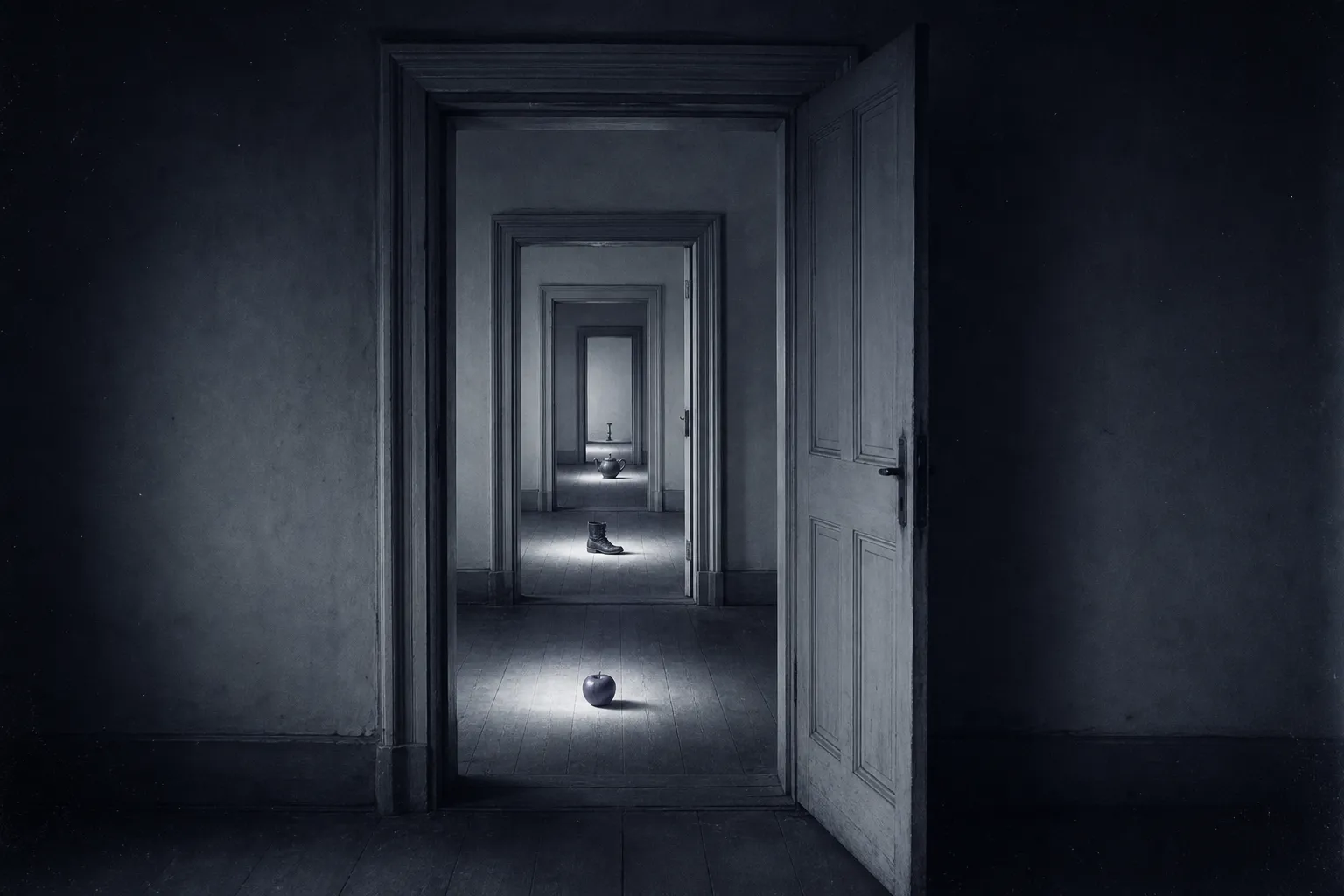
The method is ancient: Cicero used it two thousand years ago for memorizing speeches, medieval monks for canonical texts, Matteo Ricci brought it to China in the sixteenth century. It went by different names — the method of loci, the memory palace, ars memoriae — but the essence is one: you don’t memorize data, you build a structure of links, and the data hangs on it. Like clothes on a hanger: by itself the hanger isn’t yet clothing, but without it the clothing turns into a heap of rags on the floor.
What I didn’t realize then and do realize now.
The technique works because the brain in its design is closer to a network of connections than to a hard drive with cells: it stores the connections, while the data themselves in this picture turn out to be secondary. A neuron by itself doesn’t “remember” anything; what remembers is the synapse, the link between neurons — and memory turns out to be a pattern of connections.
Translated into the language of programming, retrieval from memory is the re-dereferencing of a pointer in the current context: one and the same memory in different states comes out different, because the context is different. This is what explains why we remember the same event differently and why a hundred words are memorized through a story rather than through cramming. The story here works as context; without it, the data simply can’t be addressed.
A twelve-year-old boy from Stavropol was building chains of pointers without knowing they were chains of pointers.
And then “Poisk” gave me higher algebra. Second- or third-year university level. I was twelve. Linear algebra — the science of how mathematical spaces are arranged, the ones in which equations live. Groups, rings, fields — these are structures that describe how numbers or any other objects relate to each other, and the familiar word “subject” applies to them poorly. The task here is to understand how the relations between objects themselves are arranged; “calculate” is too flat a description of the genre.
I, to put it gently, lost my shit. The difficulty here had nothing to do with it (difficult it was) — the question was why a twelve-year-old needed to know this.
The answer came six years later, when I enrolled in the computer security department and found that there was no “computer security” there: there was algebra and mathematical analysis. Encryption turned out to be the mathematics of numbers, information protection turned out to be that Shannon information theory, and computer security turned out to be mathematics dressed up in uniform.
And then, looking at those number-theory lectures, I lost my shit again — this time from the realization that they had actually been showing me the tools of my future profession, dressed up in the form of a school problem.
It was this mathematics that fifteen years later became the foundation of my model: the formulas I crammed in my second year describe the structure of reality. Shannon is about how to measure uncertainty; Landauer is about how much it costs to erase one bit; Bekenstein is about how much information fits into a piece of space.
If at the age of twelve someone had told me, “You are studying higher algebra because in twenty years you’ll need it to describe why the Universe looks like a brain,” I would have said, “Cool, can I have more?”
But nobody told me that; they told me, “Solve the equations,” and I solved them not knowing what for — like a function that doesn’t yet know its return type but is computing anyway.
Around the same time, in ninety-eight, dial-up arrived in Stavropol, and I had a 33,600-baud modem and an irresistible craving to chat on ICQ. The craving turned out to be so irresistible that the internet was promptly disconnected, along with the phone, for non-payment. Mom was very pleased.
Instead of the internet I switched to the local BBS — Bulletin Board System, an “electronic bulletin board”: you dial a number with your modem, land in a text interface, read messages, download files, play door games. The internet before the internet, the network before the network.
This BBS ran on WorldGroup — first version 2, then version 3. One day the installer for version 3 fell into my hands, and I installed it and for a long time dropped out of social life. Because WorldGroup 3 was no longer a “chat,” it was a server, with a WinAPI client, a classical ASCII mode, and HTML.
HTML in 1998 in Stavropol on a BBS — I think I encountered it before our city had Apache.
I had a FidoNet address. My point still works to this day — we’re friends, he’s a programmer at my mom’s company. Fido in the end didn’t catch on, but what caught on was a sensation — that I was touching with my hands what the world was turning into, and touching it from the inside, from the side of protocols and ASCII codes, and seeing how it assembled itself from modems, BBSes, protocols, ASCII codes, HTML tags; the role of a passive user of the internet simply wasn’t allotted to me in that scene.
And again, folds, only migrated from reality as such onto the network itself. The network was assembling before my eyes: out of telephone wires and modem squeals, out of nothing, into another world that ten years later would become the principal and only world.
In ninety-eight, sitting on dial-up in Stavropol, I literally watched reality reassemble.
(And Mom never did understand why I needed a modem. For that matter, she still doesn’t understand why I need neural cosmology. Some things aren’t for moms — they’re for modems.)
The “Poisk” school taught me two things which — I see this now — were preparation.
The first: data without links is noise, links without data is emptiness, and reality is both at once. A hundred words without a story aren’t memorized; a story without the words is meaningless; and you need both, just as a graph needs both nodes and edges.
The second: abstract structures are more real than they seem. Groups, rings, fields are the skeleton of reality; mathematics is the fabric the world is sewn from; and the moment you see the fabric, you begin to make out the folds.
I was twelve. I didn’t know I was seeing folds — I thought I was just memorizing words.