04
From Scratch Every Time
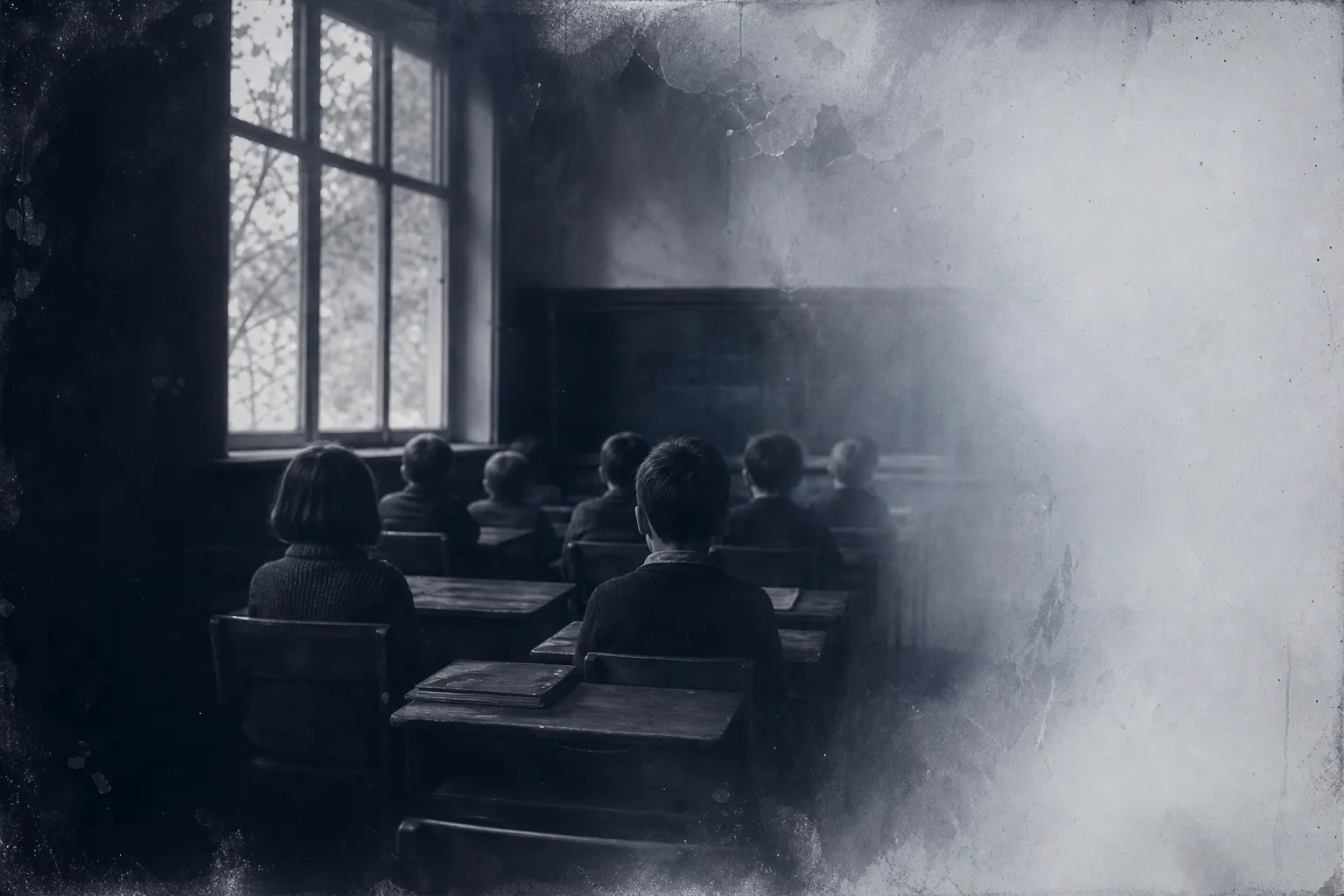
Remember your first day at school: the classroom, the window, who sat next to you, what you were wearing.
Done? Then here is the bad news: you have just changed that day. It will go back on the shelf slightly different from how it lay there a minute ago, and next time you will take out an already edited version, edited, of course, by you.
This is a laboratory result, obtained in 2000 on rats and since reproduced on people.
Until 2000, memory looked sensibly arranged.
Short-term memory is fragile and lives for minutes, long-term memory is durable and lives for years, and the transition between them, called consolidation, takes several hours, during which the brain synthesises proteins and physically rebuilds synapses. Until the cement has set, the memory can be spoiled: inject an animal right after learning with a substance that blocks protein synthesis, and the learning will not stick; let the cement harden, inject the same thing, and absolutely nothing will happen, since stone is indifferent to such interventions.
The picture was neat, confirmed by experiment and included in every textbook, and in it memory worked as an archive: written once, only read thereafter.
Karim Nader worked in Joseph LeDoux’s laboratory and set out to check the obvious.
The design of the experiment is familiar in this field: a rat is given a tone followed by a mild electric shock, and after a few repetitions the tone alone frightens it, so that the animal freezes. Within a day the memory consolidates, the cement sets, and after that, according to all the textbooks, there is nothing to touch.
Nader divided the animals in two, and the whole point lies in the difference between the halves. To the first he simply played the tone, that is, reminded them, and right after the reminder injected anisomycin into the amygdala, that same protein-synthesis blocker that has no business working on set cement. To the second he injected the same substance into the same area, without any reminder.
The next day both halves were tested.
The second half feared the tone as if nothing had happened: the drug given without a reminder had no effect, as the theory prescribed. The first half remained completely indifferent to the same tone: the memory of it had vanished.
This worked a day after learning and two weeks after, that is, with a memory long and firmly settled, and the paper came out in Nature in August 2000 under a title dry to the point of total invisibility: “Fear memories require protein synthesis in the amygdala for reconsolidation after retrieval.”
After purchase
This chapter is part of the full edition
The opening chapters are free. The full book is available after purchase and stays in your library.
· · Already bought it? Sign inAn email when new chapters and experiments come out
At most once a week. No account needed; unsubscribe in one click.