02
Twenty Watts
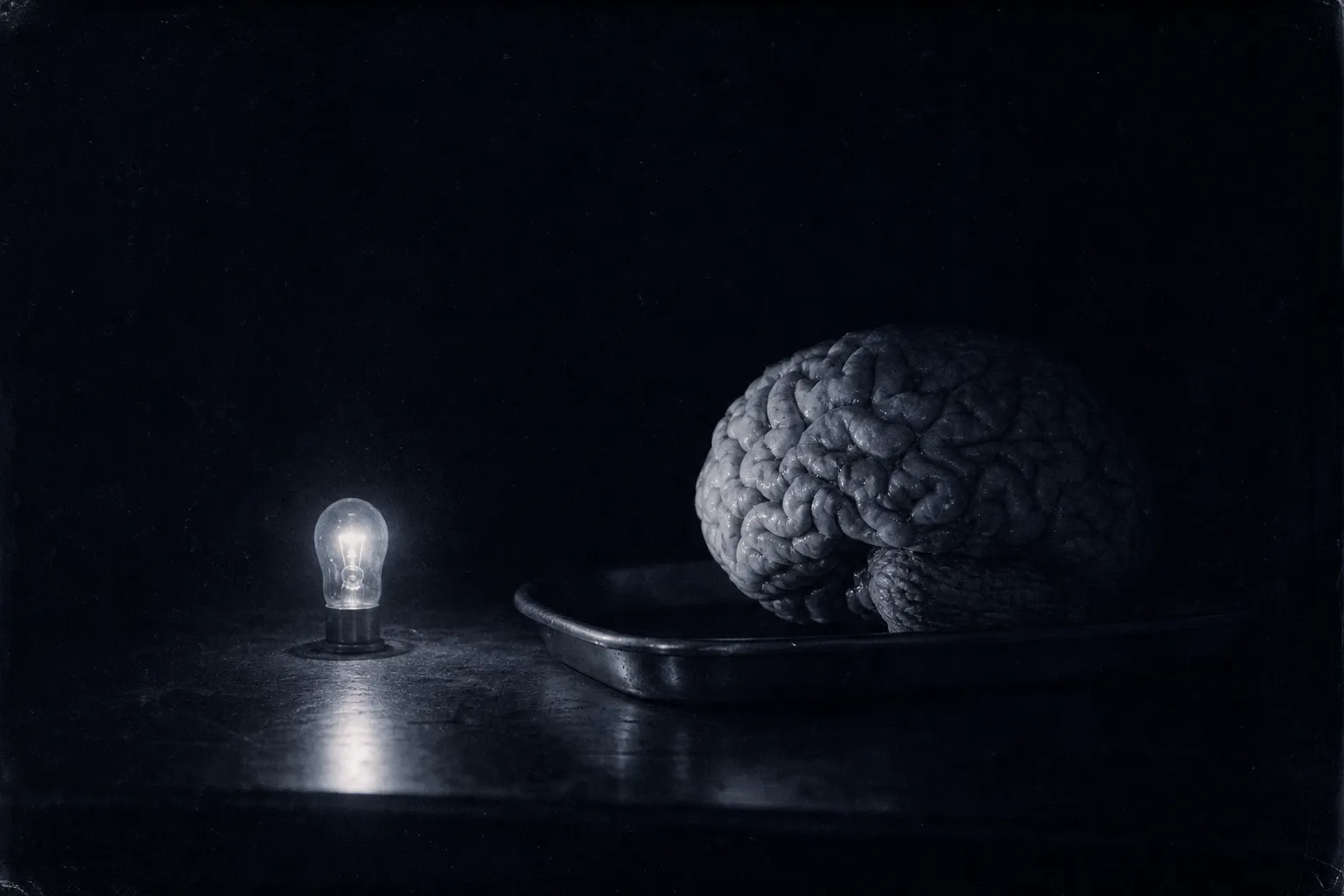
Twenty watts.
That is how much the organ you are reading this line with consumes. A fridge light bulb takes fifteen, a laptop under load sixty, a kettle two thousand.
For those twenty watts you get sight, hearing, speech, memory of the summer before last, the ability to lie to your boss and the understanding that you are lying; an engineer commissioned to build such a device on such a power supply would think in the first minute that he was being mocked.
The organ looks cheap only from the outside, though. It weighs about one and a half kilograms, that is, roughly two percent of an adult, and takes about a fifth of all the energy the body spends at rest, so that per gram it is the most expensive tissue you possess, and you keep it running around the clock, including the hours when its only occupation is showing you nonsense about school and missing a train.
What these twenty watts go on, nobody seriously calculated until the late nineties: the question looked like bookkeeping, and bookkeeping in neurobiology was considered an occupation for those who had not been given any ideas.
The calculation was taken up by David Attwell and Simon Laughlin, who in 2001 published an energy budget for grey matter in which nervous tissue was for the first time treated as a household with income and expenditure. Two years later Peter Lennie recalculated this budget for the cortex and published the result in Current Biology under a title exemplary in its directness: “The Cost of Cortical Computation.”
The breakdown is worth reading twice. Forty-seven percent of the budget is eaten by spikes, thirty-four by synaptic work on the receiving side, and thirteen goes on the cell simply holding a charge on its membrane while doing nothing at all. And almost all this money, if you look closely, is spent on one and the same job: pumping back out the sodium ions that have leaked in. In such a household sending a signal is cheap; what costs dearly is the cleaning up after it.
And then Lennie does what makes this paper worth reading in full: he takes the price of one nerve impulse, takes the whole budget and divides one by the other to find out how many neurons the cortex can afford to keep substantially active at the same time.
Less than one percent.
The cortex has on the order of sixteen billion neurons, and fewer than one in a hundred of them can really be working at any given moment. No physiology is involved here; it is a simple division of the sum by the price.
The figure is worth holding in your hands a little longer, because the familiar picture falls apart under it.
The brain is usually imagined as a huge parallel machine in which everything is computed at once. In fact the cortex is organised like an office with sixteen billion employees and a payroll for about a hundred and fifty million: almost everyone sits at home, drawing a minimal retainer for merely being available and waiting to be called in, a handful are working, and the office’s main question, whom to call in today, is decided every second without any participation on your part.
Under such an arrangement attention stops being the virtue they nagged you about at school and becomes the allocation of a fund: to concentrate means to move a fraction of a percent of your staff onto one area, leaving everything else on the answering machine.
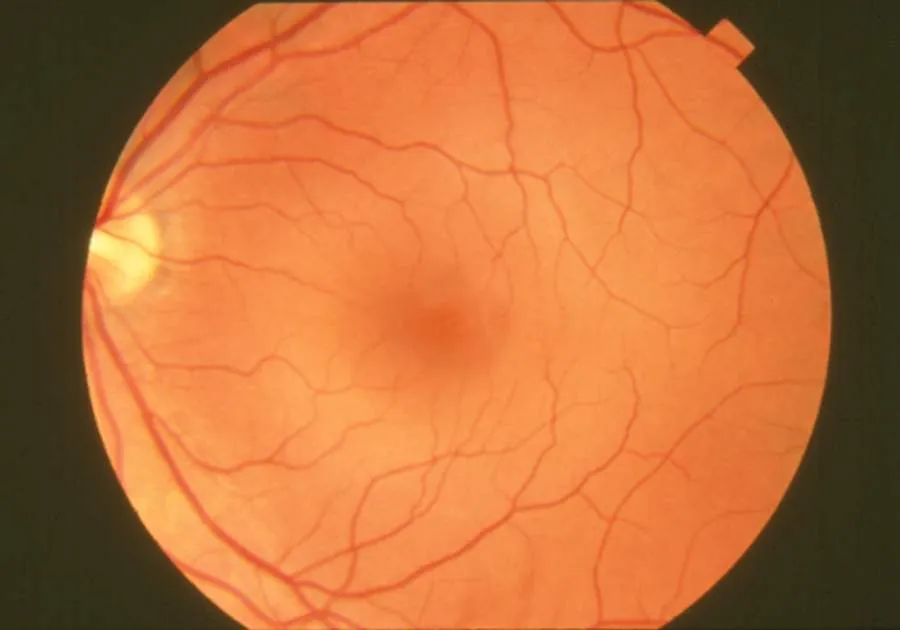
What is more, the first round of redundancies happens before the signal even reaches the cortex.
The retina has about a hundred and twenty million light-sensitive cells, while the optic nerve leaving the eye consists of about a million fibres: a hundred and twenty to one, and this compression happens on the very first storey, in the eye itself, long before any consciousness or any choice.
In 2006 Kristin Koch’s group at the University of Pennsylvania measured how much actually passes along this nerve: about a hundred thousand ganglion cells in a guinea pig deliver on the order of eight hundred and seventy-five thousand bits per second, and scaled up to a human this comes to about ten million.
Ten megabits is the stream that suffices for decent video, and a cheap surveillance camera puts out about as much. Your entire visual world, all its depth, colour and detail, reaches the brain through a channel you use at home for watching series and consider slow.
Enjoying it? New chapters and experiments by email
At most once a week. No account needed; unsubscribe in one click.
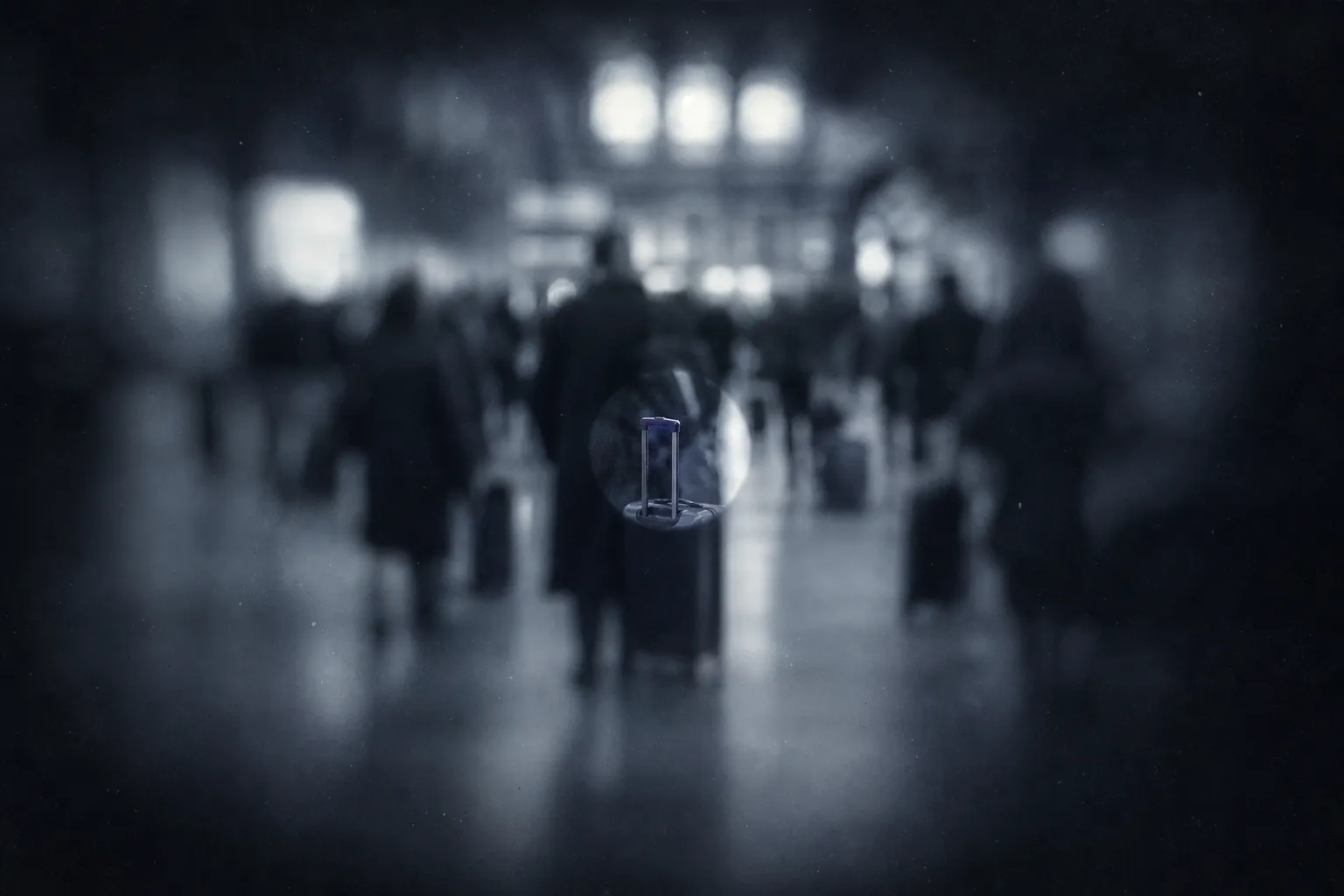
The geometry is even harsher than the bookkeeping.
The cells responsible for sharpness and colour are gathered at the centre of the retina in a tiny spot, and the zone of highest acuity covers about two degrees of the visual field, while everything farther from the centre is resolved the worse the farther it is, so that at the edge of the field you can no longer make out either a face or a letter.
You can check this without getting up. Look strictly at one word in this paragraph and, without moving your eyes, try to read a word three lines below: it is there, the light from it duly falls on your retina, and you will not be able to make it out until you shift your gaze.
This, incidentally, makes clear where the trajectories on Yarbus’s film came from. The eye runs over the canvas for a purely mechanical reason: it sees two degrees sharply at a time, and so, to make out the painting, it has to apply those two degrees to it in several hundred places; the jump of the eye turns out to be a direct consequence of the retina being built unevenly.
Since we are talking about holes in your vision, here is another one. Each eye has a place where the optic nerve exits and there are no light-sensitive cells at all, a blind spot roughly the size of a fist at arm’s length. You have never once seen it in your whole life, because it is neatly plastered over with whatever the system believes must be there.
Here it is time to slow the chapter down, or it will turn into a sermon about the thrifty, wise brain, and such a sermon parts company with the measurements.
The twenty watts hold almost constant whatever you do: whether you are solving a hard problem or staring mindlessly at a wall, the meter turns at about the same speed. Marcus Raichle, who spent two decades on the subject, showed that the increment associated with a particular task amounts to a few percent on top of what the brain always spends, while the main money goes on background work that proceeds regardless of what you are doing; he called it the brain’s dark energy, by analogy with what cosmology has the most of and knows the least about.
This breaks the simple version of the plot. The meter has no intention of spinning faster because of your diligence: the fund is spent evenly, and attention moves money from one pocket to another within a sum already spent.
The main point, however, survives this correction intact. The ceiling has not gone anywhere; it hangs low and does not ask what you want: fewer than one hundredth of the cortex can be active at the same time, and no amount of concentration will enlarge that share. Selection happens because capacity is finite.
And one more caveat, short but important. Reasoning of the form “evolution made it so because it is more economical” is a dangerous genre: it explains absolutely everything, including what is not observed in nature, and it must be checked especially rigorously. The numbers above were obtained by measurement. The conclusion that attention is built the way it is because of them is already an interpretation, and it rests on three independent constraints striking the same point.
The point looks like this.
Yarbus’s subject chose where to look because he could do nothing else: between a hundred and twenty million cells at the input and a million fibres at the output stands a compression of more than a hundredfold, between the whole visual field and the zone of sharpness stand two degrees, and between sixteen billion neurons and the number that can be paid for stands less than one percent. Each of the three barriers alone would be enough to force the system to throw away almost everything, and they stand in series, one after another.
A system with such constraints is doomed to be uneven: it cannot afford uniform quality across the whole field on any storey.
From this follows an unpleasant question for our own engineering, which for now I will only pose. We feed machines an image in which a pixel at the edge of the frame is worth as much as a pixel at the centre, and a memory in which an event from last Thursday is stored in the same detail as yesterday’s; we do this for a simple and boring reason: unlike the retina, our budget still allows it. Whether we lose more on this uniformity than we gain is a conversation for the twelfth chapter.
The modest conclusion so far is this: in a living system, selection begins before perception, and its cause is a matter of bookkeeping: there is not enough money for everything.
Money, however, is not the end of it. There is a ceiling indifferent to biology, to budget and to how well your retina happens to be built; it was set by physics, and there is no getting round it at any price.
Read “The Ceiling” free with your email
We’ll send a link that opens the chapter on this device. Then new chapters and experiments, at most once a week; unsubscribe in one click.