05
How to Properly Lose Your Mind
Wei Lin gave me a week — exactly as long, by his calculation, as my brain should hold out before the filter finally dried and cracked. In my own practical experience, four days were enough: evidently the filter installed in me was a cheaper model than the one fitted to the Academy’s target audience.
The first day went normally — in the only sense that word still had in my life: nothing happened, and I didn’t see anything I couldn’t explain away with fatigue, stress, or a vitamin D deficiency (Muscovites from October to March live in a state of permanent avitaminosis; the sun in Moscow in winter is an urban legend, like polite cab drivers and affordable housing).
On the second day, I saw the metro.
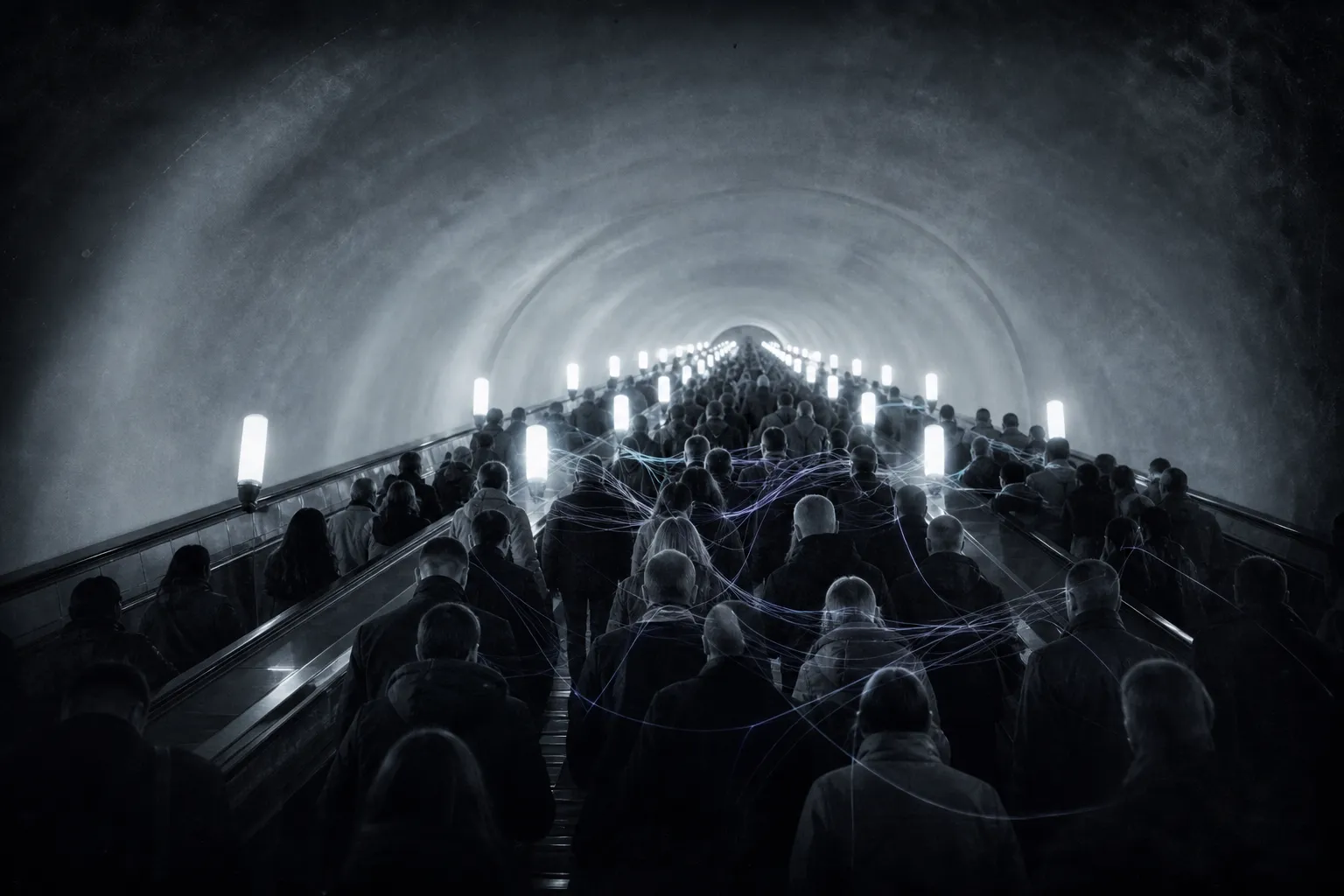
I see the metro every day: the escalator, the crowd, the smell that’s impossible to describe but instantly recognizable to any Muscovite (a blend of rubber, sweat, perfume, and suppressed despair — if Moscow were a person, this would be the smell of its armpits). I mean something else: I saw how the metro works.
In the sense that I saw the “biography of water” in the cup at Wei Lin’s.
I was standing on the platform at Shabolovskaya, waiting for a train, and suddenly — without any signal from the body or chill down the spine — I saw people from the inside.
I saw — how to put this — trajectories. No “auras,” no “thoughts,” no “energy fields.” Every person on the platform carried behind them a wake of decisions, habits, fears, hopes — and this wake was structure. Visible. Dense. Like a contrail behind a jet: you can’t see the engine, but you can see where it flew.
A woman in a red coat — her trajectory was narrow, compressed, like a wire under voltage. Everything in her was aimed at a single point: a child (at home, sick, temperature 38.2 — I didn’t know how I knew this, but I knew). A man with a briefcase — his trajectory forked, wound, zigzagged: he was making a decision that something important depended on, and each option pulled him in its own direction, and he was tearing, literally, structurally, at a level deeper than muscle and bone.
A teenager in headphones — his trajectory was... strange. It went ahead of him, not behind him like the others. As if the future was moving toward him. I didn’t understand what it meant, but the sight sent a chill down my spine.
This lasted about fifteen seconds. Then everything, as usual, collapsed back into the platform with its people and the familiar smell of the metro. The arriving train met me with open doors, and I got on, still feeling the tremor in my hands.
In the car, I thought: fifteen seconds. Last time — ten. Time before that — two. It’s escalating. Faster than linearly. If this is exponential (and the physicist in me whispered that it was), then in two or three days I’d be seeing this constantly — nonstop, with no off switch.
Like a monitor you can’t dim. Like a radio with no off button. Like a consciousness someone cranked to maximum and snapped the dial off.
Work was worse.
Because for the first time in my life, I saw the laboratory as it is. As a node, not a collection of instruments and screens. A place where the physical world is especially thin, because we systematically, daily, nine to six, poke its foundation with a stick.
A quantum lab is the only place in the world where people officially work with things that violate the rules of ordinary reality. Superposition: an object simultaneously in two states. Entanglement: two objects instantly affecting each other across any distance. Wavefunction collapse: reality becomes definite only when someone looks at it.
We do this every day. And every day we pretend it’s normal. That it’s “just physics.” That “it doesn’t work at the macro level.” That between the quantum world and our everyday life there’s a wall, and nothing seeps through.
And I stood in the middle of the lab and saw that there was no wall.
Our qubits — the very ones that in our publications fluctuate and behave evasively — didn’t end. Physically they stayed in place: the cryostat hummed, the chip was alive, the wires gleamed, the graph on the screen drew what it always drew. But in my peripheral vision — from that new layer I could now see the way you see someone standing behind your shoulder without turning round — from there the qubits were holes; tears through which the second floor was looking at our first. We’d spent two years drilling holes in the floor and wondering why it was drafty from the basement.
It was drafting on everyone, not just the qubits. On Lena, sitting a meter from the cryostat. On Seryozha, one floor down. On Grisha with his exclamation marks. On all one hundred and forty-seven employees of the institute (I’d counted on the website yesterday, out of boredom). We all worked inside a building where we were systematically, daily, at government expense, poking holes in the foundation of reality — and not one of us knew it. Except, now, me.
(Here, by the way, is a question nobody seems to ask: if a quantum lab is a place where reality is thinner than elsewhere — why do governments fund quantum research? The official answer: “quantum computers, cryptography, military advantage.” Three hundred billion dollars a year — for “military advantage.” Sounds convincing. But a quantum computer is a device that literally makes reality perform calculations. Reality itself, not a model of it. We take the fabric of the world and make it compute. It’s like taking the wall of your house and making it solve equations. The wall solves them. But what happens to the house?)
We thought we were studying the quantum world.
The quantum world was studying us.
— Dan? — Lena’s voice. — You okay?
I was standing in the middle of the lab and apparently looked bad enough that Lena decided to ask. And Lena doesn’t ask “are you okay” casually. She asks when the answer is obvious and discouraging.
— Yeah, — I said. — Just thinking.
— You’ve been “just thinking” standing with your mouth open, staring at the ceiling, for two minutes.
Two minutes. Felt like ten seconds.
— Headache, — I lied. — I’ll take a walk.
I went outside and called Wei Lin.
— It’s started, — I said.
— What exactly?
— I’m seeing. All the time. It used to be in flashes. Now in chunks of fifteen, twenty seconds: people, space, connections. And I can’t control it.
Pause. Short — maybe a second. But for a man who claims seven hundred years of experience, that second meant he was calculating.
— Come over, — he said. — Now.
— I’m at work.
— Daniil. In twenty-four hours, you won’t be able to be around people without seeing their insides; in forty-eight, you won’t be able to tell this layer from the physical one; in seventy-two, you’ll stop knowing which one is real. Work can wait; your brain cannot.
I looked at the institute building — seven floors, a broken elevator, a coffee machine that obeys the laws of thermodynamics only on even days; Lena behind her monitors, Seryozha with his soldering iron, Grisha with his exclamation marks; qubits pretending not to watch me while I pretend not to watch them.
My world. Four years. Publications, grants, conferences, paper cups of bad coffee, arguments about decoherence, late-night data sessions, the smell of bleach in the corridor, eleven cracks in the ceiling.
— I’ll be there in forty minutes, — I said.
I hung up. Stood there. Then went back inside.
— Lena.
She turned. Three monitors, flannel shirt, the look of a person who already knows she’s about to hear something she won’t like.
— I need to leave.
— Where?
— Personal matter.
— Dan. Review in six weeks.
— I know.
— Last month’s data isn’t processed. Series twenty-six isn’t finished. Seryozha says the cryostat...
— Lena. I need to leave.
Pause. She looked at me. I could see — with regular vision, no “stack-vision,” just saw it because I’d known her for four years — how behind her eyes, options were racing: he’s sick, he’s in trouble, he found another job, he’s losing his mind, he’s already lost it.
— For how long? — she asked.
I didn’t know. That’s the honest truth: I didn’t know. How long — a day? A week? Forever? Wei Lin said “training,” but what does that mean? A month? A year? Seven hundred years?
— I don’t know, — I said. — Maybe a week. Maybe longer.
— Or maybe you won’t come back.
She said it as a statement — quiet, even, no drama. Lena doesn’t do drama, Lena does facts.
— Maybe I won’t come back, — I said.
A long silence in which the cooling systems hummed and somewhere below Seryozha was dropping something heavy.
— Is this about what happened at the intersection? — she asked. — The truck, the data, that spike we “didn’t see”?
I nodded.
— You found... something?
— Someone.
She closed her eyes, opened them, stood, walked over to me and did something she hadn’t done once in four years: hugged me — briefly, hard, without a single word. Then she stepped back.
— Go, — she said. — But Dan...
— What?
— If where you’re going turns out to be a cult — I’m coming to drag you out by the ears. You know me.
I smiled. For the first time in a week — genuinely.
— I know.
— And one more thing. — She went back to the monitors. — I’ll finish series twenty-six myself. But if you’re not back for the review — I’m listing you as third author. After Seryozha.
— After Seryozha?!
— He at least shows up for work.
That was “goodbye” in Lena-speak: an insult disguised as care disguised as an insult. I grabbed my jacket, backpack, and Zoya’s notebook from the desk drawer. At the door, I turned around.
Lena sat at the monitors. Back straight. Hands on the keyboard. Three screens, code, data. As usual. As always. As if nothing had changed.
Except her shoulders were slightly raised. One small detail. She does that when she’s holding back tears.
I walked out. Closed the door. Went down the stairs (the elevator wasn’t working; the elevator, at least, was consistent in its refusal to work — and in that, there was comfort).
On the landing between the third and fourth floors I stopped, because I was out of breath — the way anyone is who has left something big behind in two flights of stairs — and because in my chest, instead of lungs, Lena’s shoulders were now beating: those two centimeters they’d risen by in farewell.
She’d stayed silent. Her shoulders went up — and that was all: tears, shouting and “don’t go” stayed inside. Four years together — and the only goodbye she allowed herself was two centimeters upward, with her shoulders, in silence.
(On the staircase, between the third and fourth floors, I thought: maybe this is what a “subjective invariant” looks like in real life. How you stay silent. And Lena’s silence is beautiful. Like Wei Lin’s. Only without seven hundred years of practice.)
I walked out of the institute and got in the car.
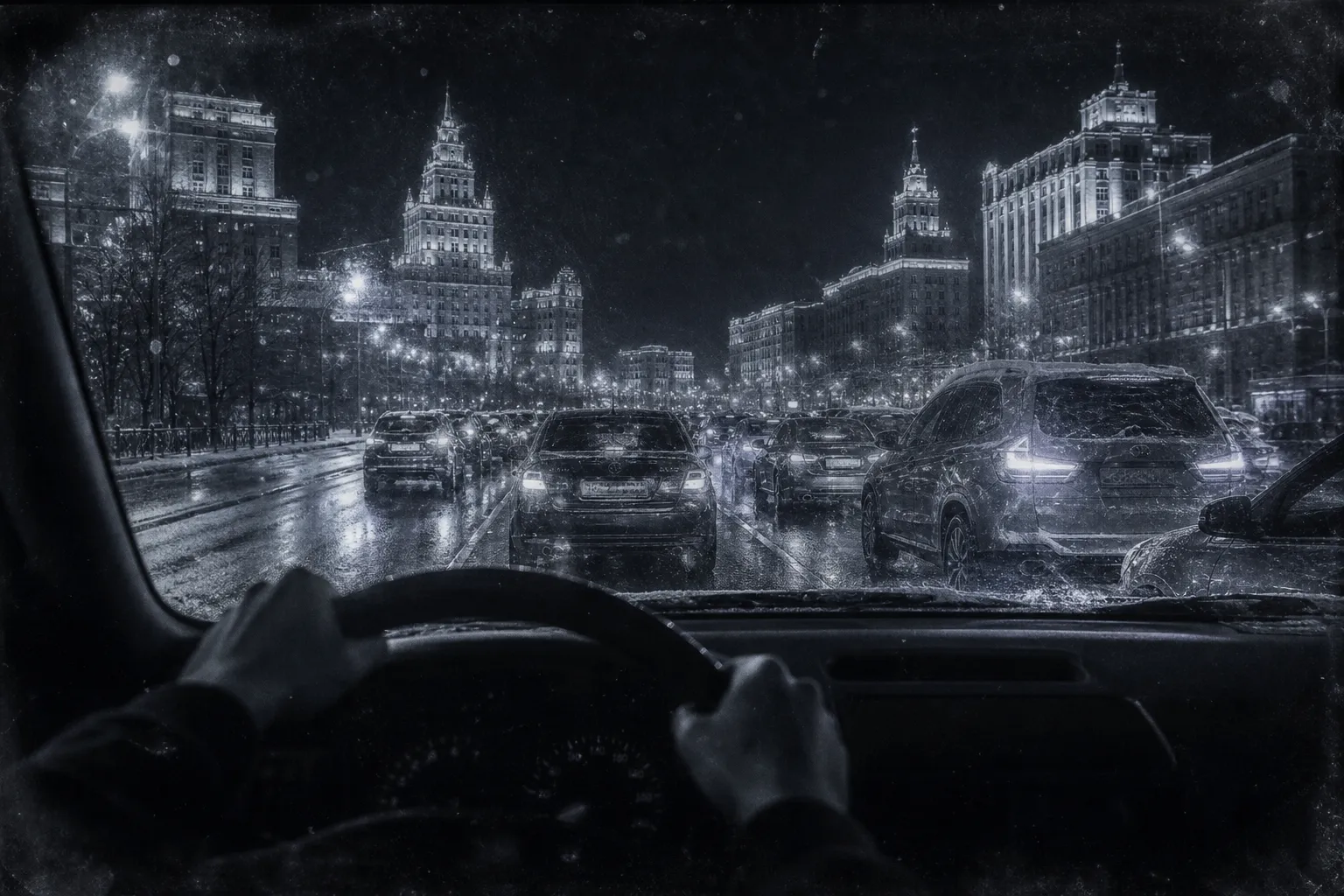
On the way to Khamovniki, it hit me.
It hit me in a perfectly ordinary Moscow traffic jam on Leninsky Prospekt, alone and at the wheel — that is, in the position any safety instructor for perceptual filters (if such a profession existed) would put at the top of the blacklist. Though every position would end up on that blacklist at once: it’s unlikely anyone anywhere ever said to himself, “Oh, what a convenient time and place for all my perceptual filters to collapse.”
First I saw the cars. Processes — metal, glass, and plastic had nothing to do with it. Every car in traffic was a node in a network of thousands of decisions: this one turned here because he’s late, because he overslept, because he didn’t sleep last night, because he was fighting with his wife, because... Thousands of causal chains woven into a single knot we call “traffic.” Traffic is a visualization of ten thousand lives simultaneously failing to fit in one space.
Then I saw the road. History, not asphalt. Layers going down: this asphalt, the previous one, the one before that. Earth that was here before the road. Forest that was here before the earth. Glacier that was here before the forest. All of it — simultaneously. As fact, not memory: all these layers were here and, at the same time, are still here.
Then — the sky. The sky itself, not the clouds. The space between me and the stars, which we consider empty. It isn’t empty. It’s full — of connections, flows, structures that... that...
That’s when I realized I couldn’t feel the steering wheel. My hands had, for a second, stopped being “mine” — and it wasn’t numbness. They were part of the car, which was part of the traffic, which was part of the city, which was part of... what? Everything?
I don’t know how long it lasted. Maybe a second. Maybe a minute. I came back because someone was honking — there was a car-and-a-half-length gap in front of me, and I was sitting motionless.
Hands shaking. Heart pounding like I’d run five kilometers. Taste of copper in my mouth. (Later, Wei Lin would explain that the copper taste is the brain’s neurochemical response to overload: when the volume of processed information exceeds bandwidth, neurotransmitters “leak,” and taste receptors pick up what wasn’t meant for them. Elegant. Terrifying. Scientific.)
I drove to Khamovniki on autopilot. Don’t remember parking.
Wei Lin opened the door, looked at me, and said:
— Sit down. Don’t talk.
I sat. He placed his hand on the back of my head. The palm was warm and dry. I expected something — a flash, a sensation, an electric shock. Nothing. Just a warm palm.
And the world around me — slowly, as if someone were turning down the volume — went quiet.
The threads vanished. The trajectories vanished. Space became simple, flat, one-dimensional again: walls, table, cup, light. That same “first floor” where all normal people live. I could no longer see anything beyond what everyone sees.
And I started crying.
For the same reason people cry when the music stops: a second ago there was an orchestra, and now there’s silence, and in the silence all you hear is your own breathing, and you don’t like the sound of it.
For twenty-eight years I’d been living in a world that, it turns out, had the sound off. Wei Lin let me hear the full version for a second. Then hit mute. And I sat in that silence and understood: so this is how everyone lives. This is “normality.” A deaf room where you mistake the walls for the boundaries of the world, and the absence of music for silence. The right name for this kind of silence is deafness, because the word silence is several sizes too big for it.
— This is temporary, — Wei Lin said. He removed his hand. Voice calm. — I installed a filter. It’ll hold for a few days. That’s enough to begin learning.
— Learning what?
— To look without burning.
I wiped my face. Looked at him. He was pouring me tea. Calmly. As if he hadn’t just switched off someone’s universe.
— Seven hundred years, — I said. — You’re serious.
— I’m always serious. Except when I warn you I’m joking.
— And you’ve been seeing this whole time?
— Seeing.
— Everything?
— More than everything. But that’s for later.
— How have you not gone insane?
— Who told you I haven’t?
Pause. I tried to determine whether he was joking. Couldn’t.
— Fine, — I said. — Suppose I don’t want to go back to the soundproof room. What happens next?
— Next, you learn. Not here. Not in Moscow. There’s a place where this can be done... more safely.
— The Academy.
— Yes.
— What is it? A school? A monastery? A military base?
— All of the above. And none of the above. — He sipped his tea. — The Academy is a space where the laws work differently. Not because we changed them. But because we stopped pretending they’re the only ones.
— Where is it?
— Everywhere and nowhere — and it only sounds mystical because people have forgotten how to use physics: the Academy exists in a layer of perception that has no geography, so entering it is a perceptual task, and you, as far as I can judge, have almost solved it already.
— Almost?
— Almost. You need to do one thing.
— What?
— Stop holding on.
— To what?
— To the configuration. — He sipped his tea as if he’d said “to the weather.” — Name, apartment, institute, the photograph on the table — that’s your shell. You are the process that generates all of it. But the process has clung to its products and decided it is them. Like a river that decided it’s the banks. Remove the banks — and the river simply flows wider.
— What if I’m not a river? What if I am the banks?
— Then you’ll have nothing to flow into the Academy with.
It was diagnostics. He wasn’t persuading. He was testing.
— She thinks I’m joining a cult.
— She’s wrong. But not by much. — The shadow of a smile again. — In a cult they first take away your doubt, and then, along the way, somehow imperceptibly, your wallet; here it’s rather the other way round: your doubt will be left to you and even topped up, and everything else you’ll gradually carry out onto the porch yourself, without any request on our part.
(I thought about that formulation for a long time afterward. It’s precise. And it explains why consciousness-awakening coaches make millions: they sell the first half — “you’re special” — without the second — “give up everything.” It’s like selling the entrance to a burning building without the fire suit. The client walks in, feels the heat, says “wow, transformation!,” runs out before catching fire, leaves a five-star review, and buys the second module. The real fire — the one you walk into and don’t run out of — costs you. Money won’t cover it. But that doesn’t fit in the marketing.)
I looked at the tea. At the table. At the black stone egg on the shelf (it was sitting quietly; whoever lived inside had apparently decided not to peek). At Wei Lin. At my hands.
My hands. The hands of Daniil Reinov, physicist, Muscovite, orphan (almost), neurotic, bug. The hands that held Mom’s slippers twenty-one years ago. The hands that pulled Lena by the sleeve at the intersection. The hands that shook when I read Zoya’s notebook.
Stop holding on.
— When? — I asked.
— Tomorrow. Morning. I’ll pick you up.
— I need to go home. Pack.
— You don’t need things.
— At least a toothbrush.
He looked at me. And laughed. For the first time. Quiet, dry, but real laughter, the kind seven-hundred-year-old Chinese men don’t usually show the first graduate student with a toothbrush who comes along.
— A toothbrush — you can bring, — he said.
That evening I sat in the apartment and did what a physicist does when his life is falling apart: inventory.
Books — one hundred and forty-three (counted last year when I was trying to fall asleep). Monitor — one. Mug with broken handle — one. Cracks in the ceiling — eleven. A Chaos Constructions badge on a nail by the door. Everything in place. Like the lab: instruments standing, data collecting, the experimenter leaving. The instruments don’t notice.
(The badge was from Chaos Constructions 2013. Saint Petersburg, two days, two thousand people, the main Russian demoscene event. The word “demoscene” never quite stuck in Russian, because it describes an activity with no clear economic function: people write programs whose only purpose is to be beautiful, on the condition that they weigh less than four kilobytes. Four kilobytes is one-twelfth of this paragraph. Four kilobytes fits a short poem or a notice about a missing dog. At Chaos Constructions, those same four kilobytes contained a three-dimensional world with music, light and shadow, terrain, and end credits; on a projector, in a big dark hall, over Baltika Number Seven, two thousand mostly bearded people raised their hands to vote on whose world had fit into the formal limit most cleverly.
I went there with two classmates from the physics-and-mathematics faculty. Plackart car, August, in tow a ZX Spectrum computer that one of us was carrying in a sports bag (why — I didn’t ask; on the physmat, by twenty you learn not to ask questions about the contents of other people’s sports bags). The first night the compos ran until five in the morning. I sat in the dark and watched a universe unfold on the screen in eight seconds — and for the first time I had a clear sense that I was seeing what programs are written for in the first place. Inside a four-kilobyte cage you can live in a way that’s beautiful. The guy who wrote that universe came up on stage, got his prize — a bottle of vodka and a printed certificate — and left, apparently without speaking to anyone.
And one more thing I couldn’t put together for a long time: everything that happened that year was about one thing. In January, twenty-six-year-old Aaron Swartz hanged himself in his apartment for downloading scientific papers from the MIT archive; he was facing thirty-five years in prison, and the day before the plea deal he couldn’t take it. In May, Cody Wilson published the blueprints for the first pistol that prints on a 3D printer; the U.S. State Department ordered the files taken down — a hundred thousand people downloaded them within two days, and that door could no longer be closed. In June, Snowden landed at Sheremetyevo with a laptop on which the entire NSA surveillance machine was documented down to the last key.
I was a third-year student. I read each of those headlines and reacted differently. To Swartz — nothing. I stared at the monitor for a minute, then closed the tab: about a kid who hanged himself the day before a plea deal, I had not a single assembled thought back then. To Wilson — I bought myself a Habr-style 3D printer kit, assembled it in two weeks, and spent a month printing toothbrush holders. The Liberator I didn’t print. I wanted to, but didn’t. To Snowden — a week not opening my email, then opening it again, because there was no other way. Then I got into a plackart car and went to the compo. In August I needed to be among the people who write programs for beauty — the other varieties seemed dangerous.
On the way back, in the plackart car, I thought about that guy. For him, four kilobytes were the rules of the game. For me, a problem to solve. People who treat the rules as the problem go into the marketing department of Pepsi. Twelve years later, almost word for word, Wei Lin would say the same thing. I’d realize then that that guy and I are different breeds. He sits in the cage as if it were home. I — spent twenty years looking for the way out.
The friends from physmat I’d lost by 2025: one drank himself to pieces, one emigrated, the third went back to Orekhovo-Borisovo to a ZX Spectrum in a basement and apparently stayed there. The badge hangs on the nail by my door. Ten grams of dyed cardboard left over from the summer when I was sure that beauty was assembled by hand, in four kilobytes, and that you got paid for it in vodka and a printed certificate. The psychiatrist on Barrikadnaya doesn’t hand out badges like that; his prescription is different, and it costs more than vodka.)
Mom’s photograph. I picked it up from the table. Dark hair. Eyes looking through the camera. For twenty-one years this photograph had stood on the kitchen counter, and for twenty-one years I’d thought it was all that was left. And now I’m told: she’s somewhere in the stack, and I carry her signature inside me. And I’m about to go to a place I know nothing about except its name. A normal evening for a normal PhD.
I put the photograph in my jacket pocket. The toothbrush — on the nightstand.
Then I called my father.
Three rings went by, then four and five; I was about to hang up — and he answered.
— Dan? — Surprised voice. We hadn’t spoken in over a month. — Everything okay?
— Yeah, Dad. Everything’s fine. I just wanted to... talk.
Pause. My father is a man of pauses. He stays silent because he’s learned that words are an unreliable tool, and silence is at least honest.
— Talk, — he repeated. — You sure you’re okay?
— Dad. I want to ask you something. Mom... did she ever say anything... strange to you? About the world. About how reality works. About seeing things other people don’t see.
The silence stretched on and on.
— Why are you asking?
— Because I think I’m starting to understand what happened to her.
Another pause.
— She did say things, — he finally said. Voice quiet. Unusually quiet. — She said the world was like a house with thin walls. That sometimes she could hear what was on the other side. I thought... I thought it was a metaphor. Or... — he faltered. — Or illness.
— It’s not an illness, Dad.
— Dan. You’re not...
— No. I’m not sick. I... figured it out. I think.
— Figured out what?
— The walls.
Silence. I could hear his breathing. Heavy, even, the breathing of a sixty-year-old engineer who’d spent his whole life building bridges (real ones, concrete and steel) and never believed in anything you couldn’t touch with your hands.
— Be careful, — he said.
— I will.
— And call. Not in a month. In a week.
— Okay.
Pause. I could hear him breathing. Then he said:
— Your mother... she started the same way. First questions. Then answers I didn’t like. Then she left.
That was the most he’d said about Mom in twenty-one years. Usually it was one sentence: “An accident.” Period. Like a beam laid across a conversation so nobody walks further. And here — three sentences. For my father, that’s roughly the equivalent of writing a memoir.
— Dad. I’ll come back.
— She said that too.
He hung up. Without saying goodbye.
(I held the silent phone in my hand for another minute, and I very much wanted to call back — to hear from him at least one more sentence about her, any sentence — but I didn’t call back, because over twenty-one years my father and I had developed our own unspoken agreement: I don’t ask, he doesn’t tell, and we both stay silent, as agreed on the day she disappeared. Breaking that agreement now would have meant admitting that the silence had cost me too much — and admitting that was more shameful than missing out on a second sentence from him about her.)
My father simply hangs up when he considers everything said — goodbyes aren’t his thing. An engineer’s approach: a conversation is a bridge, and once you’ve crossed it, you walk on.
I stood at the window. Moscow behind the glass was doing what it does best: existing. Twenty million people, four percent of reality, point-three percent of explanations. For the report — sufficient.
Tomorrow morning Wei Lin arrives. Tomorrow I go to a place that exists “not in coordinates but in a layer.” It’s the most honest thing that can be said about any place worth going to: it’s in a different mode of vision, and it isn’t on the map. Like that picture from childhood — “Magic Eye” — where you have to unfocus your gaze, and then a three-dimensional dolphin emerges from the chaos. Only here, instead of a dolphin — the Academy. And what you have to unfocus is your life, not your gaze.
I lay down and lay in the dark for a long time, not quite understanding who exactly was lying down now: the same Daniil Reinov I’d got used to over twenty-eight years, or already someone else, the same according to his passport but without banks. More precisely, not quite understanding either whether that first Daniil Reinov had been anything whole enough to be told apart from anything at all.
The toothbrush lay on the nightstand, Mom’s photograph in the pocket of the jacket hanging on the chair, Zoya’s notebook in the backpack by the door, and Wei Lin’s business card in the back pocket of my jeans: four objects and one short inventory of everything that remained of Daniil Reinov, PhD, Moscow, Shabolovka.
Then again, four objects is already more than enough: Wei Lin said “you don’t need things,” but he also said “a toothbrush — you can bring,” and a man who stopped holding onto the banks seven hundred years ago, if he understands anything apart from tea and perceptual filters, probably understands toothbrushes.
And if he doesn’t, I’ll explain it to him, and that will be my first contribution to the Academy’s seven hundred years of experience: oral hygiene as the foundation of metaphysical development.
On that thought I think I smiled — and fell into a sleep so dense that nothing like it had ever happened in the Shabolovka apartment: evidently Wei Lin’s filter closed completely even on the way to sleep.