01
Peripheral Vision
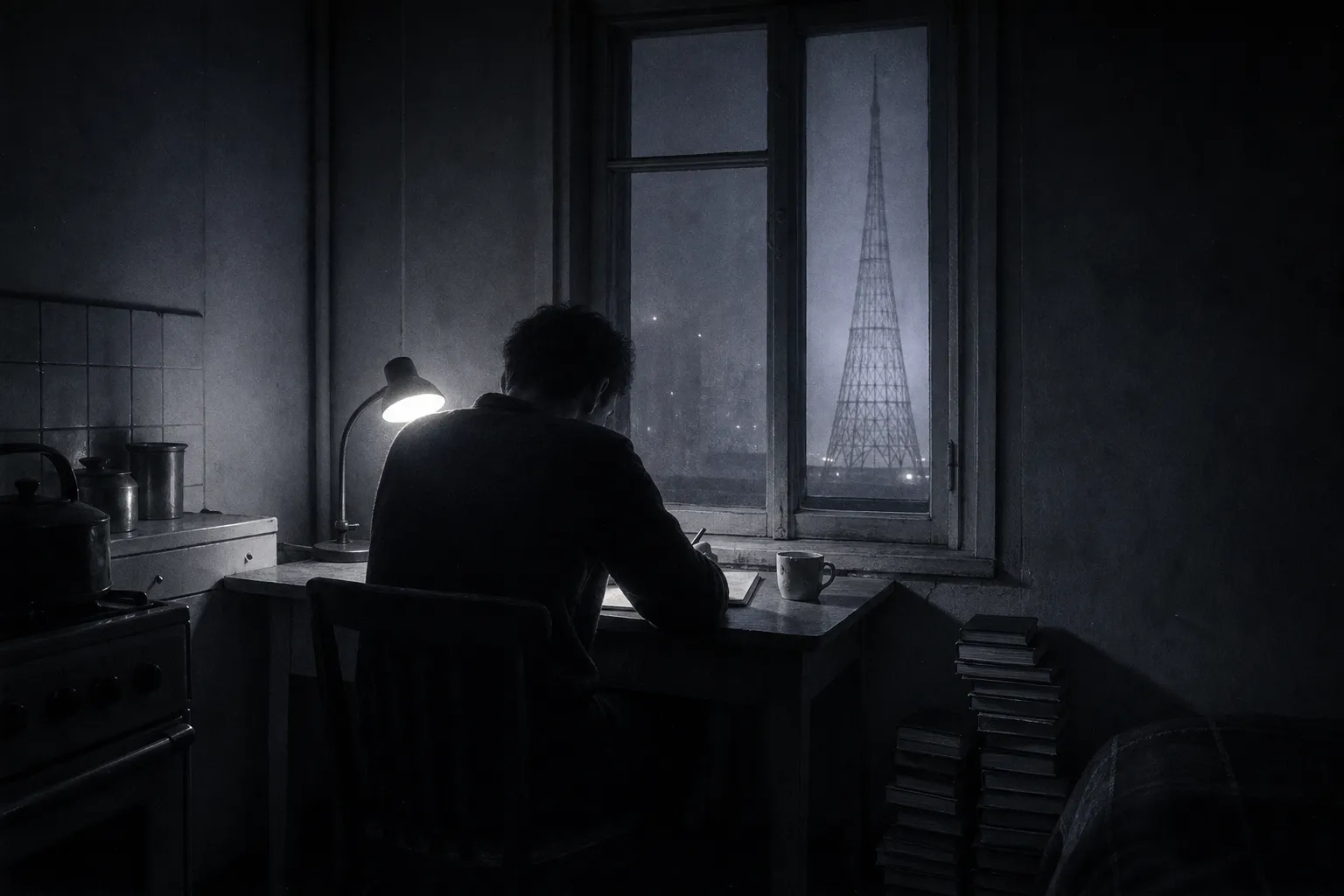
Yesterday I saved a man’s life. Not on purpose.
That’s an important caveat, because everything else follows from it. If I’d saved a man’s life on purpose — say, rushed into a burning building or jumped into a river — I wouldn’t be sitting right now in an empty apartment on Shabolovka, writing this in a notebook I bought this morning specifically to record things that can’t be said out loud. I’d be giving interviews, or lying in a hospital, or at the very least feeling like a hero.
Instead, I feel like a bug.
Not in the metaphorical sense (“oh, I’m a freak of nature, nobody understands me” — though that too). In the literal sense. Like a bug in code: the program runs, the user notices nothing, but the developer knows that on line 4078 there’s a function call that shouldn’t exist. It doesn’t break anything. It just has no right to be there. And someday — nobody knows when — it’ll fire, and then everything goes to hell.
Line 4078 — that’s me. Daniil Reinov, twenty-eight, PhD in theoretical physics, Moscow, the Institute of Quantum Technologies named after someone-I-can-never-remember (most Russian scientific institutes are named after people whom nobody remembers except by the plaque on the facade — which is the method of Russian science: a name on the plaque, silence inside).
I have an extra function. Like a sixth finger: doesn’t hurt, doesn’t get in the way, but gloves don’t fit and people stare. The function is this: I sometimes see the folds in reality.
“Folds” is a metaphor, obviously. But I don’t have a better one, because a literal description would require a language that doesn’t exist, and the closest analog is a schizophrenic’s clinical chart. So — folds. When you don’t have the word — you have the diagnosis.
I’m not a psychic, and not a prophet, and not that guy from the YouTube ad who, for 49,990 rubles (discounted, today only, just for you, just because Mercury is in Pisces), promises to “awaken your quantum consciousness.” (Side note: “quantum consciousness” is one of the greatest crimes marketing has committed against physics. Quantum means something that exists in Hilbert space. Your “consciousness” exists in the space between your second glass of wine and your third episode of whatever you’re binging. But I digress.)
So here’s the thing. Sometimes — once every few months, no schedule, no warning — the world around me goes translucent for a split second. As if reality has a lining, and the top layer — the nice one, pressed and ironed, the one all normal people live in — lifts for an instant, and underneath it is the framework. The blueprint. The markup along which all of this — trees, streetlights, your life — is stitched.
You ever notice an editing splice in a movie? Camera was on the right, now it’s on the left, the actor’s already in a different pose. Good editing is invisible. Bad editing makes you nauseous: you realize you’re being shown a trick, and the magician’s hand flickered into frame for a second.
That. Except not in a movie. And the hand — not human.
I see events being edited. I see the effect appear before the cause, and then the cause gets neatly sketched in retroactively — like a signature under someone else’s order. The world around me assembles. Right before your eyes. On the fly. In real time. From parts that didn’t exist a second ago — like IKEA furniture, except the instructions are in a language I don’t know, and the assembler is invisible.
The psychiatrist on Barrikadnaya — a neighborhood in central Moscow — (one visit, age twelve, a hundred and twenty phenazepam pills, six months in a state of a boiled dumpling) called it “heightened anxiety with elements of dissociation.” Kahneman’s book, which I read at sixteen (Thinking, Fast and Slow, the chapter on expert intuition) called it “rapid unconscious data processing.” Wonderful formulations. Both. One — to prescribe pills. The other — to not prescribe them.
Neither explains what happened when I was seven — but that’s a conversation for later, when I can reach the heart of it without the side-stepping.
The elevator wasn’t working.
In any other country, this would require an explanation. In Russia, it’s the working elevator that requires one: what happened, who got fired, whose grant money got drunk away, what did we do wrong. A broken elevator — that’s stability. That’s confidence in tomorrow. That’s an existential anchor in a world where everything else is unpredictable.
(I’m completely serious, by the way. One of the things foreigners will never understand about Russia is that here, chaos is a form of order. A Russian institute where everything works raises suspicion. It means money from somewhere. Means someone owes someone. Means — trouble’s coming. But an institute where nothing works — that’s home. Familiar. Safe. You can relax.)
I climbed to the seventh floor on foot, gasping and cursing my habit of smoking “just one before bed” (“just one before bed” is a quantum object: it exists simultaneously as one and four, and collapses into a specific number only in the presence of an observer), and discovered a working coffee machine.
The coffee machine in our institute is a state-of-the-universe indicator. If it works — the day will be weird. If it doesn’t — everything’s going according to plan. Today it worked. I should have been alarmed.
The coffee was disgusting. This was reassuring: at least the laws of thermodynamics still held in our institute. Entropy intact. Good, honest entropy, turning tolerable coffee beans into intolerable liquid.
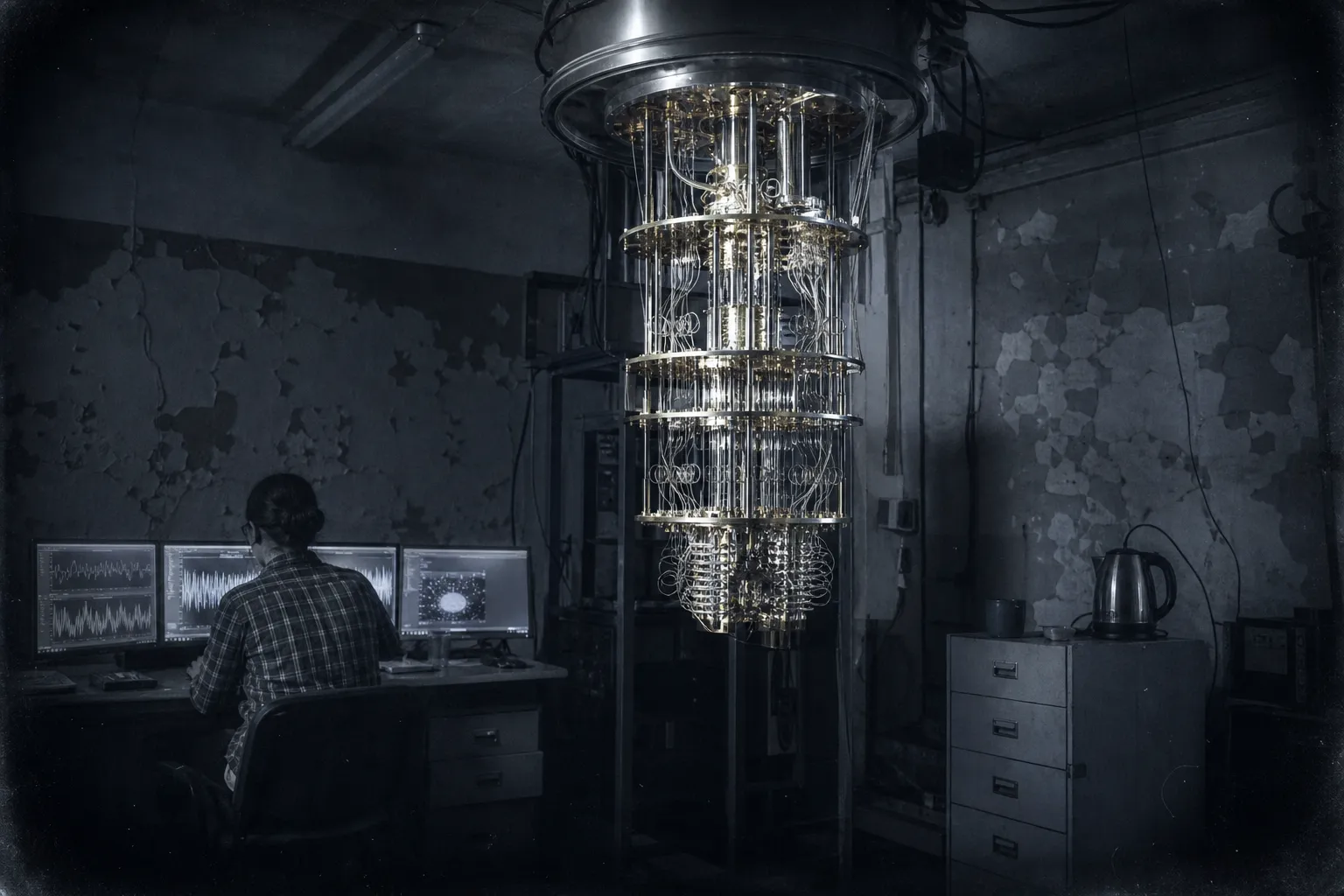
Lena Markova was already at her desk.
Three monitors, a flannel shirt, and a facial expression I’d failed to classify in four years — somewhere between “I see right through you” and “don’t make me waste words on this.”
Lena is my partner, co-author, and (I say this without a shred of romanticism) the only person within a four-floor radius I can talk to without feeling like I’m wasting my time. She’s smart. Not in the way Russians say “a smart woman” (implying: “not pretty, but useful” — one of the most nauseating constructions in the Russian language, right up there with “for a woman, you really know your stuff”). Lena is smart in the only way that matters: she understands what she’s thinking. Most people, including physicists (especially physicists), have no idea what they’re thinking. They operate formulas the way a juggler operates pins: beautifully, fast, but if you ask what exactly they’re tossing, they’ll stop and drop everything.
— You didn’t sleep again, — she said without turning around.
Lena has this ability — to diagnose my condition by the sound of my footsteps. I suspect in a past life she worked in counterintelligence. Or as a veterinarian. (The difference, if you think about it, is minimal: both deal with creatures who can’t explain what hurts, and both are forced to guess from external signs.)
— I slept.
— That’s how people breathe when they’ve been interrogating their laptop at three a.m.
— The laptop refused to cooperate.
— Fifth Amendment?
— Worse. It showed me something it wasn’t supposed to, then pretended nothing happened.
She didn’t smile. Which meant — serious.
A qubit is a quantum bit. A unit of information that, unlike a regular bit (zero or one), can exist in both states simultaneously. This is called superposition, and if you think it’s bullshit — congratulations, you’re in good company: Einstein thought so too, and then it turned out the universe was the one bullshitting.
Lena and I have been working with qubits for two years. Building a quantum processor. Or rather, trying to: building a quantum processor in Russia is roughly like cooking soup in a colander. Theoretically possible. Practically — everything leaks: money, people, qubits, hope — roughly in that order.
So here’s the thing: yesterday our qubits did something they weren’t supposed to do. They behaved — the only word that comes to mind — evasively, as if they knew they were being watched and were changing in response, and, what’s especially unpleasant, in response to me personally.
The difference between “the observer affects the quantum system” and what I saw yesterday is roughly the same as the difference between “the cat ignores you” and “the cat looked you dead in the eyes and slowly pushed your mug off the table.” The first is physics. The second is personal.
— Look, — I turned the screen toward her. — Series three-eighteen.
Lena rolled over in her chair. Her way of looking at data is a spectacle of its own: head slightly tilted, eyes narrowed, lips pressed. An Inquisitor examining a heretic’s testimony.
— Fluctuation.
— Fourteen times in a row.
— It happens.
— Lena. You know what happens fourteen times in a row? You know the probability? One in sixteen thousand. One sixteen-thousandth. That’s less likely than being struck by lightning. Twice. In one day.
— But not zero.
— Formally — no. Formally, the probability that all the air molecules in this room simultaneously gather in the left corner and we suffocate is also not zero. But we’re not sitting here in oxygen masks.
Pause. A pause is when Lena is choosing her words, and Lena only chooses words when the first ten options were “Dan, you’ve lost it,” and she’s looking for an eleventh. A softer one.
— Dan. We’re not going there.
— Going where?
— There. Where a physicist publishes a paper claiming qubits respond to his intentions. Where reviewers laugh so hard their teeth fall out. Where a year from now we’re working in a high school, explaining Ohm’s Law to sixteen-year-olds.
It came out convincing and terrifying — and beside the point, because I wasn’t talking about a publication. I was talking about the fact that my data was behaving the same way my life does: showing me something impossible, then pretending nothing happened. But I didn’t say that. I said:
— Forget it. We’ll rerun the series.
At noon, Grisha Belov showed up.
Grisha — a grad student, twenty-three, theoretical physics. If enthusiasm were fuel, Grisha could heat the entire Saratov Oblast. Unfortunately, in science, enthusiasm is a socially acceptable mental disorder, tolerated as long as you don’t start producing results. (Results are what’s left when enthusiasm burns down to ash and a fourteen-page paper that seven people will read, three of whom are reviewers, and two of those are hostile.) But Grisha was still in the fuel stage: burning bright and even, and his questions made you want to simultaneously hug him and throw him out the window (seventh floor, no elevator, poetic justice).
He burst in without knocking — knocking for Grisha is roughly what it is for a tornado: optional and physically meaningless — and blurted:
— Reinov! Zurich! Nonlocal correlations! In macro-objects!
He talked in exclamation points. Like a telegraph operator, except instead of dots and dashes — dots and exclamations.
— Saw it, — I said.
— And?!
— And I’m waiting for replication. Different group, different setup.
— That’s called being a buzzkill.
— That’s called science. Unfortunately, they’re synonyms.
He left, offended. His tablet clipped the doorframe (every time; I’m beginning to suspect it’s a ritual).
Lena, without turning:
— Harsh.
— Honest.
— Same thing when you’re twenty-three.
Right there, something clenched inside me. From envy. Real, sour, nauseating envy of a twenty-three-year-old kid for whom the universe is a Christmas present, not a package stamped “CAUTION: DO NOT OPEN.” Grisha runs toward mystery like a child toward the ocean. I run from mystery like a man who already drowned once.
The difference — twelve years and one missing mother.
(And right away — ashamed of that envy, because Grisha isn’t guilty of anything, not of my twelve extra years, not of Mom’s slippers; I immediately start composing in my head a friendly sentence I’ll say to him next time, something about his enthusiasm, — and immediately realize I won’t say that sentence to him, because in any conversation with someone five years younger than me I have the same habitual maneuver: stay silent just long enough to look distracted rather than angry.)
By six o’clock, the data was behaving flawlessly.
Any scientist will tell you that’s good. I’ll tell you it’s suspicious. Our qubits never behave flawlessly: we always have background noise, jitter, drift — normal, explainable, like a sleeping person’s breathing. But today — silence. Absolute. Dead.
Yesterday’s anomalies — in the logs. Today’s sterility — on the screen. One rules out the other. It’s like your neighbor drilled into the wall all night, and today you discover the wall is smooth, intact, and was never touched. Exactly that: never touched. As if yesterday didn’t exist. Or as if someone carefully cleaned it up.
I told myself the mantra: tired, didn’t sleep, apophenia, go home.
The word “apophenia” is one of psychiatry’s finest inventions. It means “the tendency to see patterns where there are none.” The genius of the term is that it simultaneously describes the condition and closes any discussion. The moment you say “I see a pattern in...” your colleague replies “apophenia,” and there’s nothing left to talk about. What the word doesn’t account for is the possibility that the pattern is there, and the one not seeing it is your colleague. But they never coined a term for that. Probably because then they’d have to reclassify too many diagnoses.
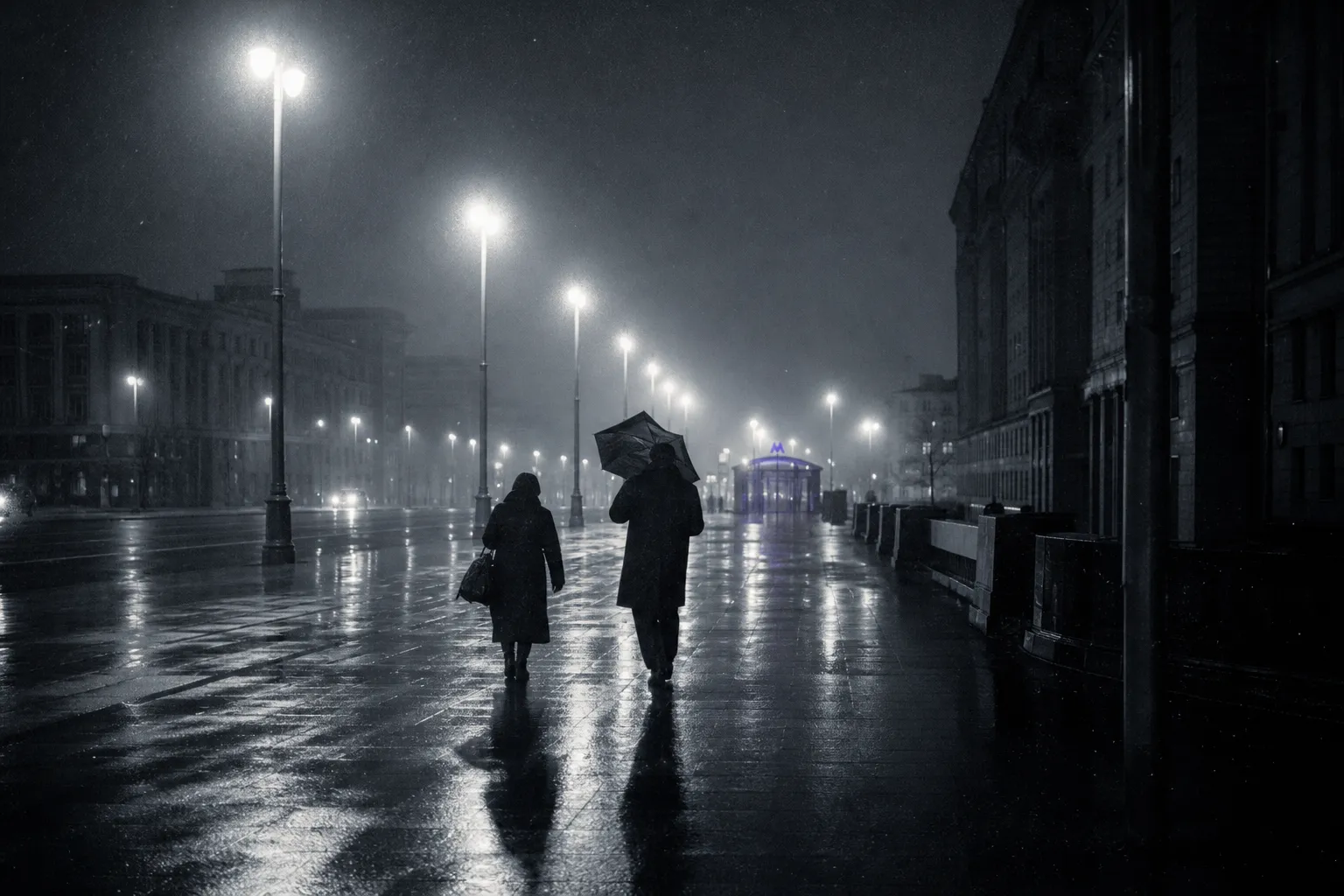
I caught up with Lena at the entrance. She was battling an umbrella. The umbrella had the upper hand.
— Want a ride?
— I’ll walk with you to the metro. If you promise not to say the word “qubits.”
— What about “quantum”?
— Also no.
— “Correlation”?
— Dan.
— Fine. Let’s talk about the weather. It’s terrible.
— Finally, a normal conversation.
We walked down Vavilov Street. In Moscow in November, at six p.m., this means some alternative aggregate state of gloom settles in around you — the sensation that someone in the cosmos hit “reduce brightness” and left their finger on the button. A mist of water hung in the air — humidity that had, for its own reasons, decided to go vertical. (Moscow doesn’t get rain from October to April. It gets this.)
As Lena talked about the Kazan conference, I nodded and watched the city, which greeted us with its usual set — streetlights, passing cars, people under umbrellas — normal and in place.
Then I felt it.
Imagine you’re listening to an orchestra: a hundred musicians on stage, each playing their part, and together it all adds up to music — you no longer pick out the individual instruments, you hear the whole. And suddenly an extra note sounds in that whole, one that isn’t in the score — a foreign one, as if someone invisible were standing behind the wall of the hall pressing with one finger on an instrument that has no business being in this score, in this hall, or in this century.
And your entire body — muscles, skin, spine — wants to pull away from that note. Because it understands what your head doesn’t: that note is a hole in the world.
We were approaching the intersection — a green light into which pedestrians had already started streaming, and Lena, not waiting for me, stepped off the curb first.
I grabbed her sleeve and yanked. My body did it half a second before my brain understood why.
— What the fu—
A truck.
It passed in silence, heavy, with no horn at all — half a meter from us, blasting wind in our faces — and the wet asphalt behind it hissed like a skillet.
Then — somewhere further — impact, screech, screams, a lamppost, the driver behind the wheel (alive), a crowd, phones. Someone filming (the standard Homo sapiens response to near-death in the twenty-first century: film it, post it, collect hearts; anthropologists of the future would weep, if they had tear ducts, but I suspect the anthropologists of the future won’t).
Lena went white and gripped my sleeve. Five seconds of silence.
— How did you know?
I stared at the truck.
— Dan. How did you know?
I turned, looked her in the eyes.
I didn’t see the truck, Lena. The truck wasn’t visible. It flew around the corner, and we both know it. I saw something else. Two seconds before — the space ahead of us assembled. As if the intersection was a construction, and in that construction, a hole appeared. Black, jagged, wrong. And from it came that same thing — the extra note, foreign air, a draft from nowhere. My body understood. My hand pulled you.
Of course, I didn’t say any of that.
— Peripheral vision, — I said. — Headlights. Caught it from the corner of my eye.
We both knew there were no headlights. But civilization is built on the ability of two smart people to jointly ignore the obvious. We do it every day — with politics, with the climate, with the fact of our own mortality. One more lie, one less — the structure will hold.
— Okay, — Lena said.
We walked to the metro. At the entrance, she turned around.
— Thank you, Dan.
— Uh-huh.
— And... maybe talk to someone? Not in the sense of... well. You know.
Wonderful formulation. “Talk to someone.” “See a psychiatrist” — rude. “You need help” — direct. But “talk to someone” is a Russian euphemism that simultaneously expresses concern and absolves you of responsibility. “Talk to someone” — meaning someone who gets paid for it.
— I’m fine, Lena.
She left, not believing me for a second — which was hardly surprising.
I sat in the car and didn’t start the engine.
There’s this state — after adrenaline. The adrenaline leaves, and in its place comes a clinical clarity — cold, precise, like the light in an autopsy room: you see everything, and nothing you see is something you want to see.
I’d seen a fold. Not the first time.
First time — I was seven. Kitchen, crayons, a drawing (house, fence, tree, sun with rays — standard set, approved by child psychologists; if I’d drawn a house without windows, they’d have sent me to a different specialist, but I drew windows, and that saved me from early diagnosis). I was drawing — and suddenly started crying, so hard that I didn’t understand why myself. Dad: “What happened?” Me: “Mom’s gone missing.” Him: “She’s at work, she’ll be home tonight.”
She didn’t come home that night; nor the next day; later it turned out she never came home again at all, because there was no longer anyone to come. An accident, body never found, case closed. I was seven, and I heard all of this from behind the door, sitting on the hallway floor, hugging my mother’s slippers. The slippers were warm. They smelled like home. I thought: if I hold them tight enough, she’ll come back for them.
She didn’t come back.
(Twenty-one years. I still sometimes dream of the smell of those slippers. The brain is an astonishing machine: it forgets formulas you studied for a week, but remembers the smell of house slippers twenty-one years later. Maybe because formulas describe the world, and smell is the world. But that’s philosophy, and philosophy is what physicists do when the experiment isn’t working.)
Since then — once every few months, always the same: first the world goes thin for a second, like paper held up to light — you can see there’s something behind it; then the fold, quick, at the edge of vision, enough to flinch and not enough to understand.
At twelve, my father took me to a psychiatrist. Old guy on Barrikadnaya, office with a ficus plant, diploma on the wall, pen behind his ear. He listened for fifteen minutes (I timed it), then wrote a prescription. I stopped talking out loud. I started — in ru_psiho on LiveJournal, and in the comments under a Lurkmore article on dissociative disorder, written by someone who, judging from the text, was seeing the same things. Didn’t stop seeing. The difference between “curing” and “shutting up” is the difference between surgery and a Band-Aid. But the Band-Aid is cheaper, and you can prescribe it in fifteen minutes.
At fifteen I found something entirely different. A kid from New Jersey, three years older than me, took an iPhone apart over summer vacation and pulled the corporate lock off it. By himself. It landed on Habr, and Habr wrote about it in a way that made it clear: this is the language in which the world can be taken apart. Every locked box is waiting for a screwdriver. A thought formed in me that I couldn’t yet formulate. All systems are dismantleable.
At sixteen, I found my own explanation. Kahneman. Rapid unconscious data processing. The brain reads thousands of micro-signals and produces a “premonition.” No mysticism. Pure neurobiology.
I lived with that explanation for twelve years. More precisely, I pretended to live with it, because a good lie — convenient, rational, with the right terminology and the right authors in the bibliography — works exactly up to the moment when someone (usually you, usually around four in the morning) asks one follow-up question.
For example, this one: what “micro-signals” could a seven-year-old read a full day before the event, from across the city, through a crayon drawing of a house with a fence?
Twelve years I didn’t ask that question. Or rather, I did ask it — but in a low voice and not addressed to myself — so that I could turn away from the answer before it could form. Today it asked itself, and turning away didn’t work.
I started the car.
On the radio — forecast: minus two Celsius, snow, northwest wind. Normal world, in which everyone is alive, the truck is stuck in a lamppost, the driver is intact, and everything is fine.
At the parking lot exit, three traffic lights blinked — left to right, in a wave. Click. Click. Click. As if someone was checking whether they worked.
I blinked — red, red, red, all in place.
That is, I just closed and opened my eyes. “Blinked” is the word I picked later, after the fact, and I picked precisely “blinked,” even though “squinted” and “screwed shut” were just as handy in the dictionary: “blinked” is when something has time to slip past between the closing and the opening. What exactly, I didn’t ask the dark cabin. I just drove home.
I drove home, thinking that “normality” is a diagnosis. Nobody issues it, because everyone has it. And what everyone has is called the norm. Perfect circular logic. Aristotle would approve.
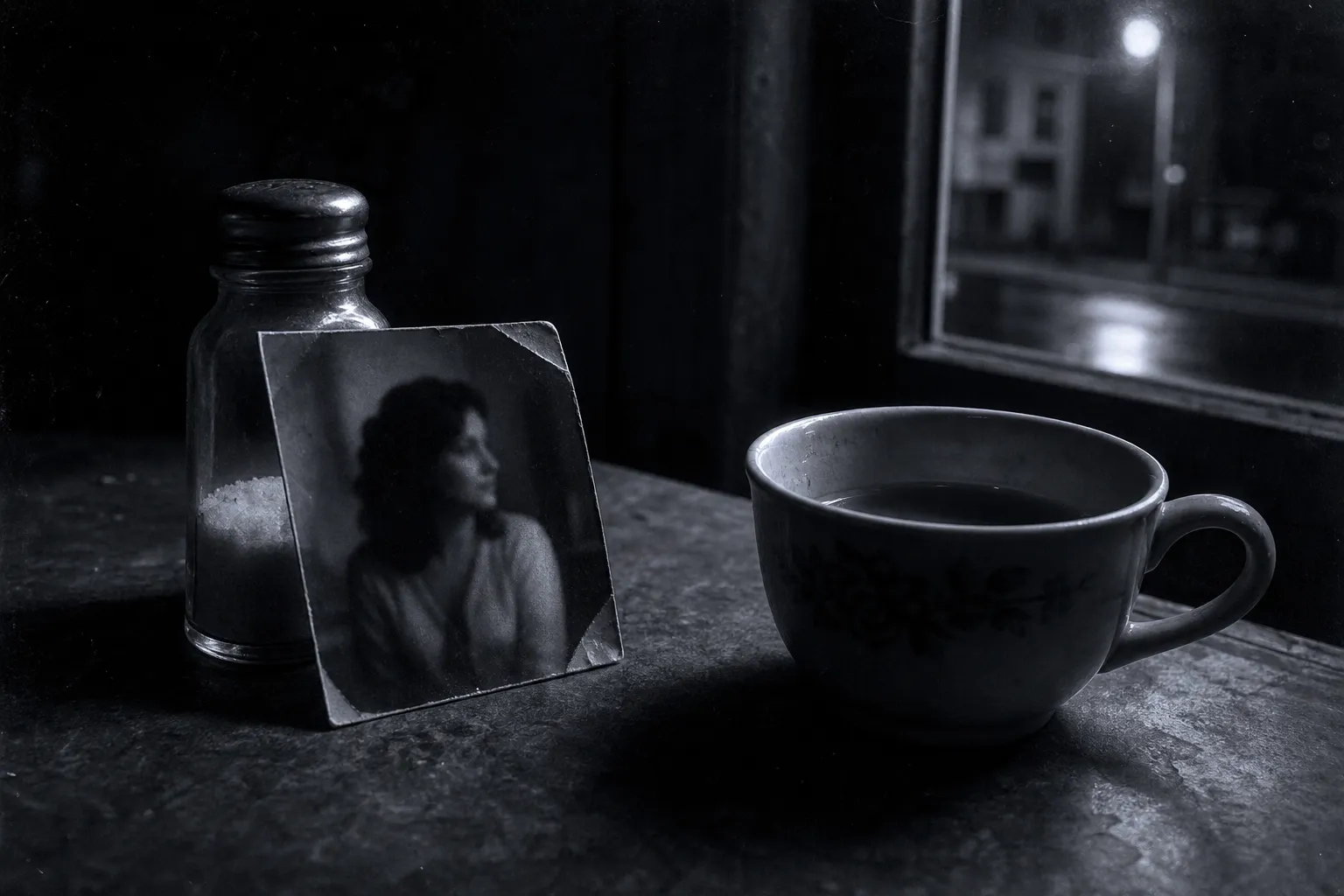
Apartment. Shabolovka. A studio. Fourth year here. Books (one-third read), a monitor (worth more than everything else combined), a mug with a broken handle (I won’t throw it away; the reason is the subject of a separate psychoanalytic investigation I have no intention of conducting).
On the kitchen table — a photograph. Paper, with a bent corner, leaning against the salt shaker. A woman with dark hair. Eyes that look through the camera. At something behind the photographer. Or behind the photograph. Or behind reality altogether.
Mom. Irina Reinova. Missing. Twenty-one years.
I stood at the window with tea and thought.
Strictly speaking, I have two options. Which is already suspicious — that there are exactly two, that they’re symmetrical, like a pair of shoes in a box, and that I’m running through them in an order I didn’t come up with myself; someone has laid out the cards for me ahead of time and is now offering me the one that’s more convenient for them.
Though.
Option one: I’m a well-trained neurotic with apophenia and a fast subconscious processor, and I need a decent psychiatrist, someone under fifty, without a ficus, with the understanding that phenazepam isn’t the answer to “why do I see things I don’t see.” A convenient option, honest, rational, with the right surname on the office door. I’d pick it myself, if I knew how.
Option two: I see something real. Something in the build of events themselves, in the stitching, in the way they’re sewn together — and then my Kahneman explanation is anesthesia; and anesthesia is a finite thing, it works exactly up to the moment the surgeon says “done,” and you hear your own pulse for the first time in your life, not from under the wool.
There is, of course, a third option — but I don’t have a third option, because I haven’t yet invented a language for it, and somewhere between university and the PhD I forgot how to think without a language.
Phone.
“Got home. Thanks again. Seriously, Dan — talk to someone. Lena”
I didn’t reply. Because the only honest reply would’ve been: “Lena, there’s nobody to talk to. The person it would make sense to talk to would have to see the same thing I do. And those people, apparently, don’t exist.”
Although — how would I know? Maybe there are half a million of us. Maybe all of Moscow is lying in the dark right now thinking: “why does it seem like the world is being assembled on the fly?” But everyone stays quiet, because everyone’s sure they’re the only one. And silence — that’s also a form of social contract: we’ve all agreed not to notice what we notice, and to call it “normality.”
The thought was stupid. But it wouldn’t leave. It settled into a corner of my mind like a stray cat: you fed it once, and now it lives here. You know this. It knows this. Neither of you plans to do anything about it.
I turned off the light. Lay down.
I dreamed of the intersection. All the traffic lights were green. All the cars drove in every direction simultaneously and passed through each other like holograms. Or like thoughts. Or like events that hadn’t yet decided whether to happen or not.
In the middle of the intersection stood a person. I couldn’t see the face, but I knew — he was looking at me. And he knew me. Had for a long time.
He said — or thought, or simply was the thought:
“Enough.”
A single word, and nothing followed it.
I woke up at four a.m. Outside the window — snow. First of the year. Quiet, vertical. It settled on the city in an even, unbroken blanket, and I lay in the dark and thought: enough — enough what? Enough pretending? Enough being afraid? Enough living? And — suddenly — a fourth, for which I no longer had a verb, and even if I had, I wouldn’t have spoken it aloud.
No answer. More accurately, the answer was there, but it was sitting in the corner of the room I deliberately don’t look at at four a.m.; to a specific question you can give a specific answer, and to a vague one you can only lie in the dark and listen to snow rustling on the windowsill and think: maybe Mom saw the same thing. Maybe she lay like this too. And at some point she got up and walked. Toward. Toward what she saw. Toward what she could no longer not see.
And didn’t come back.
I closed my eyes. Tried to sleep.
Couldn’t.