02
The Thing That Doesn't Happen Fourteen Times in a Row
The next three days I spent in a state psychologists call “cognitive dissonance” and normal people call “fuck this, but there’s no alternative.”
The qubits behaved themselves. Lena didn’t ask questions. The elevator didn’t work. The coffee machine alternated between life and death at a frequency I tried, out of boredom, to model as a sinusoid (failed: R-squared 0.41 — even the coffee machine in our institute doesn’t obey mathematics). The universe had reverted to factory settings, and I decided that maybe, after all, it was option one: I’m a neurotic with apophenia, I need a decent psychiatrist and regular meals.
The factory settings held until Thursday.
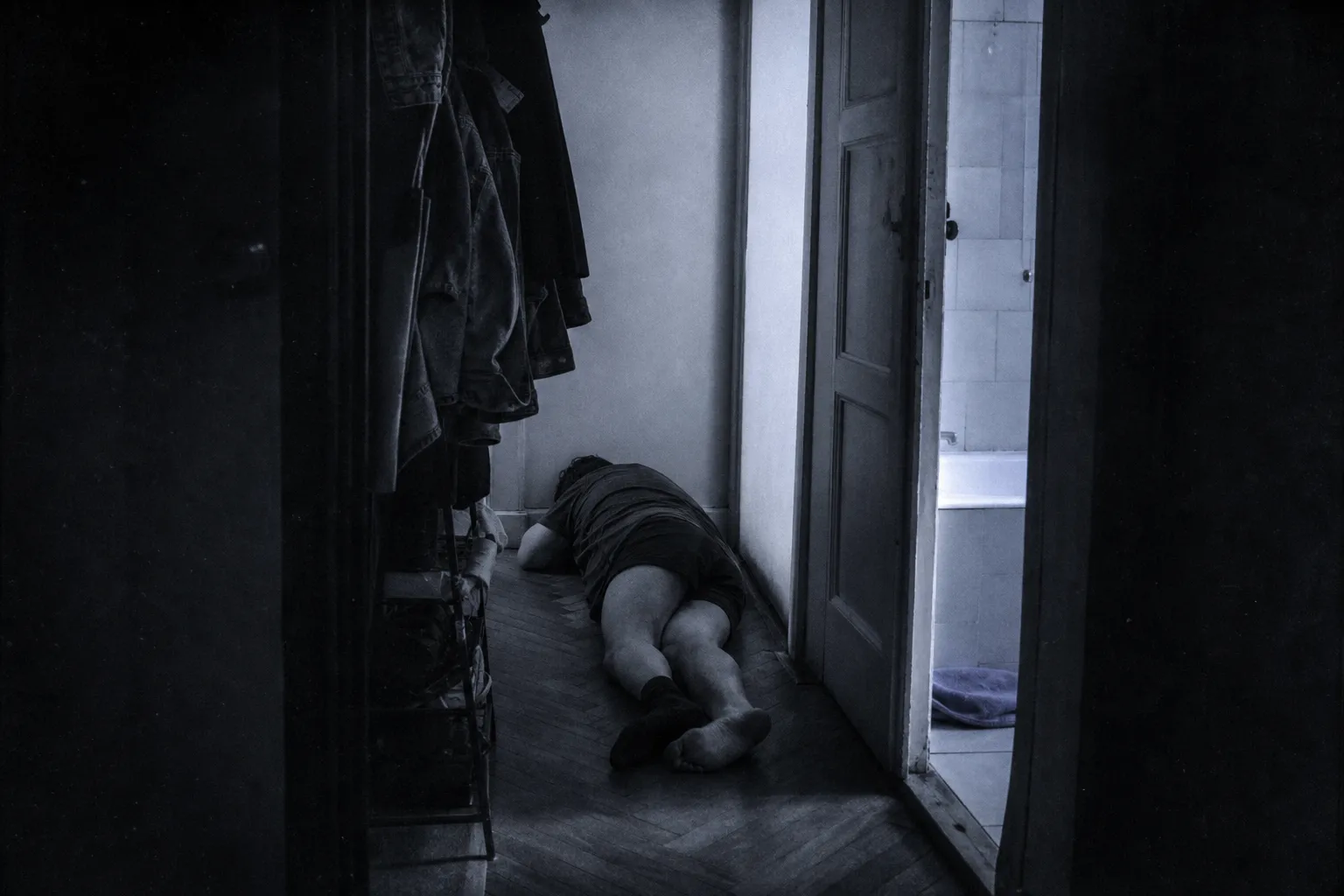
I woke up on the hallway floor.
Let me repeat that for anyone reading carelessly (including me, re-reading this notebook): I woke up on the floor. In the hallway. Between the coat rack and the bathroom door. In my underwear and one sock (left; where the right one went is one of those mysteries of existence that, unlike quantum entanglement, genuinely has no solution). With a pillow I’d apparently grabbed on my way out, the way a four-year-old grabs a stuffed bear — except I’m twenty-eight, and I haven’t had a stuffed bear since my father decided a boy my age should manage without plush toys. (I was six. The bear’s name was Professor. I still haven’t forgiven him.)
The last thing I remembered was lying in bed counting cracks in the ceiling. Eleven. I’d counted them three times, because if there’s one thing I do worse than anything else in life, it’s shutting my brain off before sleep. Other people count sheep. I count cracks, formulas, worst-case scenarios, and the number of days since I last called my father (eighteen; we just got tired of each other, the way two people who love each other but have absolutely no idea how to say it get tired).
The hallway mirror showed me a man I’d be afraid to encounter in a dark alley. Unpredictable. He had the eyes of someone who hadn’t slept in a long time and hadn’t been sure for a long time why he wakes up.
Sleepwalking, a neurologist would say. Happens with stress. I’d had it as a kid: my father told me that once I got up, walked to the kitchen, opened the fridge, stood in front of it for a minute, closed it, and went back to bed. Dad figured I was hungry. When I found out, I figured I was checking whether the fridge was still there. The difference in interpretation is the difference between a physicist and a normal person. A normal person explains behavior with motive. A physicist questions the stability of the environment.
But then something happened that made sleepwalking the least of my problems.
I was standing in the shower. Water running down my back. Brain hadn’t booted yet (for the first ten minutes after waking, I function roughly at the level of a toaster: capable of one operation, but anything requiring meaning should wait).
And then I saw my lab.
Saw it. Literally. As if someone switched the channel: one second it’s tile, steam, and water — the next it’s three monitors, blue screen glow, and my desk. On the screen — a graph that wasn’t there yesterday: blue line, exponential growth, then — a break. A clean break: the line goes up and stops, as if someone took scissors and cut off the rest.
It lasted one and a half seconds. Then — tile, steam, water.
I stood gripping the faucet, eyes closed. Heart pounding, water running, world in place.
Here I need to make an important note about the nature of hallucinations (or, if you prefer, visions — the difference between them is, strictly speaking, determined by the social status of the person having them: if you’re a saint, it’s a vision; if you’re a physics PhD on Shabolovka, it’s a hallucination). So, about the nature. A hallucination, by definition, is perceiving something that isn’t there. You see a spider on the wall, there’s no spider, you’re hallucinating. Simple.
But what if you see a spider on the wall, and then you go to work and find a spider on the wall?
That’s something else. And psychiatry doesn’t have a term for that something else, because psychiatry, like any self-respecting science, only works with phenomena it has a box for. No box — no phenomenon. Elegant. Efficient. Completely useless.
I drove to the institute in twenty-three minutes (traffic in November Moscow is its own form of meditation: you sit, you don’t move, you can’t affect anything, and all you can do is observe your thoughts; if the Buddha ever lived in Moscow, he reached enlightenment on the Third Ring Road during rush hour).
I climbed to the seventh floor. Turned on the monitors. Opened the overnight logs.
Blue line with exponential growth and a break — the same graph I’d seen in the shower forty minutes ago.
When the impossible is confirmed, the brain still tries to explain it. It physically cannot accept “this is impossible, but it happened.” It starts spinning: maybe you saw a similar graph before and forgot. Maybe your subconscious extrapolated the trend. Maybe you’re still asleep. Maybe it’s déjà vu.
The brain is an explanation machine. It searches for a version that will let it keep running. Like an operating system that on a crash generates an error message, logs it, and moves on. The blue screen of death is a report that death was avoided. For now.
I sat in front of the screen and for the first time in my life didn’t want to know the answer. More precisely, I wanted to know — like any physicist — but for the first time I wanted the answer to be boring.
— Hardware fault, — Lena said.
She was standing behind my shoulder, looking at the same graph, and had already made up her mind. That’s what I love about Lena (and what simultaneously drives me insane): she never panics. You could show her an equation proving the universe ends next Tuesday, and she’d say: “Check the boundary conditions.”
— Exponential growth of coherence in a closed system. Physically impossible. Therefore, error.
— And the break?
— Buffer overflow. Or a reset when the scale limit was exceeded. Call Seryozha.
Seryozha is our engineer. A man capable of fixing the Large Hadron Collider with electrical tape, three swear words, and a soldering iron he carries in his breast pocket the way others carry a pen. (I once asked him why the soldering iron in the pocket. He looked at me like I was slow and answered: “You don’t have one?” Question closed.) If the problem is hardware — Seryozha will find it. If the problem isn’t hardware — Seryozha will still find something, because in our institute there is always something to fix, and this fills his life with meaning, which the rest of us have to find in publications.
Seryozha checked the sensors. Fine.
Lena checked the calibration. Fine.
I checked the code. Fine.
We reran the series three times. Results — stable, normal, boring. Like yesterday. The anomalous graph stood in the overnight logs alone, like graffiti on a temple wall: out of place, inexplicable, and somehow insulting to the surrounding architecture.
— Isolated artifact, — Lena declared. — Not reproducible. Therefore, doesn’t exist.
Okay. Right here, at this point, I want to stop and talk about something important. Not about qubits, not about graphs, not about my issues with perceiving reality. About science.
“Not reproducible — therefore, doesn’t exist.” This is the fundamental principle of the scientific method. The cornerstone. The holy of holies. Any physicist utters this phrase with the same reverence a believer utters the Creed.
And this is — if you stop to think about it — the most elegant method humanity has devised for not noticing what doesn’t fit the picture.
Think about it. Your first love isn’t reproducible. The moment of your birth isn’t reproducible. Your death certainly isn’t reproducible. But try saying they don’t exist. Your entire life is an isolated artifact: a one-time, non-reproducible event that, by strict scientific criteria, lacks statistical significance.
Science is a contract: we deal only with what repeats. Everything else — not our department. That’s why science brilliantly describes the laws by which apples fall but is utterly helpless before the question of why you climbed that apple tree. Laws are reproducible. Meaning isn’t. Therefore, meaning doesn’t exist. Q.E.D. Applause, Nobel Prize, banquet.
But I got sidetracked. Back to my qubits, which also, apparently, don’t exist.
At lunch I went outside. I needed to stop being inside a building that houses equipment that shows me things I’d already seen before seeing them. (Reread that sentence. Three nested clauses. Recursion. Maybe that’s the structure of my problem — infinite nesting that at some point starts consuming itself.)
Coffee from the stand on the corner. Real coffee, without the aftertaste of budget constraints and shattered dreams. A bench in the small park. November had stopped pretending to be autumn and started rehearsing winter: trees stood bare, puddles had a thin film of ice, and the air had that specific Moscow freshness that makes you want to emigrate.
I sat, drank coffee, and tried not to think. Failing. “Don’t think” is like “don’t scratch”: the very attempt intensifies the itch. Buddhists claim you can achieve a state of “no-mind.” I claim Buddhists never worked with quantum computing.
Fine — I’ll go through the facts.
Fact one: I see events “assembling” before they happen. Confirmed: the truck at the intersection. Witness: Lena Markova, PhD, mentally sound.
Fact two: I saw a graph in the shower forty minutes before I found it in the data. Witnesses: none. But the data’s right there.
Fact three: the frequency is increasing. Before — once every few months. Now — twice in four days. If you extrapolate (a pointless exercise, but physicists can’t not extrapolate — it’s like asking a cat not to catch mice: she understands what you’re saying but considers your request absurd) — if you extrapolate, in two weeks I’ll be seeing event assembly in real time. Constantly. Everything.
I went cold. November had nothing to do with it.
— Excuse me, is this seat taken?
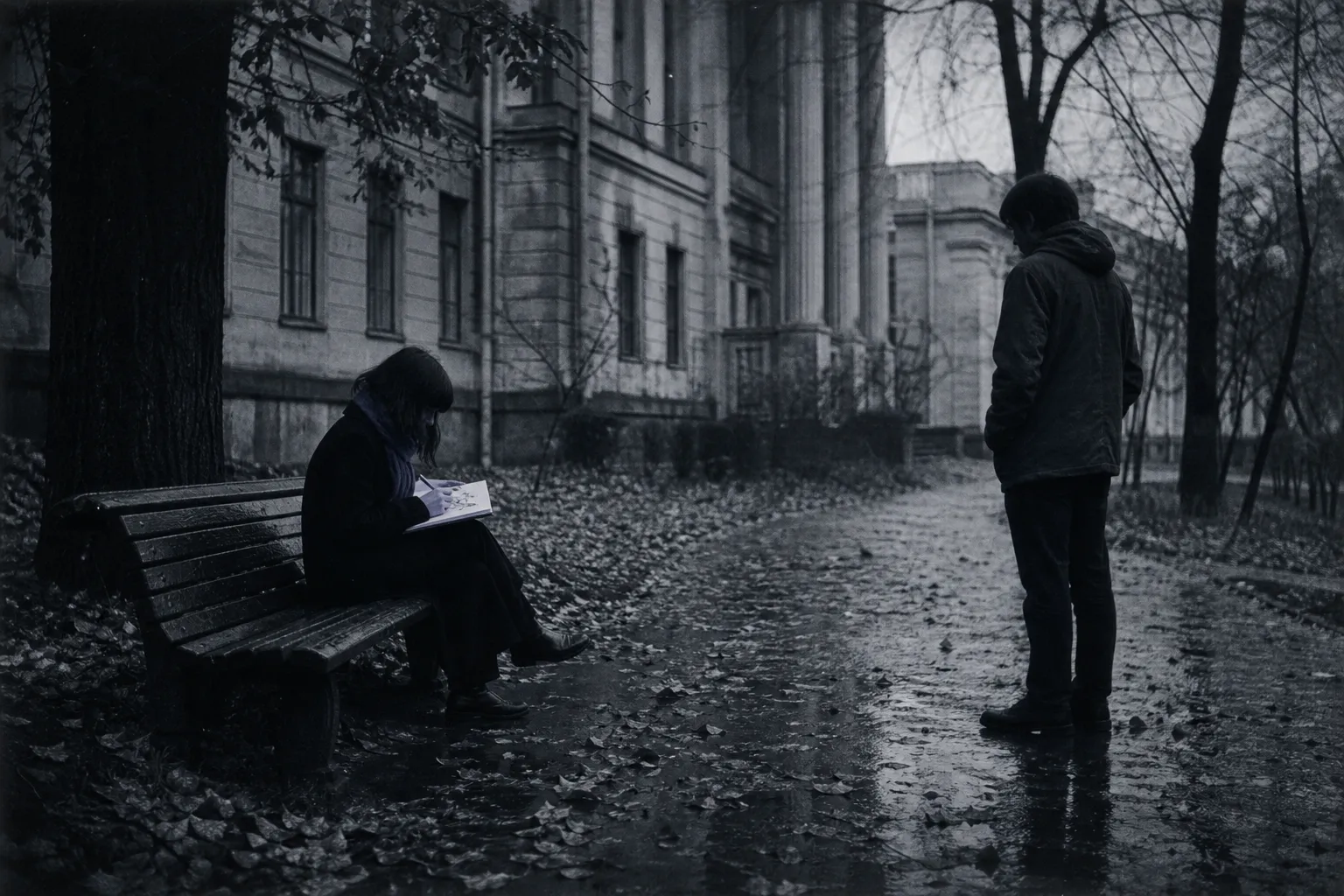
I looked up.
A girl. Maybe twenty-four, twenty-five. Dark hair, bangs, eyes — big, dark, with an expression I couldn’t read (and I usually read people fairly well; occupational hazard: if you’ve spent twenty years hiding from everyone that you see impossible things, you learn to read faces). Coat too thin for November. In her hands — a notebook. Paper.
In 2026, a paper notebook is either hipster affectation or a symptom. No third option. Actually, there is a third: someone who has things to write down and doesn’t want them in the cloud. In five years Snowden turned the paranoid into the hygienist. By 2026 the average Muscovite carried three things in his pocket in case of failure: a main messenger, a backup messenger on a different workaround network, and a physical notebook, for the cases when the first two fail at once. Distrusting the cloud had become as everyday a gesture as washing your hands. But some people still choose to write only on paper. Also a symptom — just of a different condition.
— It’s free, — I said.
She sat down next to me. Half a meter away, in defiance of the unwritten code of Moscow public seating (paragraph 3, section 7: “Strangers must sit at maximum distance from each other; violation punishable by stare”). As if personal space were a concept she was familiar with but didn’t consider binding. Roughly how I feel about traffic laws.
We sat in silence. She drew in her notebook — quick, small strokes. I drank coffee and thought about how just a week ago I was a regular neurotic with a manageable set of problems, and now I was a neurotic who sees the future in the shower. Progress.
Then she said:
— You have an interesting field.
I turned.
— Excuse me?
— Field. — She didn’t look up from the notebook. — Around you. Prickly. Like you’re trying to be smaller than you are.
There’s a set of words that, when spoken by a stranger on the street, should make you immediately stand and leave. “Field” is one of them. Right alongside “energy,” “vibrations,” “chakras,” and “have you heard about our Lord?” These are marker-words: they tell you the person in front of you inhabits a reality with different rules, and the intersection of your realities threatens a loss of time, money, or sanity.
I should have stood up. I didn’t.
Because “trying to be smaller than you are” is a precise, painful, surgical diagnosis. That is exactly what I’ve been doing my entire life: making myself smaller. I see — and immediately talk myself into not seeing; I know — and find something on which to build the not-knowing; I feel — and keep the face of a man with nothing happening inside. For twenty-one years I’ve been compressing myself to fit inside a world too small for me, and she named it in one phrase.
— I don’t believe in “fields,” — I said. Automatically. Like an answering machine.
She looked up. Looked at me.
I’m not going to describe her gaze, because any description would be trite. “Deep eyes,” “penetrating gaze,” “windows to the soul” — all that literary garbage that makes you want to howl. I’ll say one thing: with most people, a gaze is a surface. You look into their eyes and you see eyes. Her gaze was an opening. Behind it was space. A lot of space.
— You’re a scientist? — she asked.
— Physicist.
— Quantum?
— Yes.
— Then you know the observer affects the system. — She smiled slightly. — You just think it only works in the lab.
Pause. My pause. Because she’d just described my problem more precisely than I’d managed in twelve years.
— And you... — I started.
— Nobody, — she closed the notebook. — I just see things. Like you. Only I stopped pretending I don’t a long time ago. Saves the nerves. Ruins your social life, but saves the nerves.
— How do you know that I...
She tilted her head. Looked at me with an expression I’d classify as “condescending sympathy” — roughly how a vet looks at a dog that’s brought a stick and is waiting for praise, not understanding that the stick isn’t an achievement.
— People like you are easy to spot, — she said. — You’re all the same. You walk carefully, like the floor might collapse. You’re always checking whether objects are real. You count the cracks in the ceiling.
Eleven. She couldn’t have known that.
— And you all do the same thing, — she continued, standing up. — You find an explanation and hide behind it. Kahneman, micro-signals, rapid unconscious data processing. Anesthesia. — She buttoned her absurdly thin coat. — Only anesthesia has an expiration date. And what’s underneath it — doesn’t.
— Wait. — I stood up too. — What’s your name?
— Zoya.
— Zoya, how do you...
— That’s not important. What’s important is something else. — She looked at me, serious, almost hard. No smile, no mysticism, no “aura” or “vibrations.” Like a doctor telling the truth because lying is no longer useful. — You’re going to have to choose. Soon. Stop seeing — or stop pretending. There is no third option.
And she left.
Just left — through the park, past the bare trees, into the November murk, leaving behind a complete absence of phone number, business card, and link to a Telegram channel called “Quantum Self Awakening.” Which, I have to admit, was the first argument in her favor.
On the bench lay her notebook. She’d left it. Accidentally? On purpose? In a world where events “assemble,” those words might mean the same thing.
I picked up the notebook. Opened it. On the last page — a drawing. Lines, nodes, intersections. Structural. Something between a neural network diagram and a star map drawn by someone who’d seen the stars from inside.
In the lab, I stashed the notebook in my desk drawer. Lena and I launched a new series. Standard protocol, tedium, routine. Seryozha had gone to lunch (Seryozha’s “lunch” is an elastic concept; he can eat for forty minutes or two hours, if along the way he encounters something that needs fixing; once he spent three and a half hours repairing the elevator and came back beaming, oil on his forehead, proclaiming that “it’ll work now”; the elevator worked. Once. Then broke again, but Seryozha said, “It doesn’t want to,” and the matter was closed).
Twenty minutes of normal work. Qubits doing what qubits are supposed to: cohering, decohering, collapsing — the whole standard repertoire. I relaxed. Maybe for the first time in a week.
On minute twenty-one, I thought about Zoya’s notebook.
By accident. The thought just flashed — the way thoughts do: you’re focused on work, and an image flickers through, unrelated. A face in a crowd. A smell. The pattern from the notebook — lines, nodes, intersections.
The system’s coherence spiked eighteen percent.
I didn’t immediately understand what had happened. Then I looked at the screen. Then at Lena. Lena was looking at the screen.
— What did you do? — she asked.
Voice flat. Too flat. Bad sign: when Lena starts controlling her intonation, it means what’s happening inside her is roughly what’s happening outside a volcanic eruption.
— Nothing.
— Eighteen percent, Dan. In one second. With no external input. That’s not “nothing.”
I thought about the notebook again — this time consciously and deliberately, forcing myself to hold every line, every node, every intersection in mind.
Coherence twitched. Plus two percent.
We both saw it — one screen, one dataset, two pairs of eyes; no possibility of writing it off as a glitch, subjective perception, apophenia, anxiety, micro-signals, or any other anesthetic from my medicine cabinet.
Silence. Five seconds.
— Interference, — Lena said. She was already checking the shielding. By hand. Physically. Like a surgeon who doesn’t trust the X-ray and palpates it herself. — Electromagnetic interference.
— Phone’s on the desk. Airplane mode. No watch. No earbuds.
— Then something external. Maybe Seryozha turned something on downstairs.
— Seryozha’s at lunch.
She checked the cables, the grounding, and the cooling. Everything fine. Everything, of course, fine. Everything is always fine. That’s the defining feature of my life: everything is always fine, except the results.
— We didn’t see this, — Lena said.
Quietly — to herself, not to me.
— Lena...
She turned. In her eyes — something worse than fear: understanding. She knew it wasn’t interference. She’s smart, remember? She actually understands what she’s thinking.
— Dan, — the grant, the review, Troitsky Variant: you understand what happens if we tell anyone?
I understood.
(And in that very second — I understood how much I wanted the decision to lie to come out of her voice and not mine; for Lena to be the first to say “we didn’t see this,” and then I’d just nod, shrug, and for the rest of my life be able to think, inwardly, that it was her who’d talked me into it, and I’d only gone along with the more rational person. That little internal accounting — who said it first, who agreed, who came out blameless — was already running inside me while I was still “understanding,” and I caught myself at it with the same shame with which one is caught eavesdropping on someone else’s conversation.)
A scientific reputation is a funny thing. You build it for decades: publications, conferences, citations, reviews. Brick by brick, like a wall. And then one brick is the wrong color — and the wall collapses; it turns out it was only standing because everyone agreed to call it a wall. Once the agreement breaks — that’s it. You’re not a physicist. You’re a crackpot. You’re the guy who “catches telepathy in qubits.” Worse than a criminal conviction: you can get out of prison, but you never come back from scientific disgrace.
— Fine, — I said. — We didn’t see it.
We worked until evening in silence. The qubits behaved flawlessly.
Of course.
(And I thought of another Seryozha. Not ours — a namesake who runs a YouTube channel called “Science Without Magic.” Three hundred thousand subscribers. Explains that quantum effects don’t scale to the macro world, consciousness is an epiphenomenon of neural activity, and anything that can’t be measured doesn’t exist. He’s right. Within the model they gave him in grad school — impeccably right. Seryozha Volkov is a fish who wrote a dissertation on hydrodynamics and now knows for certain that water doesn’t exist. His subscribers comment: “thank you for opening our eyes!” He gave them a scientific rationale not to open them. That really is worth a like.
Today Lena and I gave ourselves the same one.)
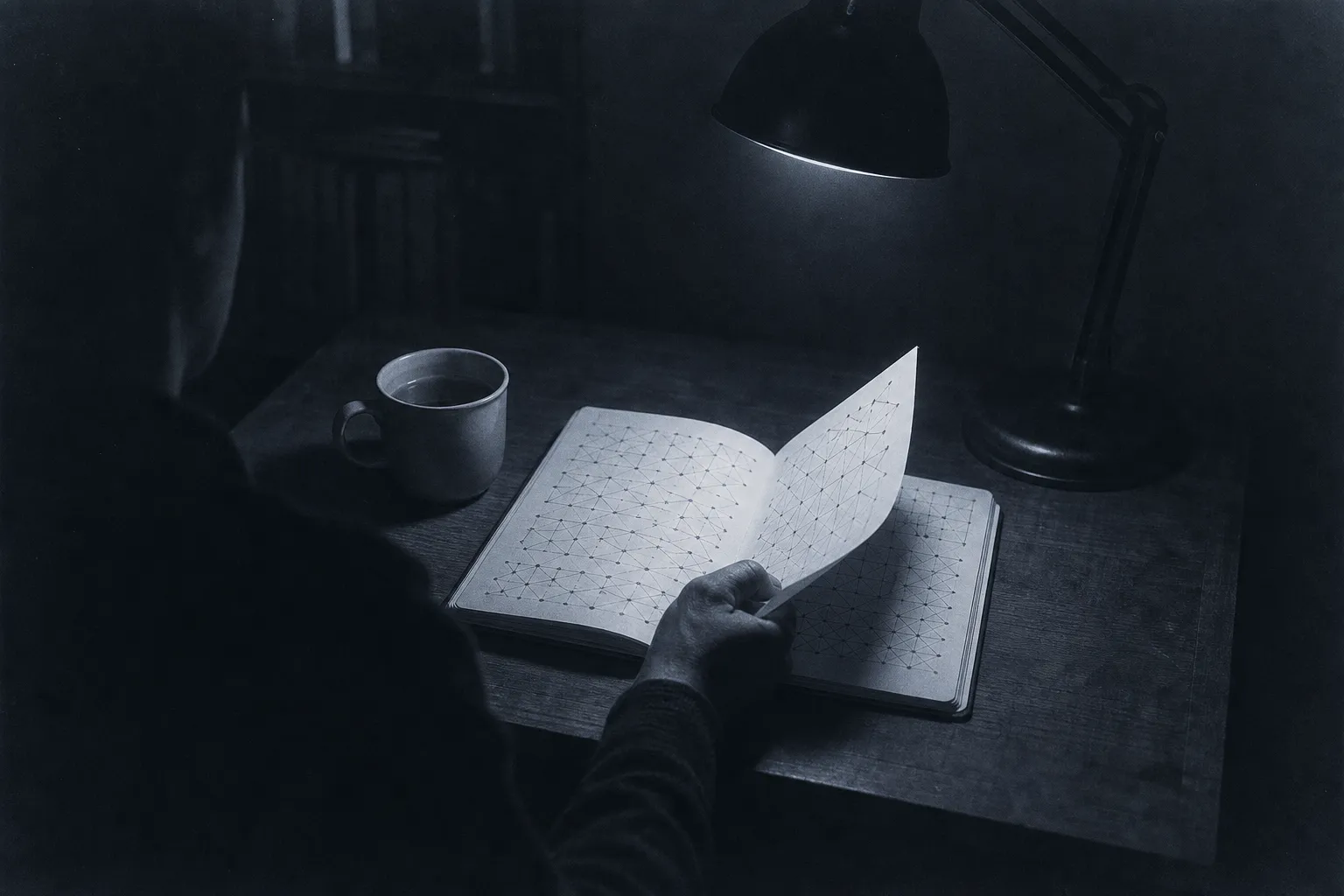
That evening I sat at home with Zoya’s notebook and tea I couldn’t taste.
Drawings. Page after page. The same elements — lines, nodes, intersections — but in different configurations. Like letters of one alphabet forming different words. I didn’t understand the language, but I felt the grammar — that strange sensation when you look at something unfamiliar and know with certainty that it follows rules, even though you can’t name a single one.
In the middle of the notebook — text. Small, angular handwriting, ballpoint pen:
“Events don’t happen. Events assemble. First — the form. Then — the cause. Then — the fact. We see the fact and invent the cause after the fact. And the form — nobody sees. Almost nobody.”
I read it three times.
Here’s the thing. The problem is that it was precise. Clever things are everywhere — bookstore shelves (the ones still standing) are bursting with clever things. But this was precise. This — exactly this — is how the thing I see works. An event builds. First comes the form — the frame, the blueprint, the markup. Then the cause: the world reverse-engineers a logical justification for a structure that’s already finished. Then the fact: the event manifests in reality, and everyone thinks it “happened.” As if by itself. As if it was always going to. As if the cause preceded the effect and wasn’t sketched in after the fact.
That’s what I saw at the intersection. The form. The scaffold of an event that had a hole in it.
That’s what I saw in the shower. The form of a graph that hadn’t “happened” yet.
Someone wrote this in ballpoint pen on crumpled paper, in a notebook left on a bench in a November park in Moscow. And that someone knew about me. And that someone left.
(In my teens I used to sit up at night picking up the Buzzer on shortwave — UVB-76, four thousand six hundred twenty-five kilohertz, the Leningrad Military District’s number station. Twenty-five tones a minute, uninterrupted, since the mid-seventies. Sometimes — once every six months — a voice: numbers, surnames, code words. I sat in my grandfather’s kitchen on his Okean-214 radio and listened for hours, not understanding what was pulling me there. Now I understand. That was form without fact too: something is happening, regularly, intentionally — and the event it refers to never appears. Only signal. I couldn’t formulate it then. Zoya, in her notebook, had the formulation.)
For a second, the apartment around me flickered. The walls themselves. Like an image on a monitor when the graphics card starts dying: everything’s in place, but for a split second you see the pixels. See the emptiness between them. See that everything you’re looking at is a picture. An image. A render.
Then it passed. The walls, the mug, Mom’s photograph — everything stayed in its place.
Did she see this too?
Phone. Unknown number.
— Daniil Reinov?
A man’s voice. Calm. His Russian was flawless, but — how to explain this — accented at the level of thought. As if the person was thinking in a language for which Russian was one possible interface. One of several.
— Who is this?
— You don’t know me. But I know you.
— If you’re selling something...
— Daniil, I know about the phenazepam, about the psychiatrist on Barrikadnaya — the office with the ficus, fifteen minutes — about the eleven cracks on your ceiling, about the truck on Vavilov Street, and about the graph you saw in the shower.
Silence. The kind of silence that comes when the world around you — the same one, the familiar one, all-in-place — quietly and irreversibly shifts. Just shifts. Like furniture in a room: everything’s the same, but it’s positioned slightly differently, and that “slightly” gives you chills.
— How do you...
— Observation, Daniil, long and thorough. — The voice carried no apology. Like a doctor reading test results: he didn’t cause the diagnosis, he’s just stating it. — You’re one of many we find. And — unfortunately — not everyone we find in time.
A pause. His. Heavy.
— You see events assembling, and you’ve seen it since you were seven; they told you you were sick, gave you pills; you stopped talking about it, but you didn’t stop seeing.
Pause. Mine. Because what he was saying, only I could have known: not my father, whom I’d stopped telling at twelve; not Lena, whom I’d never told; not the psychiatrist, who’d listened for fifteen minutes and written a prescription — none of them knew this.
— This is a beginning, Daniil. “Disease” and “bug” are a vocabulary you were issued for convenience.
— A beginning of what?
— That I won’t say over the phone. Tomorrow. Twelve o’clock. Neskuchny Garden. The rotunda.
— Why should I...
— You shouldn’t. You can not come. You can throw away the notebook. You can go back to Kahneman, to apophenia, to “statistical fluctuation.” The cork will hold for a while longer. — Pause. — But you already know it won’t hold. Don’t you?
He hung up.
I sat with the phone in my hand. Outside the window, snow was falling — slow, vertical, indifferent. The city was going white, like a blank page.
A normal person in my position would call the police. Or a friend. Or a psychiatrist (a real one, from across Moscow). A normal person would decide: scammer, stalker, cult. A normal person would not set an alarm for ten a.m.
But I am — as has been repeatedly stated and repeatedly confirmed — not a normal person. I’m a bug. A system error that spent twenty-one years pretending to be a feature.
And one more thing: he said “beginning.” And for twenty-one years, nobody had told me this could be the beginning of something. Everyone — from the psychiatrist to Kahneman — said it was the end of something: of health, of normality, of a career. That it needed to be cured, suppressed, explained, removed.
And he said — beginning.
One word. And it outweighed twelve years of phenazepam, apophenia, and “statistical fluctuation.”
I set the alarm for ten. Lay down. Closed my eyes.
Snow rustled evenly on the windowsill. Somewhere below, a car drove past. The city lived. Twenty million people slept, not knowing the world around them was assembling, like IKEA furniture — only the instructions were written in a language nobody reads.
Almost nobody.
I fell asleep.
I dreamed of nothing. For the first time in a week — nothing. Void. Silence. A blank screen.
Rereading this page in the notebook, I recognize in that void simply a quiet night in which, for the first time in years, not one of my usual thoughts caught up with me; and I no longer want to draw any beautiful conclusions from it.