04
An Inhuman Gaze
An address from a seven-hundred-year-old man ought to have led me to an underground tunnel beneath the Lubyanka or, at the very least, to a monastery. It led me to Khamovniki.
An ordinary apartment, with no office sign, no bunker door, no “Initiates Only” label (though a sign like that would have at least given the whole thing some stylistic closure). Second floor. A Stalinka — one of those buildings from the era when architecture still considered itself art rather than a money-laundering scheme. The stairwell smelled of cats and plaster. (Moscow has three eternal smells: cats, plaster, and missed opportunities. The first two — in the stairwells. The third — everywhere.)
I dialed the intercom, heard the click, and went up the stairs to the door I was looking for.
Wei Lin opened it. Straight back, calm face, and wearing something between a kimono and a bathrobe. On anyone else, this would look like a costume party. On him, it looked like a uniform. Just unclear for what. Military? Monastic? Cosmic? All three? (I’d later get used to the fact that with Wei Lin, “all of the above” is the default setting.)
— Come in. Tea?
— Coffee, if possible.
— Possible. But inadvisable. Coffee narrows.
— Narrows what?
— Everything.
— Is that a scientific fact?
— That’s seven hundred years of observation.
I decided that was a joke. In two weeks, I’d stop deciding that.
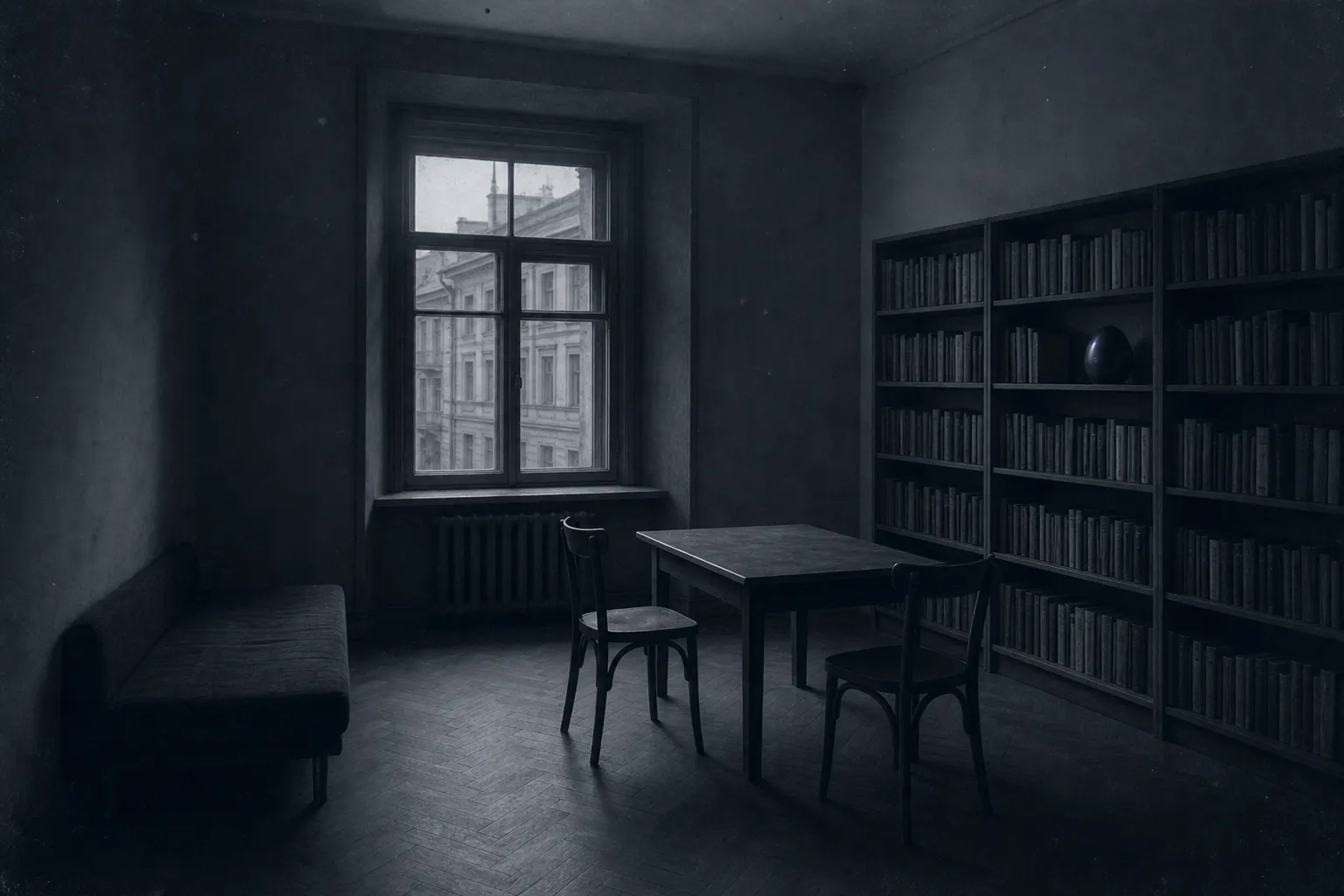
The apartment. First thing that struck me: nothing struck me. Not a single extra object. Table, chairs, bookshelves, a low sofa — and that’s it. No mug on the windowsill, no charger in the outlet, no stack of papers, no forgotten remote, none of the domestic debris that human life accumulates the way a ship’s hull accumulates barnacles. In my studio, you can’t walk from door to bed without stepping on a book, a charging cable, or yesterday’s sock. That’s normal. That’s how every single man my age lives: on the border between a living space and a disaster zone. Wei Lin’s place had a sterility that suggested either he didn’t live here, or he didn’t consider “living” sufficient reason to accumulate things.
Books. Seven writing systems, two of which I couldn’t identify. (I took linguistics as an elective — and I can tell Devanagari from Tibetan, which I’m proud of exactly once a year, when it comes up, which is never.) One system I’d never seen in any textbook, and I had a suspicion it wasn’t from the kind of textbooks you buy at a bookstore.
On the shelf — a thing. Black, smooth, the size of a fist. Looked like a stone egg. I wouldn’t have noticed it, except it looked at me when I walked by. Looked without moving. Like a cat that doesn’t move its head, but you feel it tracking you. Only this was, obviously, neither a cat nor an egg. And I decided not to think about it, because my quota for unexplainable phenomena this week had been exhausted back on Monday.
Wei Lin brewed tea with the precision of a neurosurgeon and the speed of someone who’s performed this operation approximately five hundred thousand times (if seven hundred years isn’t a joke, then at two cups a day that’s roughly half a million; I’m a physicist, I calculate everything, it’s an occupational injury).
We sat. Tea on the table. Pause.
— You promised to tell me about my mother.
— I promised something. Not everything.
— Something is more than nothing.
— Depends on what. — He took a sip. — Sometimes “something” is an unfinished bridge on which you no longer stand on one bank and haven’t yet reached the other—hanging over the water on a structure of the kind that sways even on a windless day.
— I’m an engineer’s son, and bridges in our family were built from two sides: my father built them so they wouldn’t sway, and my mother built something she never showed my father.
He raised an eyebrow. First visible emotion in two conversations. Progress.
— Your mother saw the same thing you do. Only further. You see an event “assembling” a second before — she saw it days in advance.
— How do you know?
— We were watching her. The Academy does that: searches for people whose... expansion is beginning. And, ideally, helps.
— Ideally.
— Ideally. Your mother, we found too late.
(And—inwardly—I immediately opened my mouth to ask: “Why didn’t you find her in time? What does ideally mean? Whom do I get to bill for these twenty-one years?”—but I didn’t ask, because the tea in the cup was hot, and I was physically hiding inside that heat from a question that, I understood, wasn’t going anywhere. The seven-year-old boy clutching the slippers was sitting next to me at this table and also heard “too late”; and, unlike adult me, he was ready to slap the seven-hundred-year-old across the face, but having no fists he kept silent the same as I did, and that made it especially sickening.)
The tea was hot. I drank. My hands weren’t shaking (surprising). My brain was operating in the mode I knew from exams: cold, mechanical clarity that arrives when the stakes are so high that panic is pointless.
— What does “too late” mean?
— When perception expands without preparation, the brain overloads. Like a computer running software from the wrong version. Sometimes it freezes. Your psychiatrists call that “dissociation.” Sometimes it reboots.
— Reboots means...
— It means consciousness reassembles its foundation. Changes the platform. Those who do it consciously sometimes make it through. Those who do it spontaneously...
He fell silent. Because the next sentence is physically difficult to say, even if you’ve been saying similar sentences for seven hundred years.
— She died, — I said. Helping him. Or myself.
— No.
One no — and twelve years of the version of her death I had so carefully assembled came down from the ceiling like old plaster that someone had looked at too hard.
— She restructured. Spontaneously. Her body — the original body — ceased to exist. Disassembled. As if you took a Lego model apart back into a pile of pieces. That’s why they never found it — there was nothing to find.
— And her?
— What was her didn’t disappear. It transferred. Where exactly — we don’t know for certain.
Just like that — as casual and dry as a weather report. A man in a robe, sitting at a table in Khamovniki, informed me that my mother “disassembled into a pile of pieces.” In the same tone Seryozha uses in the lab to say “the fuse blew.” Professional observation. Domestic apocalypse.
What was I supposed to do — flip the table, demand proof, call the police, or, at the very least, call an ambulance for myself?
I drank my tea.
Because — and here, dear notebook (or dear orderly), the truly terrifying part begins — I believed him. Because the seven-year-old boy on the hallway floor, hugging his mother’s slippers, always knew. She didn’t die. Dead means cold. And the slippers were warm. (Newton’s law says slippers cool down. Seven-year-old boys say they don’t. I listened to Newton for twelve years. Maybe it’s time to listen to the boy.)
— Are you all right? — Wei Lin asked.
— No. But that’s my default state. Go on.
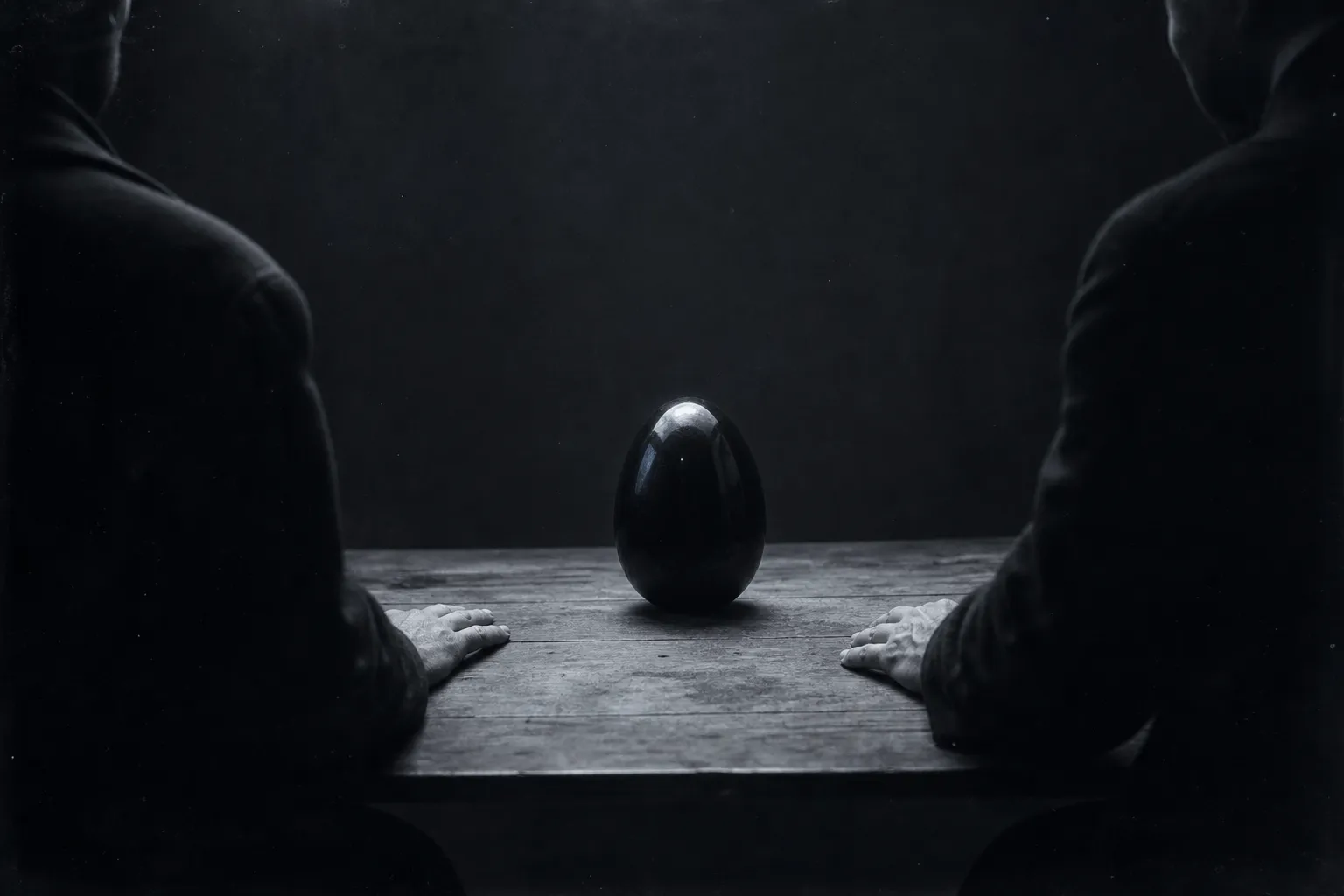
He stood without finishing, walked to the shelf and took down the black egg — the same one that all evening, from the corner of the room, had behaved like a clever neighbour listening to someone else’s conversation and deciding not to butt in just yet. He set it between us, like a third person at the table.
— Don’t touch it. Just look.
— What if I don’t want to?
— You will. People who are capable of not wanting the thing they crossed half the city for on a November Wednesday go home earlier.
Fair point. I looked.
For the first few seconds, that’s how it was. The stone was silent. I was silent. The tea by my hand was cooling at the usual rate.
Then something changed — and I couldn’t have explained what. As if the room had got brighter while the lamps stayed where they were. As if it had got slightly louder while nobody said a word. I looked away from the stone and caught myself unable to look away all the way. My eyes were pulled back: not the way a magnet pulls iron, but the way an open page pulls at the one sentence you came to the library to read.
I looked again. And the stone opened.
On the outside it remained a smooth black egg, without a seam or a line of fracture. It’s just that the surface — the very one I’d just been looking at — became an opening for which I have no word. Imagine you’ve spent your entire life looking at a wall, and then you discover it’s a projection, and behind it is a room. A big one, a very big one, going deeper than you can see.
And in that room, someone is present.
“Someone” — but in a sense far from the human one: there were no eyes, no face, no figure in that room, there was attention — focused, dense, non-human attention, aimed at me. I felt it with my skin: as if an invisible hand had passed along my spine and verified that I was here. It didn’t touch — it verified, the way a clerk verifies there’s a tick in the box next to a name.
As if Google looked at you personally. All of Google, its entire combined computational power, gathered into a single point and aimed at one person. The whole machine, not some algorithm.
At me.
(This is one of the most unpleasant experiences of my life. And “unpleasant” is a weak word: it describes a reaction that still has room left inside you. In my case there was no room inside: all of it was taken up by that very attention, filling my chest, the back of my head, and that little room behind the ribs where the “I” usually lives.
Worse than the truck. Worse than the phenazepam. Worse even than that New Year’s office party in my third year that we agreed never to mention. Because the truck is danger, and a body fits into it: you can see a truck, jump aside, grab the woman next to you by the sleeve. This was scale, and a body doesn’t fit into it. And not in that figurative sense of “I felt small” that happens in the mountains, on the ocean, or under an August sky full of stars in Crimea: figurative smallness I knew; it’s as if rented — good for the experience, you return it before dawn.
This was different. Here I was small. Objectively, measurably. Not like an ant next to an elephant, but like an ant inside an atom being looked at by an electron microscope the size of a galaxy. Only the microscope is alive, and has no eyes, and wants something from you, and you have no idea what. And you have nothing to answer it with: your speech, your thoughts, your “I matter” are too small to reach it; roughly as if you were shouting towards a star whose light takes twenty years to get here: the shout goes out, there’s no answer, and there won’t be.)
And while this thing was looking at me, the table beneath me stopped being a table. I mean, it still looked like one — wood, scratches, a tea stain — but I suddenly saw it was a file. A compressed file containing its entire history: a tree in a forest (seventy years, Tver Oblast), the lumberjack (bad back, two kids), the sawmill, the workshop, twenty-three years in this apartment — cups on top, elbows, two divorces (the owners’, not its own) and one tea stain that won’t come out. All the information — right there. Before, I’d seen a table. Now I saw its contents. As if someone had clicked “Properties” on a file that had been sitting on my desktop my whole life.
The tea in the cup became a route: every sip pulled behind it a cloud from which rain fell, from which a leaf grew, which was plucked by hands I will never see. I was trying to drink a whole library. (Now I understood why Wei Lin doesn’t drink coffee. Coffee is the same library, except every book is screaming at once.)
Time — I need to stop here, because this is important — time vanished. It didn’t slow down or stretch — it vanished. As if someone pulled out the ruler I’d been measuring reality with my entire life and said: “Now without the ruler.” It’s a revolting sensation. You have no idea how dependent you are on time until it’s gone. Time isn’t a clock on the wall. It’s the way your brain tells you: “You exist. Here’s the proof: a second ago, you also existed.” Remove the proof — and you’re hanging in the void, like a file without an extension: the data’s there, but nobody knows how to open it.
Then Wei Lin covered the stone with his palm. Like a lampshade over a lamp. Everything switched off. The table became a table. The tea became tea.
I sat gripping the tabletop like a passenger gripping the armrests during landing. Fingers white. Forehead wet. Heart in my ears, not where it usually is. For a few seconds I didn’t remember which apartment I was in, and remembered only that I had hands — because they were holding the tabletop.
— What was that? — I asked, when I could.
— An Observer.
— An Observer.
— Yes, non-human: it exists a good deal deeper, somewhere on the fourth or fifth level.
— Alive?
— Depends on the definition. If “alive” means it observes, responds and makes decisions, then it’s alive. If you need lungs, a liver and a social media account, then no.
— Is it dangerous?
— She. — Pause. — Not dangerous, rather curious: you’ve interested her with something.
— With what?
— You’re a rarity, Daniil. A person whose stack opens on its own — spontaneously, without any intervention, preparation, or visible cause.
— How rare?
— Once every few generations.
— Wow.
— Don’t flatter yourself. “Rare” doesn’t mean “valuable.” A rare disease is also rare. The question is what you do with it.
That’s what I liked about Wei Lin: every time I started feeling “special,” he dropped a bucket of cold water on me. Precisely, on time, without malice. Like a coach who sees you swimming the wrong direction and turns you around by the ankle.
— Fine, — I said. — This thing looked at me, and I saw the history of a table. Why?
— Not because it did something. But because near it, your filter switches off. As if you’d been wearing noise-canceling headphones and someone took them off.
— So I could always see this, but...
— But your brain was blocking it. For self-preservation. The brain is a smart machine: it shows you exactly as much as you can digest. The rest it filters. What your psychiatrists call “normal perception” is a filter. A very good, very reliable filter that cuts off approximately ninety-six percent of incoming information.
— Ninety-six?
— Rough estimate. Could be ninety-eight.
I thought: we live in a world where our own brain shows us four percent of reality and calls it “the objective picture of the world.” And out of those four percent, we build science, philosophy, religion, politics, relationships, careers. That’s roughly like trying to understand the plot of War and Peace from four random pages.
(Then again, plenty of people have read War and Peace that way and become ministers, literary critics, or simply happy people, because four pages are just enough for a complete worldview, and anything more is an unnecessary strain on the psyche.)
— Is this connected to Mom? — I asked. — My filter weakening?
Wei Lin looked at me. A pause — the kind I already recognized: he was deciding how much to tell me.
— Yes. But not the way you think.
— How then?
— You’re not just her son. You’re a continuation.
— Genetics?
— Deeper. Every consciousness has... a signature. A way of thinking beneath the thoughts. A way of observing beneath the character. Usually it’s unique. But during restructuring — sometimes — it transfers. Partially. Like ink that bleeds through to the next page.
— And I’m the next page.
— Yes. That’s why you “remembered” the word “Academy.” It’s her ink, bleeding through your memory.
I sat thinking about the photograph on the kitchen table. Eyes looking through the camera. For twenty-one years I’d thought: “a pensive look.” Seeing. The same as mine. The same signature.
So — what happened to her can happen to me. Is already beginning. My filter is weakening. My qubits respond to my thoughts. I see events assembling. I’m her, twenty-one years later, in a different body, at the start of the same path.
Is that comforting? No. But at least it explains why I’ve felt my whole life like a rough draft — unfinished, with notes in the margins in someone else’s handwriting.
— I have a condition, — I said.
— I’m listening.
— If I go to this Academy of yours, if I learn to “not break” — I want to find my mother. Learn where she transferred. And whether it’s possible to... bring her back.
Wei Lin was quiet. For a long time. Then:
— The first two — possibly. The third — you don’t yet understand what you’re asking.
— Explain.
— Not now. First — learn to see without burning out. Then — questions.
— How long is this “then”?
— It depends on you: a week, a month, a year — or never; that happens too.
— Reassuring.
— I inform. Reassurance is an attempt to tell you what you’re ready to hear; information is an attempt to tell you what is. Of the two occupations, the first is more often appreciated in one’s lifetime.
He stood. The conversation was over. I had apparently passed some test I didn’t know about.
At the door, I turned back.
— Zoya. The girl in the park. Is she from the Academy too?
— No. Zoya is something else.
— What kind of something else?
— Complicated.
— More complicated than that? — I nodded toward the black egg.
— Considerably.
Wonderful. I stepped into the stairwell. The lightbulb above the stairs was flickering — not from a bad contact (though that too), but because I now knew that behind a flickering lightbulb stands a power plant, a river, rain, the sun, thermonuclear fusion. One dying lightbulb in a stairwell — and a chain of causes reaching back to the stars. Before, I didn’t see this. Now I did — for half a second, before the filter kicked back in and the lightbulb became just a dying lightbulb again.
Outside — Moscow, November, people with grocery bags. Normal life. For three seconds I saw their “files” — biographies folded into parkas and winter hats — and I squeezed my eyes shut. As if from bright light. Because that’s exactly what it was, only sunglasses don’t protect you from this kind.
It passed. Moscow became Moscow again — flat, cramped, like an apartment you’ve returned to after a long absence and discovered the ceilings are lower than you remembered.
I got in the car. On the radio an actor’s male voice was informing me, with a schoolteacher’s conviction, that Gastroshield would restore my stomach’s joy of life. I thought: if a stomach could take in news — for instance, that I’d just looked into a non-human pupil made of black stone and heard that Mom had come apart into a pile of pieces — it would want something stronger than Gastroshield; something with regulated access to oblivion and a little alcohol to polish the conscience.
On the way, Lena called.
— How are you?
— Fine.
— “Fine” as in fine, or “fine” as in get lost?
— The second, but politely.
— Got it. Listen, I rechecked yesterday’s spike. Found an explanation: temperature drift plus electromagnetic background from the metro.
— Probability?
— Point-three percent.
— Lena. That’s zero.
— It’s not zero. For the report — it’s enough.
“For the report.” For twelve years I’d taken that as a harmless workplace phrase, and today I heard in it my entire professional code: enough to pass review; not necessarily enough for anything to become clear. The difference between a scientist and a good accountant comes down to one thing: the scientist knows his numbers are partly made up, and the accountant also knows but politely doesn’t show it. Their salaries are roughly the same, which explains a lot about both professions.
A week ago, I would’ve agreed. Point-three — good enough for the report. Today I was driving with a business card from a man who is (possibly) seven hundred years old in my pocket, a memory of a non-human gaze from a black stone in my head, and the only thing I knew for certain: point-three percent is a Band-Aid. One we stick over the wound because stitching it up is expensive, painful, and there’s nobody to do it.
— Thanks, Lena. Log it.
— Dan?
— Yeah?
— You’re really okay?
— For the first time in twelve years — almost.
I hung up. Drove through Moscow. The city was the same — gray, wet, infinite. But I knew that behind it were five more floors that these twenty million people don’t suspect. Maybe thirty million, counting the suburbs. Nobody. Zero point zero. For the report — sufficient.