03
A Debt
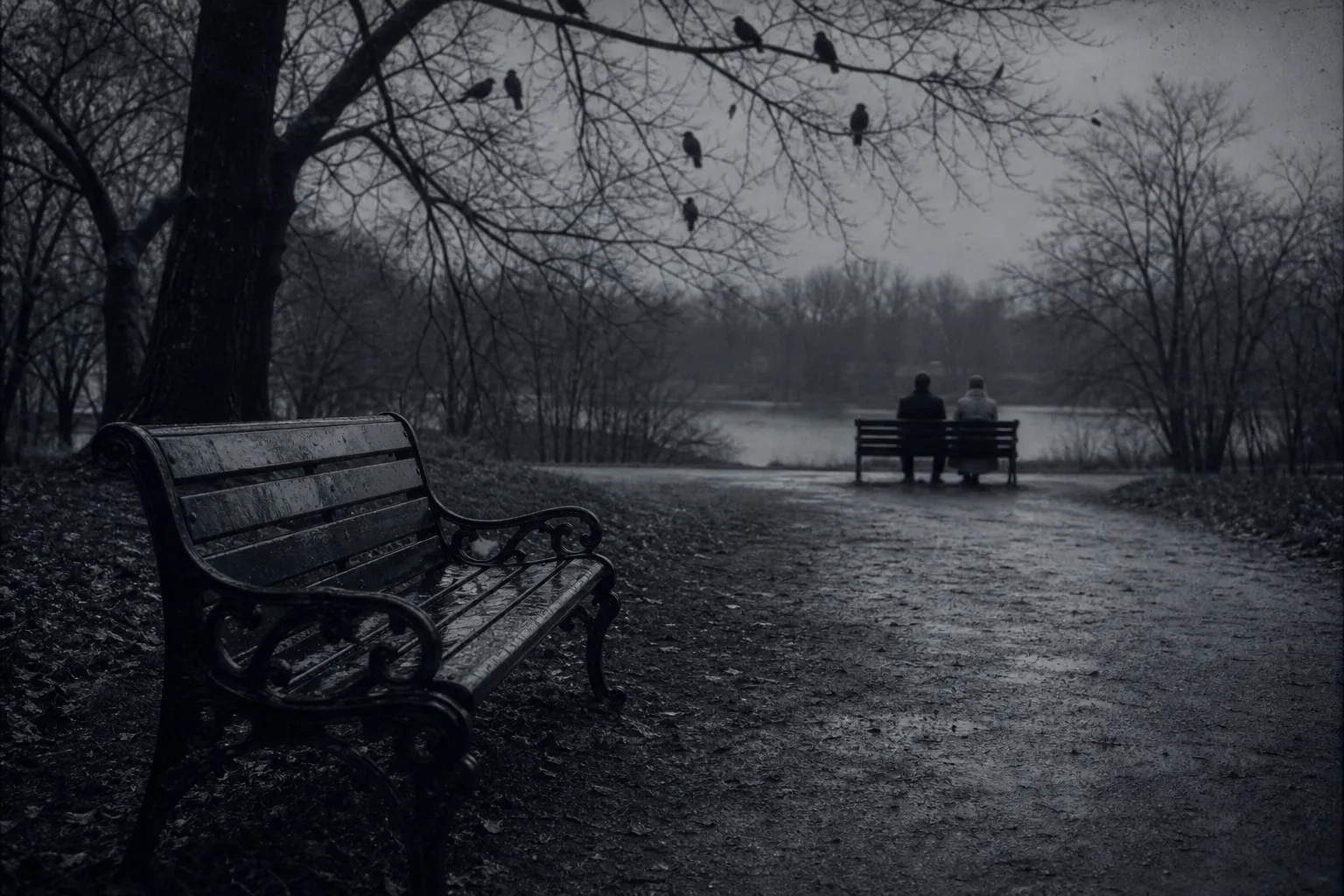
Neskuchny Garden in November is an oxymoron. Everything in it is “neskuchny” — the name means “not boring” — except the garden itself: bare trees, wet benches, crows that look like they personally witnessed the collapse of the Soviet Union and haven’t believed in anything since. The only entertainment is the joggers. Moscow has a special breed of people who run in minus-two weather in skin-tight pants with a facial expression that says: “I’m suffering, but it’s good for me.” Stoic philosophy, embodied in twenty-thousand-ruble sneakers.
I arrived fifteen minutes early, out of paranoia, wanting to look around and figure out in advance what I was getting into.
The rotunda — white, round, neoclassical — stood empty. Nobody around, unless you count the crows (three of them, on a branch above the rotunda, looking down with the expressions of elderly professors evaluating a thesis defense). I sat on a bench opposite. Pulled out my phone. Opened the news. Closed the news. Opened the messenger. Closed the messenger. Standard behavior of a person who’s waiting and doesn’t know what for: simulation of activity to avoid losing your mind from inactivity.
At five to twelve, I realized I was being watched.
An ordinary, prosaic, animal feeling: someone is looking at you. Your back muscles tense. Your neck wants to turn. Evolution hardwired this into us over a million years on the savanna, where those who didn’t feel a stranger’s gaze didn’t live long. We think we live in civilization, but our bodies still live on the savanna. The difference between us and ancient humans is roughly the difference between a wild cat and a house cat: same animal, just with a collar, a bell, and a diet of premium kibble.
I turned.
A man stood ten meters away, at the edge of the path. He was simply standing and looking, not even trying to hide. Dark coat over bare skin — no scarf, no gloves. Maybe fifty, maybe a bit older. Asian features, blurred — something mixed, unplaceable, one of those faces that could be from anywhere. Clean-shaven. Close-cropped hair. Straight back, calm hands.
I registered all this in two seconds. Professional habit: when you’ve spent twenty years expecting reality to pull something, you learn to assess a situation fast. Useful skill. Useless life.
But there was something else.
Around this person there was no draft, no “extra note,” no sensation of assembly, editing or rough draft; the space around him was even, calm and real: he stood on the world as an anchor around which everything else did arrange itself.
I’d never felt that before. Around people, there’s always a ripple: small, ambient, familiar — thoughts, emotions, intentions, fears, rocking the surrounding space the way wind rocks the surface of water. I’d gotten used to that ripple and stopped noticing it. But near him — silence. The kind of silence that makes you realize how loud everything else is.
He walked over and sat down beside me the way a man sits down in his own armchair, without asking permission, or even that ritual “is this seat free?” which in Moscow parks is implied by default. Or sits down on his own planet.
— Daniil, — he said. Not a question. A statement.
— You’re the one who called.
— Yes.
— And you’re going to tell me how you know about the phenazepam?
He tilted his head slightly. A gesture that on a normal person would mean “interesting question,” and on him meant — I’d understand later — “you’re asking the wrong question, but I’ll answer it because it’ll lead you to the right one.”
— My name is Wei, — he said. — Last name — Lin. If you need a last name.
— I need an explanation. Who are you? How did you find me? And why?
— Three questions. Let’s go in order. Who I am — long conversation, and I suggest we table it for later. How I found you — wrong question. Why — that’s the right one.
— Fine. Why?
— Because in the next few weeks, you’ll either lose your mind or understand what’s happening. There is no third option. I’d prefer the second.
This is where I should have stood up and walked away. This is textbook recruitment. I’ve read about cults: a stranger who “knows everything about you,” promises “answers,” offers “help.” In six months you’re selling your apartment and wiring money to an account in Panama. Classic playbook. Chapter one: “You’ve been found.” Chapter two: “You’re special.” Chapter three: “Sign here.”
But I didn’t stand up.
For two reasons. First: he knew about the phenazepam, the cracks, the graph in the shower. No cult has that kind of data (at least none I’m aware of; though, admittedly, my knowledge of cults is limited to a Netflix documentary and one bad date with a girl who turned out to be an acolyte of Hellinger Family Constellations — but that’s a separate story).
Second reason: the silence. Around him, it was quiet. Not acoustically — the crows kept cawing, the joggers kept suffering, Moscow kept humming. It was quiet inside. Near him, my permanent inner buzzing — that same anxious buzzing I carry around like underwear — suddenly became noticeable. Like how you get used to the smell of your own home and stop noticing it until you step outside for fresh air — that’s what happened with him: I suddenly felt how loudly I live. How much background I generate by the mere fact of my existence.
— Suppose I’m listening, — I said. — What’s happening?
— You’re seeing how events assemble.
— I know that already.
— No. You know that you see something. But you don’t know what exactly.
Pause. He wasn’t in any hurry. At all. As if he had an infinite amount of time and could afford to spend it on my questions.
(Later I’d realize that wasn’t “as if.”)
— All right, — I said. — What am I seeing?
— You’re seeing the stack.
— The stack?
— Imagine reality isn’t one thing but six things, layered on top of each other. Like floors. The top one — what everyone sees: the physical world, matter, energy, spacetime. Solid, stable, convincing. That’s the interface. A computer screen, if you like.
— If I like — what?
— If you like the analogy. — A shadow of a smile. First of the entire conversation. — Physicists love analogies.
— Physicists love data.
— Then here’s your data. Four days ago, you saw an intersection “assemble” a second before the accident. Yesterday you saw a graph in the shower forty minutes before it appeared in your data. Your qubits respond to your thoughts. — He looked at me. — This isn’t a disease, Daniil. It’s not apophenia. It’s — you’re beginning to see the second floor. The back side of the screen.
Any normal scientist would say: “That’s unscientific nonsense.” Any normal skeptic would say: “Prove it.” Any normal adult would say: “Show me some credentials.”
I said:
— What second floor?
And by the way I said it — “what floor, tell me more” — I understood I’d already made my decision. More precisely, the decision had been forming inside me for a long time, and I noticed it only now — somewhere between the phenazepam and this bench, between the seven-year-old boy with the slippers and the twenty-eight-year-old physicist with the notebook, I’d already decided: if anyone ever tells me the world isn’t built the way everyone thinks, I’ll hear them out. Because “the way everyone thinks” is a version I never truly believed.
(Here — a digression about everyday belief. The kind you use every day without noticing. You believe the chair you’re sitting in will hold. You believe the food in your fridge isn’t poisoned. You believe the sun will rise tomorrow. Not one of these things do you actually verify. You believe. And you call it “common sense.” And “common sense” is a set of untested assumptions on which your entire life rests. Like a building on stilts: every stilt an untested hypothesis, and if you suddenly test even one — and it turns out to be rotten — everything shifts.
Wei Lin had just offered to test a stilt. The deepest one: “the world is built the way I think.” And I — instead of refusing (because — who tests stilts? why? the building’s standing!) — said: “let’s do it.” Because that stilt had been wobbling since I was seven. And twenty-one years of pretending it wasn’t wobbling is more exhausting than finally looking at what’s wrong with it.)
Wei Lin looked at me. For a long time. With an expression that was the expression of no expression: controlled neutrality, behind which something was being calculated, evaluated, weighed.
— Have you ever wondered, — he said, — why galaxies look structurally similar to neural networks?
— It’s a visual coincidence. Scale invariance. Fractal patterns.
— Three answers, none of which is an explanation.
He was right. And I knew it. “Scale invariance” is a description of the fact, not its cause. It’s like being asked why it rains and answering: “Because water falls from the sky.” True. Useless.
— Fine, — I said. — What’s the real answer?
— The real answer: they look similar because they are the same structure. Not “similar to.” Not “reminiscent of.” Are. The brain is a neural network, and the universe is a neural network. Not a metaphor. A fact. The same organizing principle at different scales. And you, Daniil, are beginning to see this principle directly, without instruments as intermediaries.
I was silent. Because something was happening in my head for which I had no words. As if someone took the puzzle I’d been assembling for twenty years — pieces, scraps, fragments — and rotated it ninety degrees. And suddenly you could see that it was a picture: whole, coherent and meaningful.
A mother who “saw something” and didn’t come back; a truck that “assembled” before it appeared; qubits responding to thought; the notebook; the traffic lights; the seven-year-old boy who knew.
One system. One stack. And I was someone who was beginning to see how it’s built.
That was... you know what? It was something for which the English word is better than anything Russian has: dread. When you simultaneously understand that you’ve found the answer and understand that the answer is bigger than you.
Considerably bigger.
You know what’s interesting about the word “dread”? It cuts both ways: you’re terrified of the answer and at the same time can’t look away, like a car crash in the oncoming lane you don’t want to watch, but you watch. Because the brain is a greedy machine: it needs information, even the kind that will destroy it — especially that kind. And this is the main design flaw of Homo sapiens: we’re the only species that wants to know what will kill it. Every other species runs from danger; we run toward it with a notebook and a pencil and take notes until our last breath.
(Seryozha would say: “That’s a feature — just a feature for a user who hasn’t been invented yet.” Seryozha is an engineer. Engineers believe in features. Physicists believe in bugs. The difference is optimism.)
— Suppose, — I said (and my voice was steady, because I’m a physicist, and physicists die before they show they’re scared; that’s our professional pride, pointless and beautiful). — Suppose I see... the stack. Suppose it’s not a disease. Then what do I do with it?
— Learn.
— Learn what?
— How not to break.
I looked at him.
— Excuse me?
— What you’re seeing, Daniil, is the beginner level. First floor out of six. You see event assembly — that’s the minimum. Like a child starting to distinguish letters: he can’t read yet, but he already sees that signs aren’t patterns but words. You’re at that stage.
— And?
— And that stage is dangerous. Because your consciousness is expanding, but your ability to handle it is not. It’s like your monitor suddenly started showing ten times as many pixels, but the graphics card stayed the same. The result: overheating, artifacts and glitches in the frame.
— Sleepwalking, — I said.
— Sleepwalking, — he nodded. — Spontaneous visions. Blurring of boundaries between “here” and “there.” Loss of ability to distinguish memory from premonition. And then — if you don’t learn — collapse.
— Collapse of what?
— You.
One word. It hung in the air and didn’t leave.
— Nobody explained it to your mother. She saw the stack — and didn’t understand what she was dealing with. Didn’t know she needed help. Didn’t know there are people who can teach. And she walked toward what she saw — alone, unprepared.
— You know what happened to my mother?
It burst out of me. Twenty-one years. Slippers in the hallway. Case closed. Body never found.
Wei Lin looked at me. For the first time in the entire conversation, something human appeared in his face. Something more complex than sympathy. As if he knew the answer to my question, and the answer was the kind you can’t give sitting on a bench in a November park.
— I know part of it, — he said. — The rest you’ll learn yourself. When you’re ready.
— I’m ready now.
— No.
One word — with no arguments and no explanations. Just “no.” And something about how he said it — with absolute, granite certainty, stripped of both rudeness and condescension — made me go quiet. He knew exactly how much truth I could hold right now, and the amount was — not all of it.
A minute of silence. Crows cawed. A jogger ran past. Moscow lived. The world assembled around us, as usual — except now I saw it. Saw how the air between the trees was laid out slightly differently, how light fell “out of” objects, how space generated things, every second, continuously.
It lasted a few seconds. Then collapsed back into the ordinary picture: garden, trees, bench, man beside me.
— You just saw it, — Wei Lin said. — Second floor. For two seconds.
— What was that?
— The stack. Unfiltered. Your brain for a moment stopped constructing the familiar picture and showed you what is. Without interpretation.
— And you... you see this constantly?
— I see considerably more, — he said. Without boasting. As a fact. Like “I wear glasses” or “I speak Chinese.” — But I learned to. Over a long time. With help. And I had... — pause — ...those who explained.
— The Academy, — I said.
He turned. For the first time in the conversation — surprise. Real, unfeigned, for a fraction of a second.
— Where do you know that word from?
— I don’t know. It... — I fell silent, because I didn’t understand where it came from. It just arrived. The way a word arrives that you never learned but always knew. Like a melody you’ve never heard but can hum from the first note. — It just came to me.
Wei Lin was looking at me. And in his face I saw something I didn’t expect to see: interest. Alive, real, mixed with something I couldn’t identify.
(Much later, I’d understand that it was recognition.)
— The Academy, — he repeated quietly. — Yes. Exactly. — Pause. — Interesting that you know this.
— I don’t know it. I guessed.
— Daniil. In the stack, there is no “guessed.” There is — remembered.
I wanted to ask what that meant — “remembered.” What could I have remembered? From what life? From what layer? But he was already standing.
— This is enough for a first conversation, — he said. — You know you’re not sick. You know you see the stack. You know the word “Academy.” That’s enough.
— Enough for what?
— For you to make a decision.
— What decision?
— To come back. Or not.
He pulled a business card from his pocket. White. On it — just a phone number. No name, no title, no logo. The emptiest business card I’d ever seen.
— If you decide — call. If you don’t — don’t call. Keep the notebook. Zoya left it for you, not for me.
— You know Zoya?
— Zoya is a separate conversation.
He turned and walked down the path. Calmly, without looking back. Dark coat among bare trees. The crows watched him go and stayed silent. (Which, for Moscow crows, is the highest form of respect.)
I sat on the bench, holding a white business card with one number, and thought about how a normal person in my position would decide: crazy, con man, cultist. And go home. And forget it. And keep living.
But I’m not normal. That, by this point, should be obvious to everyone, including me.
He said: “Your mother saw the stack and walked toward what she saw — without preparation.”
Twenty-one years. Body never found, case closed.
What if it’s not closed?
I sat on the bench for another twenty minutes. Then drove home. On the way — nothing unusual: traffic, radio, snow. An ordinary November day in an ordinary city of an ordinary country that, admittedly, was never particularly ordinary.
At home, I took out Zoya’s notebook and Wei Lin’s card and laid them side by side on the table, then looked at Mom’s photograph. Three objects (notebook, card, photograph) and three doors: into someone else’s knowledge, into someone else’s world, into someone else’s — my own? — past life.
(Back in school I’d read about the Sklyarov case — a Russian programmer the FBI arrested in 2001 in Las Vegas at the DEF CON hacker conference, over a talk on Adobe e-book protection. He sat for a month and a half, got out under diplomatic pressure, returned to Russia, and never publicly broke anything for anyone again. That was the first time I understood: speaking out loud about other people’s locks is punishable. Now, twenty years later, I was looking at a notebook, a business card, and a photograph — three objects on a table, each with its own lock — and thinking that the one about to speak out loud was me.)
Then I did what any self-respecting scientist does when confronted with the inexplicable: I went online.
“Reality stack” — zero results, unless you count programming.
“Seeing events assemble” — articles about anxiety disorder. Useful if you want to confirm you’re sick. Useless if you want to understand.
“Academy” — five hundred million results. Not one useful.
“Consciousness awakening” — and here Google blossomed. Fourteen million results. Marathons, webinars, retreats. “Quantum consciousness leap — first module free!” “Awaken your potential in 21 days!” “Personal transformation: from victim to creator. Next cohort starts Monday.” Prices — from a hundred to two thousand dollars. Reviews — with photos from Bali: tanned people in white, with smiles that say “I found myself” and simultaneously “I lost my critical thinking.” One course — nine cohorts. Nine cohorts of four hundred people. Three thousand six hundred people paid real money for what Wei Lin told me for free on a bench in November. With one difference: after Wei Lin, my nose was bleeding and my hands were shaking. After the course — judging by the reviews — people experienced a deep sense of satisfaction and a promo code for the next cohort at fifteen percent off. Maybe they’re charlatans — or maybe it’s a brilliant business model: take something that in the original kills and rebirths you, water it down to room temperature, add candles, neuro-music, and a homework PDF — and sell subscriptions. If you could sell death without dying, they’d monetize that too. Then again, I thought, that is their product.
“Reality stack” led me after a few minutes to a three-hundred-and-twenty-page PDF. No cover. No author name (the field was empty, as if the person who wrote it had decided that a name was a superfluous identifier). Four mentions across the entire internet: one in a 2012 ham-radio forum archive (last post 2015, dead link beyond), one in the comments under an article on a closed Habr clone, one on a site that looked like the warmed-over corpse of a 2008 LiveJournal community, and one in the index of a pirated scientific-publications archive, under a number that wouldn’t open without a circumvention network. I opened it. Read the first chapter.
Closed it, opened it again, and read it once more — slower.
The PDF was... strange. In the literal way. It described the universe as a neural network. As a fact, not a metaphor. The same structures, the same connection patterns, the same architecture at different scales. And the author wasn’t crazy: cited real studies, real data, real mathematics. Just drew conclusions from them that no reviewer would pass in a reputable journal.
But the conclusions matched what Wei Lin had said. Word for word. As if the PDF and the conversation were written from the same outline.
I sat at the table, staring at the screen, and thought: what if this isn’t a coincidence? What if there’s knowledge — real, structured, testable knowledge — that exists but doesn’t fit into any of the existing sciences? Not physics, not neurobiology, not psychiatry, not philosophy? What if it’s seeping through — through books, through strange men on park benches, through girls with notebooks, through men with blank business cards — seeping into a world that’s desperately trying not to notice it?
And what if my mother found it before me?
A message popped up on my phone screen — Lena.
“Are you coming in today?”
I looked at the clock — two-thirty, the middle of the workday. I’m a physicist, an institute employee, a PhD, and I have qubits, a grant, and a review in two months.
“Sick,” I typed.
First lie to Lena in my life, not counting “I slept.”
(And—looking at the sent “sick”—I noticed that nothing tightened in my stomach, that lying turned out to be as easy as writing “thanks”—and that ease scared me more than the lie itself, because I was already mentally trying on a second round: if needed, I’d say something about a fever, then about a neurologist, then about a relative—and each next lie, I understood, would cost me even less than the one before.)
A lie. I was, possibly, beginning to recover for the first time in my life. Only recovery, I suspected, was going to be worse than any illness.
I picked up the card. Dialed the number.
Three rings.
— Listening, — Wei Lin’s voice.
— I’ll come, — I said. — But I have a condition.
— What condition?
— Tell me about my mother.
The pause dragged on — I could hear wind behind his window (or behind his — what?).
— All right, — he said. — But not right away. And not everything. And you’ll wish you hadn’t asked.
— I already wish I hadn’t, — I said. — About a lot of things. That’s no reason to stop.
— Then tomorrow. Nine a.m. I’ll send the address.
He hung up. I stood by the window with the phone in my hand. Outside, snow was falling — for the third time that week. Moscow was going white. Trees, rooftops, cars — everything being covered in white, as if the city were being carefully erased.
I thought: Wei Lin is probably right, and in a week or a month I’ll regret this call. It was a calm, grown-up thought, one I’d have been proud of if not for one small fact: somewhere under that calm grown-up thought, something childish and absurd was stirring in my chest, something very much like hope that the man on the other end of the line knew where Mom had gone, and that tomorrow I’d finally be able to ask someone about it.
I closed my eyes — behind my eyelids it was dark and quiet, as if inside an unsent letter.
The cork — the one I’d been using for twelve years to plug the hole — lay on the floor: I couldn’t push it back in, and honestly, I didn’t want to.