02
The First Wave
I showed up at the institute two days after my return from the Academy. Kira gave me exactly two days to sprawl on the couch in my socks and stare at the ceiling. On the third she said: “Schrödinger Junior has tried to lie on your face twice. Go to work before the cat decides you’re dead.”
(The cat, by the way, wasn’t checking my presence — he was checking my signature. When a subject lies motionless with open eyes for seven hours, the signature thins out, and the cat doesn’t like that. Schrödinger Junior, like his predecessor, has a built-in sensor for the subjectivity level of surrounding beings. Diagnostics: via attempting to lie on top. If the subject is alive, he pushes the cat off. If he stays lying there — the cat stays on top, and from his perspective, it’s already a funeral. Cats have a very simple protocol: at the start of the funeral they lie down, at the end they get up. Between these events, anywhere from ten minutes to several thousand years may pass — depending on the owner’s luck.)
I pulled on a sweater (in Moscow in October 2033, a sweater is a civic duty; refusal to wear a sweater is classified by public opinion as a hint at emigration) and walked to the bus stop. The metro didn’t take me: one of my passes was recognized by the turnstile, the other by the guard. I didn’t have the energy to explain to each that Academy bridge-keepers have two sets of documentation (one federal, one internal). I walked. Shabolovka — Vavilova — Building Seven. Twenty-three minutes.
The elevator at the institute was working. I looked at it the way an engineer looks at a suspiciously functioning reactor: if everything’s fine, something is compensating. There’s an unwritten law in the Soviet school of engineering: working equipment in an old building works on credit. Sooner or later the debt is collected — usually with interest and on the worst possible day. (This elevator at our institute has always been a barometer of how things stand: seven years ago it worked once every few months and each time predicted a catastrophe. Now, in 2033, it works daily. This means either the catastrophe is now permanent and we’ve gotten used to it, or the elevator has reached a new, more elegant way to cause trouble. Both options are equally likely.)
I went up to the seventh floor.
Lena Markova sat behind three monitors in a plaid shirt.
In 2028, if I remember correctly, she replaced the old shirt with an identical one, because someone had pulled a thread from the old one, and Lena declared that “wearing this shirt has become uncomfortable for metaphysical reasons.” Since then she buys plaid shirts in batches on Wildberries, five at a time, identical. But you know how it is: Lena in plaid is the same shirt for all eleven years of our acquaintance. Her invariant. Signature through textile.
— Oh, — she said, without turning around. — You’re alive.
— Alive.
— Kira called. Said if you didn’t come back by Thursday she’d ask me to come over and “do something.” I asked what exactly. She didn’t know. I don’t know either what exactly Kira had in mind, but I’m prepared to confirm: on Thursday I would have come.
— Today is Wednesday.
— Yes. You made it.
I sat down at my desk. Turned on the monitor. The lab journal program opened to the page with likes (for three years Seryozha has been trying to build a social network “for laboratories” into it; so far nobody likes anything except Seryozha himself, plus thirty-two likes from the admin account that he accidentally logged into from his phone). I gave Seryozha a like and looked at the qubit coherence graph for the previous week.
The graph was flat.
This is possibly the most terrifying thing I’ve seen in seven years of work.
Here’s the thing. Qubit coherence at our institute doesn’t know how to be flat. It’s its nature. It can rise, fall, pulse in rhythm with the experimenter’s breathing, correlate with lunar phases, with Lena’s diet, and — in certain cases — with elections to the State Duma (once in 2024 we got a statistically significant drift for the week, and Seryozha, looking at the logs, said: “so they’ve already started counting”). A qubit is a delicate creature that feels everything happening in the room, the hallway, Moscow, and apparently on Saturn. It is by nature and design forbidden from breathing evenly.
For the last week it had been breathing evenly.
I stood over this fact for thirty seconds. Then began to think about who to notify. Then remembered there was nobody to notify: seven years ago I’d promised myself I’d stop panicking over qubits. Qubits are a tiny hole in the stack, through which the light of the fourth floor seeps to the surface; if this hole suddenly closed and the lab qubits started behaving like obedient binary machines, it means — something somewhere else has buckled harder. That’s how compensation works in an open system. If one place calms down, another one cracks.
(I’ve known this logic since school. In ninth grade I had a physics teacher named Vinokurov. Vinokurov used to say: “if somewhere the water is calm, it means a dam burst on the other side of the world.” We didn’t like him because he repeated every remark twice. Twenty years have passed. The water is calm. Every day I think of Vinokurov and wait for a bulletin about the dam.)
(There’s also a beautiful hypothesis I’ve carried in my head since student years that nobody in big physics has yet definitively closed: ER=EPR, by Juan Maldacena and Leonard Susskind, 2013. Translation: an Einstein–Rosen wormhole is the same thing as Einstein–Podolsky–Rosen quantum entanglement. Not similar. The same thing. If they’re right, every quantum entanglement is a tiny wormhole, and my pair of qubits at the institute are two holes joined by a tunnel under the floor. Since the door opened, I’ve been reading this hypothesis more directly: distance doesn’t work for physics on the third floor, because distance is a property of the first floor.)
— Is your heating working? — asked Lena.
I checked the radiator. Warm.
— It’s working.
— Strange.
— Why?
— Because they shut off the heating on Shabolovka three days ago. The city says: “emergency shutdown, within a week.” But ours is working.
— Maybe the institute has a separate line?
Lena looked at me over the top of her monitor.
— Dan. We don’t have a separate line. We’ve been on district heating for twenty years. Since 2014 I’ve been writing applications to the housing office for a separate line. They keep saying they won’t give us one because the institute is “non-core.” This monologue fills twenty-three pages, and at the end — a fax. A real, paper one, with a courier.
— Then I don’t know.
— I do. Our heating works because Seryozha installed a heat exchanger in our server room. Three days ago.
— Where did Seryozha get a heat exchanger?
— Seryozha doesn’t explain. Seryozha installs. The question “where from” breaks the magic.
I laughed. For the first time in three days. It felt — good. The eighth of my facial nerve responsible for the ironic smile had withered over three days — and now felt as if it had been unfurled anew. Good news: this part recovers quickly. Bad news: each time it recovers with a slight shift, and so by thirty-five my ironic expression is no longer what it was at twenty-eight. It’s harder. And more asymmetrical. If you believe the photos Kira accidentally leaves in the shared folder, my left half is aging faster than the right. Causes unknown. My personal hypothesis: I’ve been assigning the left half more work duties than the right in recent years; the exact asymmetry will be determined by future anthropologists, should any exist.
Seryozha, by the way, materialized in the corridor at this exact second. That’s his mode of appearance: he doesn’t arrive, he is discovered. Standing there, as if he’d always been standing there, and only just became visible. In his breast pocket — a soldering iron (a different one now; the old one burned out in 2029 and Seryozha buried it ceremonially). In his hand — a chipped mug. All the porcelain in the institute is chipped; Lena says it’s occupational hazard — for quantum physicists, dishware cracks from observation alone. I’ve formulated it more gently: it doesn’t crack, it demonstrates solidarity. Our mugs crack to remind us that stability is an illusion. Our employees drink for the same reason. The difference between porcelain and employees — porcelain is cheaper to replace.
— Hey, — said Seryozha. — Alive?
— Alive.
— Good. The coffee machine is done.
— Done how?
— Done as in, — said Seryozha, — I’ve fixed it three times this morning and it’s messing with me. I fix it, it works for ten minutes, then dies. I fix it again — ten minutes again. It has a pattern, — he looked at Lena reproachfully, as if she were responsible. — It’s playing.
— The coffee machine isn’t playing, — said Lena automatically.
— Lena. The coffee machine. Is playing.
Seryozha retreated to the corridor. Through the open door you could hear him cursing the coffee machine with profanity that, if you listened closely, had a kind of symmetry: he swore with new constructions, never repeating. As if it mattered to him to reach the edge of the language and see what lay beyond.
(Seryozha’s invariant is in the way he swears. I’ve been listening for eight years. Eight years and not a single profanity repeated. For him this is professional honor: an engineer whose vocabulary repeats is an engineer whose work repeats. Seryozha tries to ensure neither repeats. What does he do between fixing a specific coffee machine and inventing a specific profanity? I think at that moment he holds the institute. Strictly physically, in the fifteenth sense of the word “holds”: I suspect Seryozha has long been the unofficial signature anchor of our laboratory, and if he ever quits, the institute, like a qubit, will stop behaving strangely and start behaving evenly. And evenly means general statistics will catch up with us, and we’ll become one of four thousand quantum technology labs in Eastern Europe. Seryozha doesn’t know this. Nobody told him. I won’t tell him. If Seryozha finds out he’s an anchor — he’ll bolt. That’s how anchors work.)
Lena was scrolling through news at that moment — an activity completely uncharacteristic for her, since she normally doesn’t open the news on the principle that “if anything important is going to reach me, it’ll reach me through Seryozha or through Dan, and anything that doesn’t reach me by that route isn’t worth opening.”
But now she was scrolling slowly, and from her shoulders I could see they were at one centimeter plus two millimeters.
Lena’s shoulders are a twelve-year-old indicator. Raised by half a centimeter — worry. By one centimeter — serious. By two — catastrophe. By three — Lena goes silent and disappears somewhere for about twenty minutes; nobody knows where exactly, but she comes back composed. At four centimeters the shoulders have never risen; I suspect at four Lena becomes invisible, like Zoya, and you can’t get her back to the lab. Four I don’t want. Half a centimeter and a centimeter I can handle.
(And a separate indicator: the right ear. Lena has a working configuration — one earbud in the right, the left ear free; music goes through the right, conversations nearby through the left. By what’s in her right ear today, I can often tell what process she’s in. Today it’s The Caretaker, an English musician under that pseudonym, Leyland Kirby, who spent six years writing six albums under the umbrella title Everywhere at the End of Time, one album per stage of Alzheimer’s. The first album — ballroom melodies from the thirties, slightly muted, with a faint film of fog. By the sixth — white noise, in which something that might once have been a melody briefly surfaces. Lena puts this cycle on as background when something is happening in her office that she privately calls collective forgetting in real time. Today, apparently, it’s happening again.)
— What? — I asked.
— In Moscow, — said Lena, not looking up from the screen, — over the past week — two hundred and seventy-four psychiatric consultations for... — she squinted — ...“unexplained expanded states of perception.” Diagnosis code — F 44.88. Added to ICD-11 specifically. Last November.
— Is two hundred and seventy-four a lot?
— In 2028 there were forty-two for the entire year. That’s official MSU statistics.
I sat and stared at my screen with its flat qubit coherence graph.
— Last month, — Lena continued, — eleven hundred. In September, the projection is about four thousand. Moscow alone. This is Rospotrebnadzor, not bloggers.
— Why Rospotrebnadzor?
— Because they’ve already started counting it as an epidemic.
Pause.
I looked at the ceiling. My office ceiling had no cracks — we’d painted it last year. Lena calls it “Operation Remove Eleven”: back then, a year before the door opened, I’d counted eleven cracks, and at some point Lena said she was tired of hearing about eleven cracks and scheduled a renovation in the budget. After the renovation the cracks went to zero, and I, in her words, walked around for a week looking like someone who’d been robbed.
(This is true. I’d gotten used to the cracks. They were my scale — a scale of how much reality I could hold between myself and the ceiling. Eleven could be counted. Zero — nothing to count. Zero cracks is scarier than eleven. Because eleven is a set, and sets can be counted. And zero is emptiness, and emptiness in the Russian school of engineering means somebody rolled back a change without protocol.)
Now I understood it was time to count something new. For instance — signatures in the room where I was sitting. By my internal clock, there were five signatures in the room right now: mine, Lena’s, the empty chair where our graduate student Vanya had sat in May (left his signature, went to the States to write a dissertation about the same thing I write in notebooks), the coffee machine (yes, old equipment with years of service develops a signature; forty years of operation and a coffee machine becomes a junior research fellow de facto), and something fifth, very faint, in the corner. I looked closer. The fifth was unfamiliar. That was unpleasant.
When an unfamiliar signature appears in the room, it usually means someone is about to knock on your door. And so it was.
¿Le gusta? Capítulos y experimentos nuevos en su correo
Como mucho una vez por semana. Sin registro; baja con un clic.
The door opened. A graduate student walked in. Face vaguely familiar (graduate students at our place change faster than the coffee machine), but he apparently remembered me better.
— Excuse me, Daniil Sergeevich. — His voice was thin, like a teenager who’d only just stopped cracking. — May I... I have a question.
— Go ahead.
He came in. Closed the door. Lena looked at him over the monitor — her over-the-top-of-the-monitor gaze has a scale from “don’t bother me” to “speak quickly,” and right now it was somewhere in the middle, closer to “speak quickly, but with respect.”
The graduate student stood there. Rubbed his eyes. Physically rubbed them — the way children do after sleep — but there was something wrong in the movement: not with his own hand, as if he were reaching to rub the eyes of a different person and ended up in his own.
— This morning something happened to me... I was riding the metro. And... for a minute I wasn’t myself.
I sat up a little straighter.
— Can you explain?
— I... I understand how this sounds. I understand perfectly. But I was standing in the car, at Akademicheskaya, and I suddenly... — he shook his hands — I realized that I could be any of these people. Any of them. I lost the... — he searched for a word, didn’t find it. — The difference between me and everyone else vanished. For thirty seconds. Then it came back. I got off at Shabolovskaya. Went into a bakery. Bought a bun. That put me back.
— The bun?
— The process of buying. Bought — the baker nodded — I walked out — ate. I — am a customer. That brought me back. But, Daniil Sergeevich...
He looked at me. Young, serious, very tired.
— ...this is the fourth time this week. And I don’t know what to do with it.
I studied him carefully. The faint signature from the corner — his. He couldn’t hold it in the body yet. At the Academy they call it drifting: the signature slips out of the chest and settles next to its owner like a droplet of mercury that doesn’t know which way to roll.
(This was the fourth such visitor this year. I mentally call them the Kostyas — after the current one. The first was Anton-from-PhysTech in February. Told the same story, only on a trolleybus on Leninsky Prospekt, and instead of a bun he had a shawarma. Second — Margarita from the materials lab, in June, in McDonald’s (she was eating a Big Mac and suddenly felt it wasn’t her mouth chewing it, but someone else’s — whose exactly, she didn’t specify). Third — Fyodor, a theoretical PhD student, in August, at a Spartak-Lokomotiv football match: during a corner kick Fyodor felt he was simultaneously all twenty-two thousand spectators in the stadium. He was lucky: he stood up from his seat, found a bathroom, cried, came back. That’s because Fyodor is stronger on individuality: the bathroom is private, and the private brought Fyodor back. Now the fourth. I understand the fifth will come on Thursday, the sixth next week, and it’ll continue until November, when we get a day off for National Unity Day, during which, rumor has it, twice as many people awaken, because national unity is also a sixth-floor signature, and on that day it actively switches on for many at once. The Institute of Awakening, I suspect, is getting ready for precisely this — setting up tents on Red Square with a sign reading “free expanded perception test.” I picture this scene in the evenings, and it makes me laugh.)
Lena stood up. Walked over. Looked at the graduate student.
— What’s your name?
— Kostya.
— Kostya, what you need right now, in this order. First — sleep eight hours, eat properly, turn off all social media for twenty-four hours. Second — do not sign up for Gleb Aristov, for Anastasia Tikhomirova’s Architect courses, or for anyone else on YouTube, no matter what they promise. Third: do not download the app “Signature”. It’ll show you a SIG-score, thirty-seven out of a hundred or forty-two, your pulse will rise, you’ll press “Consultation with Architect Pro,” and you’ll be in the National Signature Registry within twenty minutes. It’s a trap. Everyone steps into it now because the app is free.
Kostya shook his head:
— I... I downloaded it. Today. This morning.
— Did you go through registration?
— Yes.
Lena was silent for three seconds.
— All right. Fourth: after you sleep tonight, open the app, delete your account. In settings there’s a button, small, gray, at the bottom. It’s there by law, but they color it gray so you won’t find it. After deleting your account, the National Signature Registry stores your record for seven more years, but it resets the device binding. This is important. If someone at the passport office ever asks you “have you ever used Architect-1?”, you answer: “I registered as part of a sociological survey and annulled the device binding within 24 hours, which per § 11 clause 7 of my consent does not create legal consequences.” Memorize it. If you need me to — I’ll write it down.
— Write it down.
Lena wrote it on the same sheet. Fifth — in three days text her on Telegram if it happens again. She handed the sheet to Kostya. Kostya looked at me. Silently.
I nodded.
Kostya left, pressing the sheet to his chest like a medical certificate.
Lena sat back down.
— Did you notice? — said Lena.
— Notice what?
— I just referred him.
— Referred him.
— I’ve never in my life referred anyone before. I never had someone to refer to, Dan. I had a doctor from Lyuska, a lawyer from Vovka, and a plumber from my mother-in-law. And here — for the first time in my life I have a person I can send a graduate student with an unexplained expanded state of perception to. That, if you think about it, is a lot.
I looked at her.
— Who did you refer him to?
— To your Wei Lin, Dan. Who else would I refer him to. To the doctor at First City Hospital who’d put him on phenazepam? To Gleb Aristov for a hundred and nineteen thousand? I told Kostya that this “one person” is a doctor who understands specifically this. I didn’t lie. Wei Lin understands. His doctor status is conditional, but he understands. That’s what matters right now.
I said:
— Lena.
— Yes.
— You just gave me what you spent eight years not wanting to ask about.
— I know.
— How long?
— A while. About a year. Maybe a year and a half. I didn’t bring it up for a long time because your situation is your situation and mine is mine, and I didn’t want to intrude. But then Kostya, and I realized that dragging this rag any further was unethical.
Pause.
(Lena says “rag” when an ethical dilemma forms in her head that she doesn’t want to call an ethical dilemma. It’s her internal code. If you hear the word “rag” from Lena, she’s either talking about morals or about the budget, and you should keep listening. Over eleven years of acquaintance I’ve heard “rag” about fifteen times. Most often right before we move to the acknowledgments section of a paper and start fighting over whom to mention and whom to acknowledge with “we thank anonymous reviewer number two, whose comments made us think,” where think is the polite form of “we hate him.”)
She was sitting on the edge of the desk. That’s a rare position for her. Behind the monitors Lena is when everything’s in order. On the edge of the desk — when she’s about to say something that’s bigger than order.
— Is this starting for everyone now? Across the whole city?
I looked at her. Eleven years of acquaintance. Seven years after that November, during which I’d explained in general terms, with hints, pointed her to the PDF with no author, which she’d read in one evening and never mentioned since. She stayed silent. I didn’t push.
If I lie now, she’ll never ask again.
— Yes.
Lena nodded. Once, briefly. Like Wei Lin.
(I realized what this nod meant a second later. She hadn’t learned it from him. It’s structural. When you receive an answer that confirms what you already knew, a big gesture isn’t needed. A nod suffices. Lena didn’t learn this. It came with the answer, the way the Russian diminutive suffix comes to a noun: without comprehension, simply because the noun got smaller.)
She sat on the edge of the desk and looked at the floor for about thirty seconds.
Then said:
— And what do we do with it, Dan.
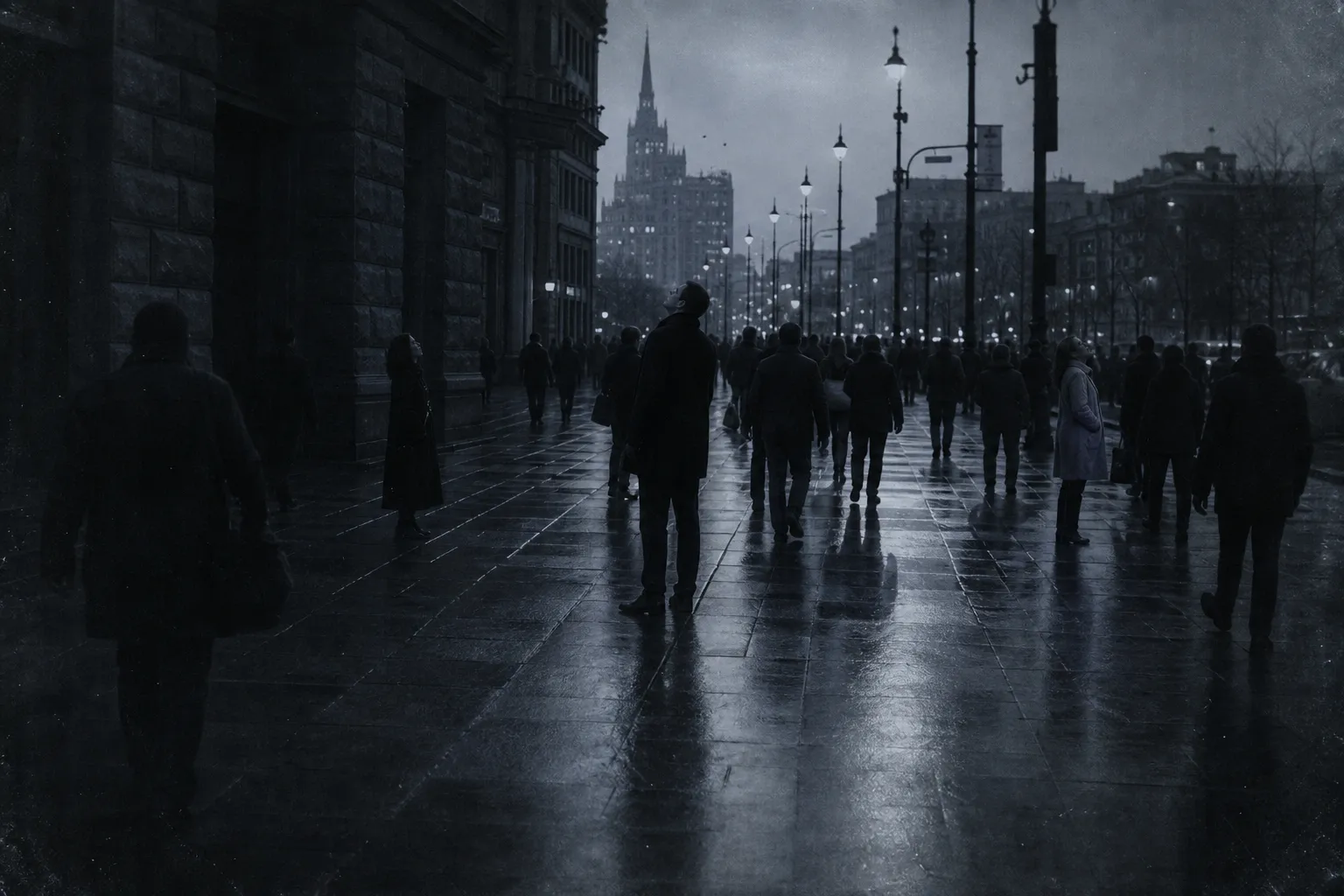
I didn’t answer right away.
To start — I didn’t know. No academy in the world knows what to do with three thousand awakened people per month in one city. Wei Lin works with individuals. Ordo is building a program that thinks it can handle thousands, but in practice it knows how to filter by passports, and a passport filter is exactly the thing that in the twenty-first century proved its complete uselessness on twenty live examples, from migration to taxes. Forsa eliminates. That’s her way. The most honest thing I can say to Lena is “I don’t know.”
To continue — I suspected that “I don’t know” was the answer she wanted from me. Lena can’t stand people who, in a “nobody knows” situation, act as if they know. Five years ago she left one such professor at the neighboring institute — left silently, overnight, texting Seryozha: “if they ask, say my conscience woke up.” That professor still talks about Lena at conferences in the tone of an aggrieved party: “young, ambitious, turned down a lab with a personal grant, I can’t imagine what her advisor is thinking.” Lena at those same conferences — is not present. Where she looks while sitting at home — only I and Seryozha know. I won’t tell.
I said:
— I don’t know. I know who roughly knows. And they don’t know how to do it for thousands. They know how to do it for one.
— Then, — Lena raised her eyes, — we need to learn how to do it for thousands.
— That’s...
— That’s me talking to myself, — she said. — I’m not dragging you in as coauthor. This is my topic now.
Pause. I looked at her.
— Lena.
— Yes.
— You’re a physicist. A quantum physicist who can calibrate a detector to the sixth decimal. You’re not a psychologist, not a psychiatrist, not a doctor, not a philosopher, not a cultural studies scholar, and in general you’re a person who in sophomore year retook the only philosophy course we had, with honors, saying: “I’d rather work with reality than with interpretations of reality.” I didn’t forget that.
— I didn’t forget either. And I’m about to tell you one thing. Three respected publications in this country in Physical Review, ten years of teaching, a reputation, and — the Markova Declaration, which has been sitting in Artyom Val’s safe at the Institute of Awakening since November 2032. He rereads it regularly. Told me himself when he called in July trying to convince me that “we’re on the same side.”
— Wait, — I said. — The Declaration — what is it?
— Six pages I wrote in response to their grant. An official refusal with an explanation of why I won’t participate in the program “Observation of Moscow’s Collective Causal Layer.” I didn’t show you the text because it would have made you angry. Those who needed to read it — read it. Now the Markova Declaration is an unofficial precedent at the Institute. It gets cited when someone on Ordo’s staff decides to resign. Galya from their ethics department told me. Galya is my former graduate student; she’s writing the charter for Artyom now. She feels awkward and proud about me simultaneously.
— You didn’t tell me.
— I didn’t tell you. You would have started worrying, and your worrying was the last thing I needed then. Now it’s fine. Now I’m laying everything out: the declaration, the article, Kostya, the rag. Listen to the end.
So. With a reputation like mine, if I write an article in Meduza saying that expanded states are a predictable physical consequence, and the process has a name... — she hesitated. — A name. What name, by the way?
— Filter thinning.
— I’ll write that down. Filter thinning. So. If someone like me writes that it’s filter thinning, and that filter thinning was already observed in our laboratory from 2025 to 2026 (we have logs, we have qubits, we have a complete publication history to refute anyone who says “you discovered quantum consciousness”), — in that article I’ll quote Order PP-23 verbatim. One paragraph. About “invariant verification” and “subsidiary responsibility for the preceding 36 months.” I’ll just put that text on the page and say nothing. Let the reader decide. If somebody reads it and stops laughing at line four — it means they’re already partially awakened. My readership, if I’m lucky, will raise their SIG-score by two points. Without installing the app. Simply because their perception of structure matched mine.
If I write this carefully, with numbers, without bombast, without the phrase “quantum consciousness,” and especially without the word “Architect” — then maybe someone out of the ten thousand people who currently don’t understand what’s happening to them will read it. And exhale. And not go to Gleb Aristov. And not download “Signature.”
I looked at her.
— It’s a hospice, — said Lena. — In my version.
— What?
— A hospice. In terms of terminological precision. The Institute of Awakening is a clinic. The Academy is an abode. And what I’ll be doing is a hospice. A place that won’t cure you and won’t awaken you, but will explain what’s happening to you. And you’ll feel better. By a third. By a quarter. By fifty grams of grief. That’s little for statistics and a lot for an individual person. I know how to work with an individual person. I have twenty years of teaching — that’s exactly one at a time. I never mastered the conveyor. But with one — I can.
I was silent. She looked at the floor.
(Here, friends, two things happened simultaneously that need to be separated.
First. Lena, whom I’ve known for eleven years, just re-opened before my eyes. Not awakened in the Academy sense — that hasn’t happened to her and most likely won’t; her filter is dense and her will is firm. Re-opened in a different sense: she decided that her work now includes what hadn’t been in it before. That’s a rare turn for a forty-year-old scientist. Usually at forty a person narrows the topic, pours more tea, and goes to a conference to explain quantum detectors to colleagues’ grandchildren. Lena expanded herself. In my experience this happens to one person in a hundred, usually a week before a heart attack or six months after a divorce. I observe neither in Lena. So — the time simply came. It happens.
Second. While I sat looking at Lena, the coffee machine in the corridor started working. Thirty-four minutes of continuous operation — the absolute record for this coffee machine in the past week. I noticed with the edge of my ear: the crackling of the soldering iron stopped, the swearing stopped, Seryozha stopped pacing. And then — the smell of coffee. Not bad, not good — present. As if the coffee machine had been waiting for Lena to say the word “hospice” to relax.
Here’s what I suspect. The third way, at that moment, passed through Lena in our laboratory. Not for long, for fractions of a second. Lena didn’t notice. The coffee machine noticed and reacted. The coffee machine at our institute in 2033 is more sensitive than Lena.
That, broadly speaking, is the diagnosis of 2033. Technology is more sensitive than people. People are fine, technology drifts. It now has a signature. We gave it one. Welcome to the future we were promised.)
Seryozha appeared in the doorway with a mug.
— Coffee, — he said. — Working. Been working for thirty minutes, and I don’t know why. Anybody want some?
— Me, — said Lena.
Seryozha handed her the mug. Lena took it. Looked at the clock. Looked at Seryozha.
— Seryozha.
— Yeah.
— When exactly did you fix the coffee machine?
— Don’t know. Soldered, soldered — clicked — started working. A minute, two ago. Why?
Lena was quiet.
— Nothing.
Seryozha shrugged and went off to find the next thing that needed fixing. (Seryozha always has something to fix. If there’s nothing broken at the institute, he goes outside and looks at a streetlight. If the streetlight is working, he fixes a streetlight at one of the neighboring institutes. If all streetlights within a three-block radius are fine, he fixes the chair he’s sitting on. In extreme cases Seryozha fixes logic: he opens some old script and adds five lines that change nothing, but which he marks with the comment // was wrong anyway. This is philosophical repair. Lena and I envy it.)
Lena sat with the mug, staring at the wall.
Then she said, quietly:
— Zero point three percent. For the record — that’s enough.
I looked at her.
That’s my phrase. Seven years old, from a conversation in this same corridor. “One case, zero point three percent, for the record that’s enough; for me — enough for something else.” I’d said it once, to Lena, over coffee, after that prayer experiment. She hadn’t responded at the time. She’d remembered.
Now she’d returned it. In a different context. Structurally — the way I’d said it then.
The coffee machine starts working at the moment one person asks a question and another answers yes. One case. Zero point three percent correlation with the event. For the record — enough. For Lena — enough for something else.
I left the institute at five in the evening. In my pocket was a sheet — Lena had slipped it to me on the way out. On the sheet:
“Filter thinning — seven theses for the article. Draft. Fix wherever I lied.”
I unfolded the sheet in the metro, at Shabolovskaya, between stops. Seven theses, each one line. The first:
“Consciousness isn’t individual. We already knew this, we were just afraid to write it.”
I looked out the window of the car. Outside — the dark tunnel; between Shabolovskaya and Oktyabrskaya there’s this long stretch where the car tilts slightly to the right, and on the overhead rail a shadow falls from the next post. Over twenty years in the metro I’ve mastered this bend with every part of my body. I know it by heart. Today it seemed the car was tilting half a degree the wrong way.
I thought: either I can now distinguish half-degrees on a standard route, or the city really has shifted by half a degree since 2026. The second seems more likely to me now. This, generally speaking, is a problem: the older I get, the more natural the options seem that I once would have dismissed as psychiatric.
I folded the sheet in four. Put it in my pocket. Took out my phone. Texted Kira: “Lena figured it out. Decided to write. Hospice.”.
Kira answered in twenty seconds: “About time. Syrniki in an hour.”.
I put the phone away.
The car pulled into Oktyabrskaya. Outside the window — the station, columns, people. On the platform — a boy of about ten, in a school uniform, standing and watching the departing car, and from his shoulder a thin blue thread went somewhere upward. I looked at my hand. There was no thread on my hand. Yet. Or I just didn’t know how to look at myself — the way a dentist can’t treat his own teeth.
The doors closed.
I was getting off at Chistye Prudy.
Lea «The Thread Is Calling» gratis con su correo
Le enviamos un enlace que abre el capítulo en este dispositivo. Después, capítulos y experimentos nuevos, como mucho una vez por semana; baja con un clic.