09
Sixty Times
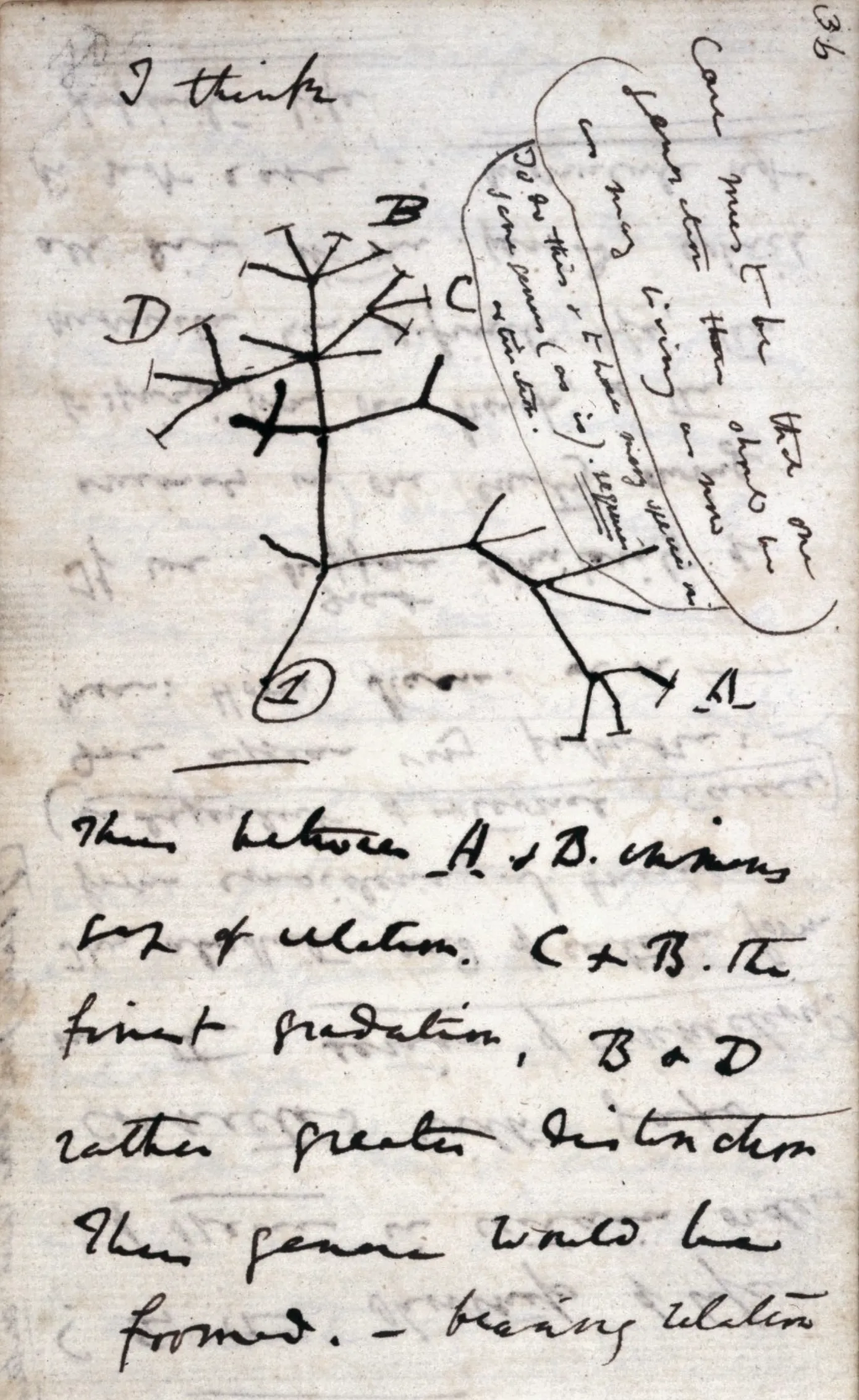
Charles Darwin published On the Origin of Species in 1859. Since then biology has rested on three words: mutation, selection, inheritance. Random changes in DNA. The environment “picks” whoever fits best. The fit pass their genes to offspring. Repeat. A billion years.
The scheme works. Nobody argues. The giraffe has a long neck — to reach the leaves. The butterfly mimics tree bark — to hide from birds. It all makes sense, it’s all verified, it’s all in the textbook.
The problem is that the textbook is silent about the main thing. Darwin explains why the giraffe has a long neck, but says nothing about where the giraffe came from in the first place. A bacterium got along perfectly fine without a neck for three and a half billion years, and it simply had no “problem” that the presence of a brain, eyes, or a spine would have solved. Newtonian mechanics is correct for cannonballs and useless for electrons; Darwin is correct for adaptation and useless for direction.
But direction in this long story is, after all, traceable — and that, conveniently, is the most uncomfortable topic of contemporary biology.
The word “direction” in biology is like the word “god” in physics: everyone understands what’s meant, and nobody wants to say it out loud. Because “direction” implies a purpose, and claiming that evolution has a purpose is teleology (from the Greek “telos” — purpose, end). Biology has been slapping people’s wrists for teleology since 1859 — ever since Darwin explained evolution without purpose.
And rightly so. Because phrases like “nature strives for perfection” or “god directs evolution” belong to the genre of human projection onto a process that is indifferent to us, and in science such phrases really have little to do.
If you look at the history of life on Earth without prejudice and simply stare at the data, leaving outside the door both the search for a pre-stashed teleology and the principled defense of blind chance, you’ll see a trend. A clear, persistent, statistically significant one.
First, the facts alone, without any interpretation, so that the reader can keep a margin of disagreement for the interpretation that will arrive a little later.
3.5 billion years ago — the first cells: bare, single-celled, no nucleus and no frills. Then two billion years — and absolutely nothing happens. Bacteria breed, mutate, adapt to anything at all — and stubbornly remain bacteria, as if someone had put evolution on pause and gone to lunch for a third of the planet’s history.
1.5 billion years ago — cells with a nucleus appear (biologists call them “eukaryotes” — literally “with a true nucleus”). A fundamentally different architecture: one cell swallowed another but didn’t digest it, and instead tamed it. The swallowed cell became the mitochondrion — the “power plant” that still lives inside every one of your cells and produces energy for it. The result came out more complex than the sum of its parts.
600 million years ago — multicellularity: cells begin for the first time to negotiate, divide duties among themselves and work as a crew, and out of one single type hundreds of specializations unfold — skin, muscle, nerve, bone.
540 million years ago — the Cambrian explosion. In a geological “instant” (20–25 million years — nothing for evolution, which is used to billions), all the major body plans that exist today appear: eyes, limbs, nervous systems, skeletons — as if someone had hit “fast-forward” on evolution’s playback.
And then come fish, amphibians, reptiles, mammals, primates, Homo sapiens: each step yields an increment of complexity, integration, and — to use Tononi’s language — of .
There is only one direction in this sequence: from simple to complex, from disjointed to integrated, from unconscious to conscious.
Notice: none of the transitions is gradual — each of them is a jump. Two billion years of the same primordial bacterial routine — and then eukaryotes. A billion years of single-celled life — and then multicellularity. Three hundred million years of slow evolution — and then the Cambrian explosion. These are phase transitions: water heated and heated — and suddenly, in a jump, turned into steam.
In machine learning this is the same phenomenon. Emergence: the model trains and trains, the metrics creep up slowly — and suddenly a new capability appears, one that wasn’t there a second ago. A phase transition. GPT with ten billion parameters is helpless at logic tasks. With a hundred billion, it solves them. Qualitatively differently.
Tras la compra
Este capítulo forma parte de la edición completa
Los primeros capítulos son gratuitos. El libro completo está disponible tras la compra y queda en tu biblioteca.
· · ¿Ya lo compró? Inicie sesiónUn correo cuando salgan capítulos y experimentos nuevos
Como mucho una vez por semana. Sin registro; baja con un clic.