06
A Body Without a Manual
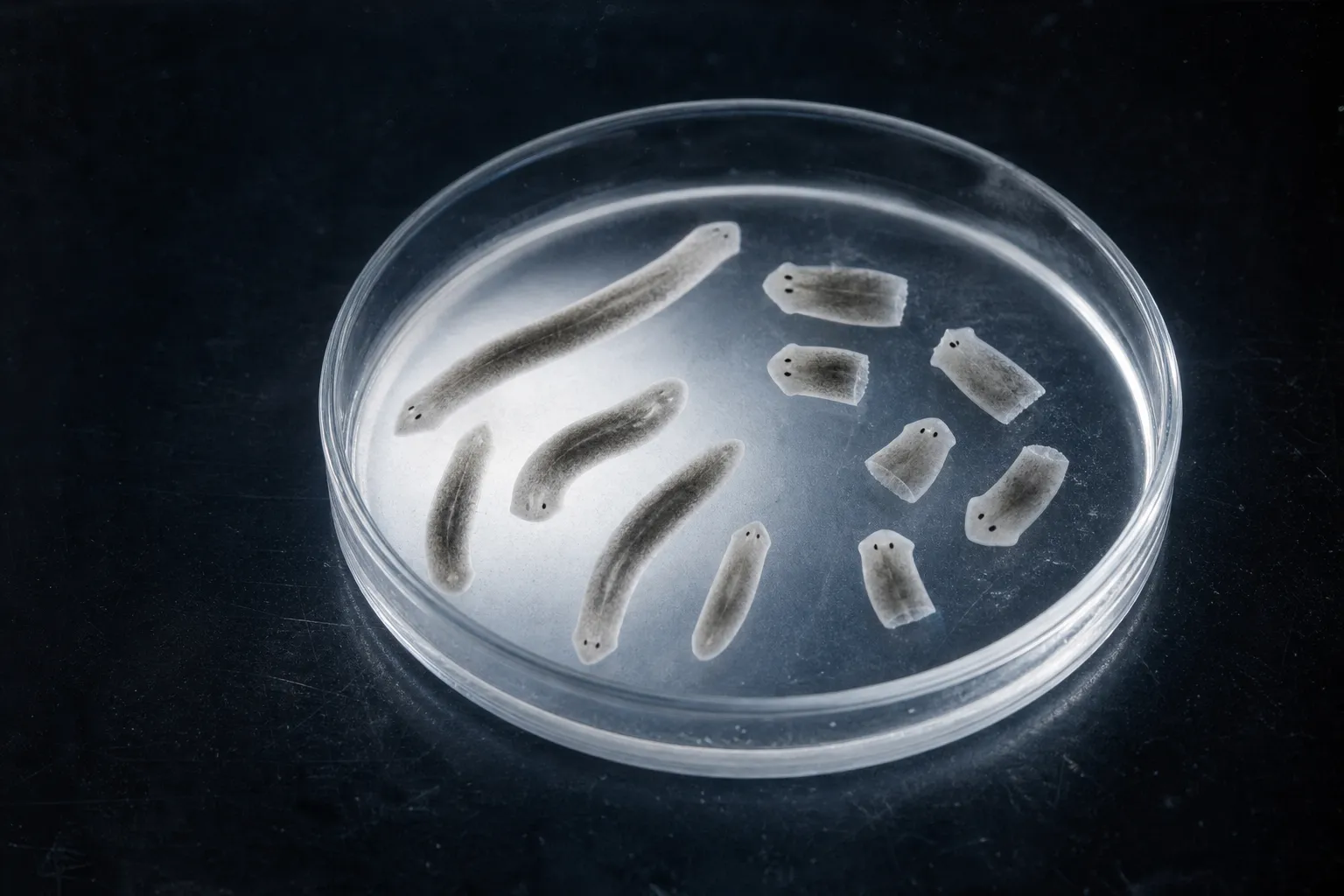
In Michael Levin’s lab at Tufts University, there’s an aquarium with planaria — flatworms half an inch long, with two black dots for eyes. Nothing particularly remarkable about them — except for one thing: some of them have two heads.
Levin made them two-headed himself, by rewriting the electrical signals between cells while leaving every gene in their DNA as nature drew it: mutation and genetic breakage have nothing to do with these worms. The most important part is this: when these two-headed planaria were cut in two (planaria regenerate beautifully — cut a worm in half, get two whole ones), both halves grew back as two-headed again, without any further intervention. The information about “two-headedness” had been written into an electrical pattern that the cells passed to each other, bypassing the DNA.
Levin grew eyes on a tadpole’s tail — functional eyes, with which the tadpole saw. This happened after the bioelectric “address” of the cells was changed: the tail cells were told, by a purely electrical signal, that they were now an eye; the DNA was not touched, not one letter of code was edited. As if you had renamed a folder on your computer and the files inside had rebuilt themselves to fit the new name.
In 2020, his team created xenobots (PNAS): they took skin cells from a frog embryo, separated them from the organism — and the cells self-organized into new life forms. Out came something else — a creature for which biology still has no catalog name: calling it a frog is now indecent, calling it a skin cell is laughable, and a catalog of new life forms isn’t officially kept by science. No genetic script was written for this result, no blueprint was handed out, no instructions came in from anywhere; the cells, left alone with each other, simply invented a new form from scratch.
In 2021 things got even stranger. Those same xenobots — clumps of cells with no genome whatsoever for reproduction — began reproducing, and not by division or budding: they swam around the Petri dish, gathered free-floating cells into clumps, and the clumps became new xenobots, which in turn gathered the next round.
Kriegman et al. (PNAS, 2021) called this “kinematic self-replication” — a form of reproduction not described in any known organism, and purely behavioral. The xenobots “knew” what shape to build so it, too, could build; the optimal shape turned out to be a “Pac-Man” — with an opening. So who exactly “told” frog cells that reproduction calls for a Pac-Man shape?
(You’re thinking right now: “That’s just physics. The shape is determined by hydrodynamics, surface tension, mechanics.” Maybe. But then explain to me why this particular physics leads to that shape capable of reproducing — to a Pac-Man with an opening of the right size, rather than a circle or a cube. Physics explains how, but says nothing about what for.)
Nobody told the cells — mathematics did. The same principle as in the slime mold building an optimal network; the same self-organization that at other scales builds the cosmic web. Form is computed from rules, from physics, from what Kauffman called “order for free,” and is not assigned by anybody.
How did they “know” what to build?
Tras la compra
Este capítulo forma parte de la edición completa
Los primeros capítulos son gratuitos. El libro completo está disponible tras la compra y queda en tu biblioteca.
· · ¿Ya lo compró? Inicie sesiónUn correo cuando salgan capítulos y experimentos nuevos
Como mucho una vez por semana. Sin registro; baja con un clic.