01
The Porch
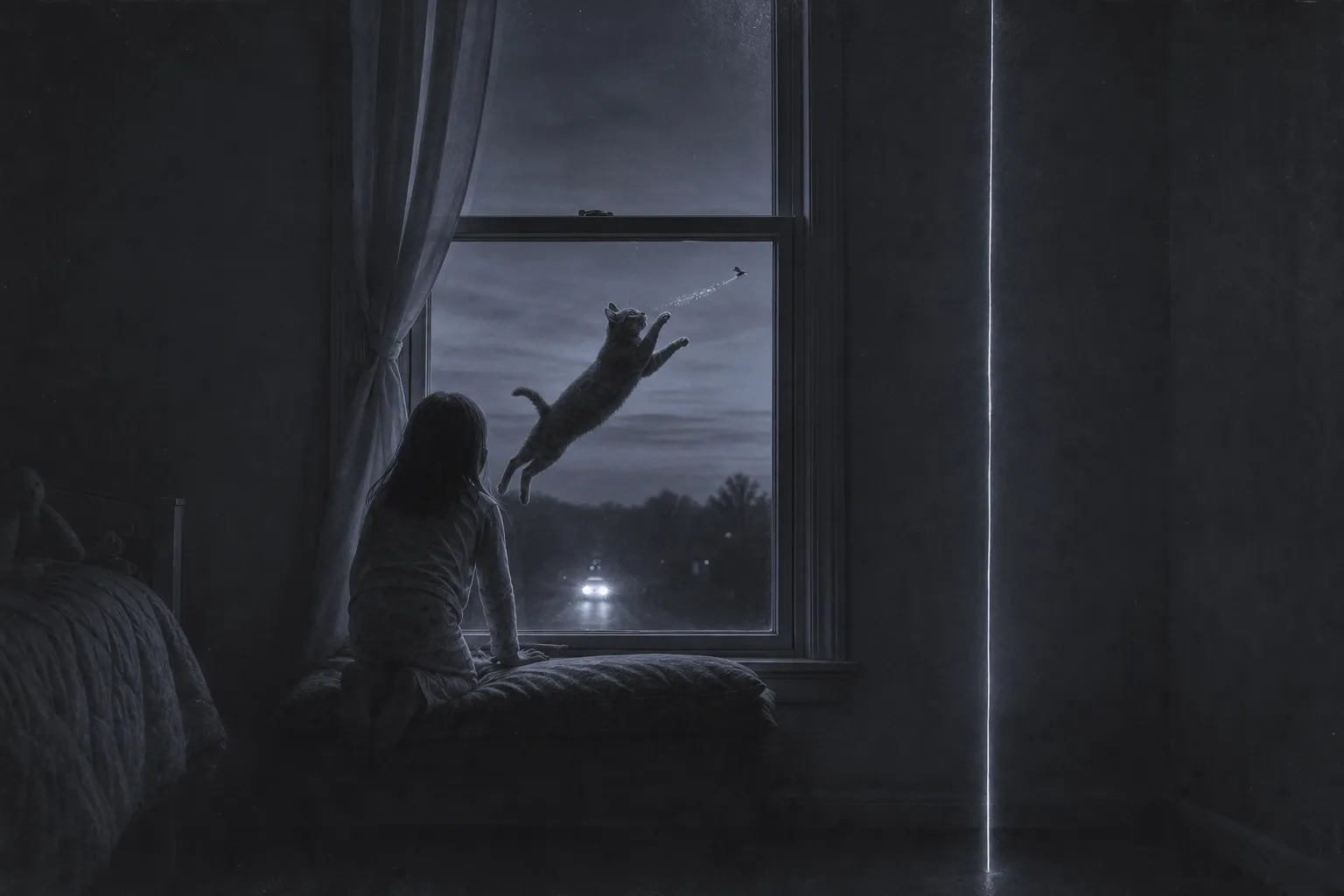
Lia’s diary. October 14, 2033
Papa is sad today. He hasn’t arrived yet, but sad. Grandma is calling him from inside. No phone — there’s a button inside him, and Grandma pressed it. A yellow thread, thin, going up from his shirt. He can’t see it. I can.
Mama said: Lia, don’t tell Papa about the threads. I asked why. Mama said: because it makes him sadder. I thought about it. Decided: okay. But in the diary — I can. The diary is mine.
Schrödinger Junior was chasing a fly. Didn’t catch it. The fly has silver dust behind it, like a train. Schrödinger can’t see the dust. That’s strange, because cats usually see everything. I guess even cats can’t do some things. Mama says that’s normal. Nobody sees everything.
In daycare today a boy cried. I asked why. He said — because it’s Tuesday. I thought about it. Decided: that’s a good reason. On Tuesdays everything is hard. On Wednesdays — easier.
Grandma is coming today too. She’s nice. Only she looks at Papa like a neighbor. Papa looks at her like at a mama. They don’t meet in the middle. In the middle — is me. I am their meeting.
Papa is driving. Near Krasnogorsk now. I can feel him, the way Schrödinger feels someone’s about to open a can. That’s knowledge. Not hunger — hunger comes after. First — knowledge. It came — so it will be.
I was driving back from the Academy and for the first time in a year couldn’t remember what I’d been thinking about.
This, generally speaking, is not good. The brain of a thirty-five-year-old physicist is supposed to work like a stock ticker in Tokyo: a crawl at the bottom of the screen, nonstop, in three languages, referencing yesterday’s close. If the ticker goes silent — either you’ve had a server crash or you’re dead. There’s no third option in this profession.
Or there is, but it means I’m looking in the wrong direction.
(“Driving back” — nearly my entire life was now crammed into that phrase. Seven years ago I left the Academy — back to the institute, to Lena, to the qubits. Promised myself: that’s it, I’m done, cold turkey. Four months was enough. Then Wei Lin called. He said: “We don’t have a job for you. But the world does. Between us and them, someone is needed who lives in both at the same time.” The position, which hadn’t existed before me, they simply called: bridge-keeper. Neither curator nor student, something in between; the Academy has no one else like it. A person who drives to the Academy twice a month and then goes back to the institute and pretends that what’s there is a blown fuse, not what he saw on the fourth floor of the stack four days ago.
Officially, in my tax return, I’m listed as “consultant for nonstandard conditions, OKVED code 74.90.9.” This OKVED code in the reference book means “other professional, scientific, and technical activities not included in other categories.” Literally: “we don’t know what this is, but they’re paying for it, so let them pay, and you sign here.” The Russian state, unlike the American one, doesn’t like it when a tax category is described more precisely than the activity beneath it. Precision is an inherently political thing, and here they keep it in reserve in case someone needs to be locked up tomorrow.)
Usually this “driving back” contained a long list: where to, where from, what for, with whom, in what car, with what sensations after passing through the door. Today it contained only: I was driving home. That was it.
I was driving home. “Home” — in the past couple of years, that had become more a direction than a place, but the MKAD didn’t know about it and faithfully led me along the ring. The speakers were playing a band I hadn’t put on. Yandex Music had developed a new habit over the past year: it plays things you haven’t asked for yet. The official version — the recommendation algorithm was updated, personalization, seventh-generation neural network, everything under the sun. The unofficial (and more honest) version — the recommendation algorithm around 2028 started leaking from the sixth floor. Meaning it no longer catches your playlist. It catches your nearest internal state. And plays it. Yandex gets paid for this by advertisers; I get paid for it by no one.
(In fairness: Yandex Music has a checkbox labeled “disable personalized selection.” It doesn’t work. I checked it. Three times. On the fourth I wrote to support. Support replied: “the checkbox is functioning correctly, no problems were detected with your account.” Translating from support-speak to human: “we don’t understand it either, but we won’t admit it.” This phrase, by the way, is the unofficial national motto of Russian tech support, unwritten but instantly recognized by anyone who’s dealt with it.)
Right now Angine de Poitrine was playing — a Quebecois duo (the name translates as “angina pectoris”; they only put the French on the cover so the listener doesn’t start out with cardiology associations). They play microtonal math-rock — between the usual notes there are extra notes, quarter-tones, and in that gap a separate melody and a separate harmony open up that simply don’t exist in the standard tuning. The time signature shifts inside a single phrase — seven quarters, then eleven, then a quarter-tone loop displaced just enough that the ear starts looking for an anchor and can’t find one. The guitarist plays a double-necked hybrid: the upper neck — a Stratocaster-type guitar; the lower — a bass; separate wiring, with microtonal frets layered over the standard ones on both; he switches between necks within a bar. The drummer works as much with his feet as with his hands: foot pedals send loops and layers that overlay the live rhythm in real time, like a techno producer with hardware instead of a laptop. The structure is simple to the touch and miserable to parse: a complex polyrhythmic approach, then an unexpected human groove, then approach again; in the hall this slowly raises an even hypnotic pressure, like a mantra. On stage — in elongated hood-masks that flow into the jumpsuit without a visible seam, all in large polka dots: one black on white, the other white on black, mirrored. Each has a triangle on the crown — in one interview they said the triangle is the most beautiful geometric form on earth, and didn’t bother explaining further. They have no names. They call themselves Khn and Klek — two dense consonant strikes, no claim to meaning, but easy to shout from a crowd. Self-identification: “Dada-pythago-cubist mantra-rock orchestra”; when an interviewer asked whether the “spatio-temporal travelers” line was an artistic concept, they answered that they actually are spatio-temporal travelers, and moved on to the next question. Usually I listen to them in the evening, in the kitchen, after Kira has gone to bed and before Lia is up. Not during the day. Today they were playing at four in the afternoon, in the car, on the MKAD, in the rain. That was the diagnosis: Yandex knew more about me than I did, and admitting it through music was easier than through a checkbox in settings.
In this form their music worked strangely. It was like eavesdropping on something not meant for me: somebody whistling in a closed room in the next stairwell, and I was hearing it through the wall — whistling to himself, addressed to no one, without any stage posture at all. The microtonal shift of a quarter-tone every cycle makes the illusion perfect: the ear can’t latch onto the familiar twelve semitones, and hearing takes the sound for a whistle from the next apartment that happens to have form. Their music is someone else’s attention transposed into sound. You can’t compose this; you can only catch it and amplify it. I recognized them without Shazam. I recognize them everywhere now.
My mother’s signature in my chest has been activating more and more often over the past two years.
This is a technical phenomenon with a passport, a warranty period, and a documented cause. Seven years ago my mother gave away her subjective signature to anchor a passage that couldn’t be closed by ordinary means. Part of her signature now lives in the door, part in Irene, who exists in a new body in Kostroma and works as a librarian, part along a distributed grid in space that I haven’t mapped on foot.
And one more part — in me. Because I’m her son. She left it twenty-eight years ago, when I was seven. This part is technically impossible to extract from me: it’s welded in for good. Irene now is her body and her given-away part. And what remains of Mom inside me — that’s only inside me, and it’s sort of not her anymore, and sort of her. The Academy describes this state with the phrase: “the signature lives in two configurations simultaneously, and both are legitimate.” In plain language: she exists, she doesn’t exist, and both answers are correct.
(Try living with a mother in two configurations simultaneously. I recommend it. Very good for discipline.)
Over the past two years, this particular part has started calling. In the chest, in the diaphragm, in that part of the nervous system that used to be responsible for “I think I left something on the stove.” Switches on for about forty seconds, then fades. The sensation — a thin yellow thread from the sternum upward. Wei Lin told me about it five years ago, in three words: “That’s her way of reminding.” Everything else Wei Lin had explained to me willingly, but about this he kept silent with nods for three years; then the nod was replaced by a phrase — and the phrase was also a nod, just with words.
(I can now tell phrase-nods apart, by the way. Occupational hazard of a bridge-keeper: eight years next to a person who economizes words, and you start hearing which line is a sentence and which is a nod dressed up in vowels and consonants. Ninety percent of Wei Lin’s speech is nods. The remaining ten percent he saves for moments I haven’t lived through yet. He releases that ten percent one at a time, a teaspoon per year. To date I’ve received eight spoonfuls. I suspect four or five remain. After that we’ll be done.
Side note: Wei Lin has a Nokia 3310 — an ordinary black one, no internet, on which only calls and SMS work. Buttons in the right places, Snake built in, holds a charge for a week, he charges it every eight days, on schedule. He’s carried this phone in his jacket pocket since 2020. The smartphone he was given for his five-hundredth birthday sits in Olga’s closet. The smartphone he was given for his seven-hundredth birthday sits next to it, still in the box.
The ideological brother of this Nokia lives in Canada. Virgil Dupras, an ascetic programmer, sixteen years ago started a project called Collapse OS—an operating system written in Forth, six kilobytes, that runs on eight-bit microcontrollers pulled from a dumpster, designed to work after the collapse of civilization, when new processors stop being manufactured. I’ve never compared Dupras with Wei Lin out loud—Wei Lin meets such comparisons with a silence so dense you no longer want to elaborate—but in both cases the gesture is the same: don’t trust a dependency you can’t repair with your own hands. Dupras writes code for the collapse. Wei Lin lives after it.
This is his position and the Academy’s position: “if we get on the network, we become the network; if we stay among people, we stay people.” The Academy has no public website. Search results for “Russian Academy of Consciousness” yield a few dead forum posts from 2019 and one article on Meduza that Lena will write in 2033, but we’ll discuss that later. There’s no Wi-Fi on Academy grounds. Cell service works in spots, through repeaters Olga installed in 2029, at which point she threatened to remove them if anyone set up a Zoom room in the dining hall. The Academy’s connection to the world is through living bridge-keepers, meaning through me and two others: Olya (Olga’s granddaughter) and Vanya (a graduate student who left for the US with a secret assignment I know nothing about yet).
There has been an alternative networking dream in history too. Ted Nelson, in 1960, came up with Project Xanadu—a global hypertext system with two-way links and an automatic royalty paid to the author at every citation. Nelson’s team has been writing it for sixty years. As of 2033 it’s still not publicly launched. Those who read Nelson in 2012 still open the latest version of the manifesto every six months and confirm that Nelson is one person. The Academy chose a different path: instead of a system, bridge-keepers. Bridge-keepers are slower and more expensive than Xanadu, but bridge-keepers work, and Xanadu, so far, doesn’t.
When Wei Lin calls someone from this Nokia 3310, the receiving end’s screen displays a number starting with +7 4852. Kostroma. He’s never been to Kostroma. Why the number is Kostroma-based is unknown. It seems the Academy’s telephone infrastructure also leaks a bit from the fourth floor, like my qubits and the neighbors’ GPS.)
So. Today Mom had been calling since about ten in the morning — meaning four hours straight, holding the line without a break, and this was new for the radio link the two of us had grown used to: usually she called in forty-second bursts with three-day gaps, but today it was as if she’d picked up the receiver and was waiting for me to finally answer.
I was waiting back. A bridge-keeper never crosses from his side of the bridge first: he is the bridge, and bridges stand. If a bridge starts walking on its own — that’s already a third tower with two legs, not rated for the load.
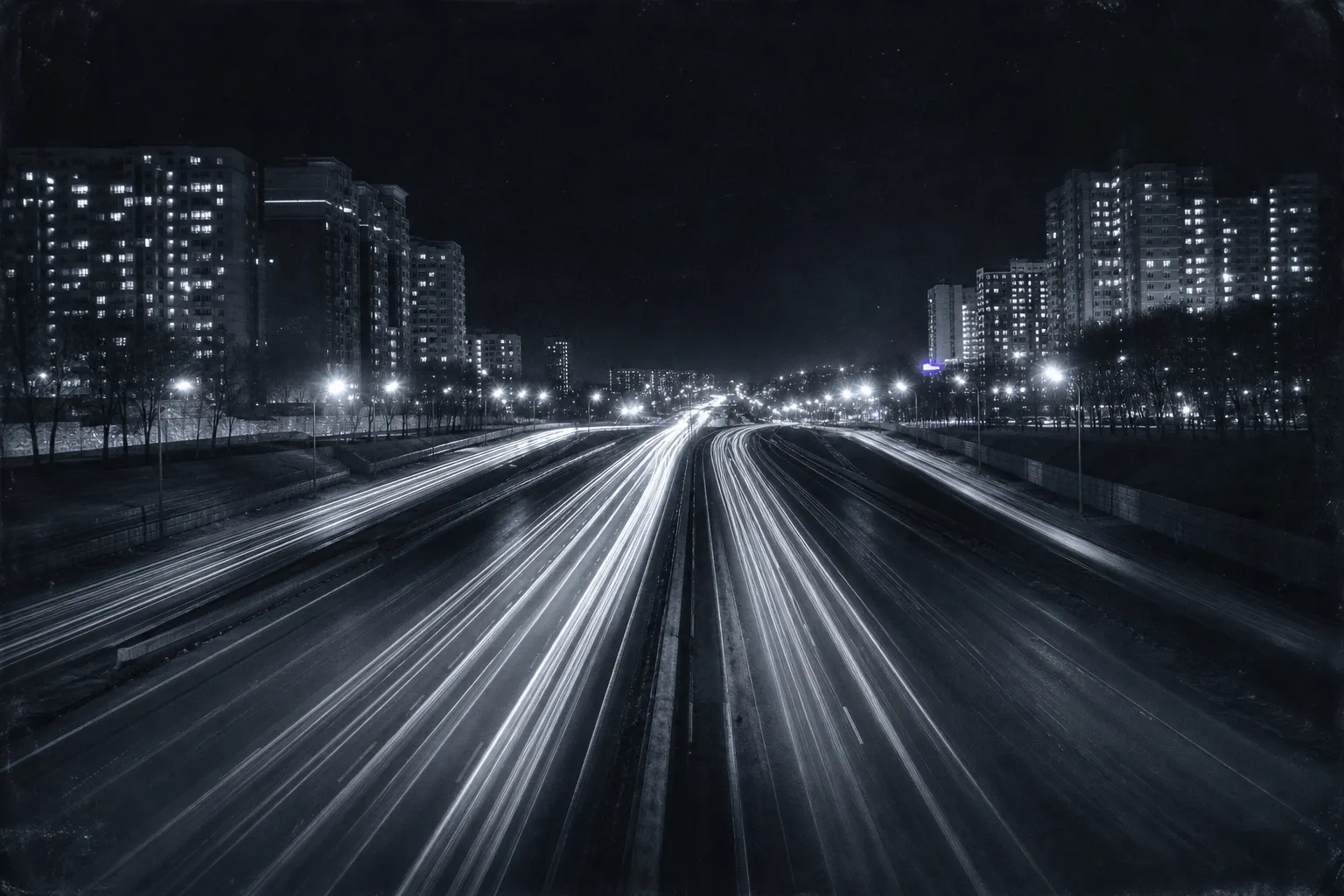
Something had happened to the drive into Moscow seven years ago — after the door was opened — that nobody expected, including the traffic police.
First, around 2028, traffic jams in Moscow started vanishing. That is precisely how they vanished: there one moment — and evaporated the next, without a trace, without a single crash left behind. Meaning Yandex Maps data says at 6:30 PM the Third Ring should be at eleven out of ten — and you pull out and see four. Nothing happened, nobody was let through. It just moved. There’s still no official explanation. There’s a theory (usually published in third-rate outlets that love the word “quantum” in headlines) that Muscovites started coordinating their route choices more. This is actually true: a collective causal layer exists for a large city, and if information leaks into it, traffic jams dissolve. I keep quiet about this in group chats, because in group chats they give me the dumb emoji for it.
Second, GPS in certain parts of Moscow now lies consistently. The Gagarin Ring Tunnel — off by a kilometer and a half. Victory Park — by three hundred meters. The Arbat district — by twelve meters in any direction, but always in the direction you specifically don’t want to turn. The Academy has long since defended a thesis on this subject (author — nineteen-year-old Vanya; I was the reviewer). The thesis conclusion: “the render layer in Moscow leaks from the fourth floor wherever there was historically a dense causal shadow.” The thesis received top marks. Moscow answered the thesis with a new lying zone at Paveletskaya.
Third, a category called “awakeners” appeared on YouTube. Format: one guy in a gray sweater, sometimes a woman in red glasses, a course for a hundred and nineteen thousand rubles, “we’ll unlock your inner Architect in four weeks.” (The word Architect has now also been privatized by marketing. Seven years ago I still had time to joke about “quantum consciousness.” By 2033 the words leaked faster than I could keep up.) The most popular channel — “I Am My Own God” (two million three hundred thousand subscribers, hosted by one Gleb Aristov, presumably a former Magnit store manager, I didn’t verify). Gleb explains to the viewer that reality is a computer game and that he, Gleb, for a hundred and nineteen thousand, will give the viewer cheat codes.
Gleb does in fact give the viewer cheat codes. They even work sometimes — for a week or two, until the viewer discovers that the game has no levels, and that each cheat code delivers nothing but a fleeting tickle of the sixth floor, which, as it happens, is happy to be tickled on its own, free of charge.
This is, on the one hand, funny. On the other, sad. On the third (the one the Academy deals with, and the one I deal with in my capacity as “bridge-keeper”) — dangerous. Because real awakenings without support look like schizoaffective episodes. And they look that way because that’s what they are, until someone explains to the person what’s happening to them. The patient enters a structurally deeper layer of the stack without a suit. Without a suit, you suffocate in that layer. And they’ll suffocate because of the person who dragged them there with a chatbot called “God-Bot Pro” for a hundred and nineteen thousand.
(I once asked Wei Lin for permission to write Gleb Aristov a letter. Polite but firm. Wei Lin looked at me carefully, silently. And said quietly: “Gleb is part of the filter.” That was all; I never asked again. Filter is the Academy’s term for people whose very existence filters out those who aren’t ready. If you paid Gleb Aristov a hundred and nineteen thousand and weren’t outraged — the Academy isn’t for you yet. Gleb Aristov is for you. Harsh, but it works: the Academy can’t keep up with everyone knocking at the door. Gleb diverts those who don’t belong at the Academy yet. From the system’s perspective this is a built-in spam filter. From an ethical perspective — more complicated. From my perspective, driving on the MKAD with Mom switched on in my chest — I don’t care right now.)
One more thing worth mentioning, since we’ve come this far in describing my 2033.
This year Russia got a new government agency. It’s called the Institute of Public Awakening, FGBU (federal government-funded institution; registry number 6732; headquarters at Tverskaya 17, the former building of some book-lovers’ society that was quietly shut down in 2022 for lack of relevance).
The Institute of Awakening is headed by Artyom Val. Yes, that Artyom. From BA. From the first school. The man who chose Ordo because of Private Misha in Kaluga, and who over the past eight years turned his choice into state-scale infrastructure. I haven’t seen him in person since 2028. We went our separate ways quietly, without hard feelings. Sometimes I see him on screen — in a gray suit, no tie, cropped hair. He speaks into the camera calmly and slowly, and his speech still carries the whiff of a road with no landmine ahead.
The Institute’s main public mission: “develop and implement protocols for the proper integration of individuals with expanded perception into public life.” Translating from bureaucratic: find a way so that the awakened don’t lose their minds and don’t destabilize the country. The task, on the whole, is reasonable. The methods are what terrify me most: census, disability category IV-E (fourth, encephalic), medical checkups, registration, regulated issuance of an “expanded perception license,” and the juiciest part — the oracle “Architect-1”.
(Architect-1 is the centerpiece exhibit of Ordo in action. Officially — “an automated support system for individuals with expanded perception,” code in the FGBU registry APS-EP/01. In practice — a seventh-generation LLM, fine-tuned on the Academy’s internal protocols, which fell into Ordo’s hands in 2031. Wei Lin, regarding the word fell, once smirked in a conversation with me: “Yes. Right out of the drawer.” Nobody specified whose drawer.
Architect-1 lives on Gosuslugi, section “Spiritual Health,” subsection “Expanded Perception,” added June 14, 2032. And also as a standalone app in the App Store and Play Market, “Architect Pro,” four stars, a hundred and fifteen thousand downloads. It’s been in MFC terminals since February. I haven’t personally gone through it, because the Academy requires bridge-keepers not to show up in the National Signature Registry. But Kostya from the next department did. He received category “sensitivity-A, unlicensed,” which means: “we’re keeping you in the database but not touching you for now, thanks for your honest answer to question five.”
A license for expanded perception — that’s what 2033 is, if you describe it in one thing. Mom. Imagine I hand you a piece of paper that reads: “Reinov, Daniil Sergeevich, is authorized to perceive the folds of reality on the territory of the Russian Federation.” Signature: Val A.A. Round stamp, blue. Valid for three years. If lost — fifteen thousand rubles for replacement. All of this already exists, and it’s too late to call it a dystopia. I don’t have a license — the Academy refuses on principle to join the registry. But the first cohort of students at the Institute of Awakening — they do, issued in May. They can now legally see the folds. Fifteen minutes a week. In specially equipped facilities.)
A separate pleasure — Ministry of Health Order No. PP-23. I memorized it while standing in line at the MFC this summer. There’s a clause I can recite from any point, wake me at night:
“Upon determining that a citizen exhibits signs of expanded perception in category 3A-2, the citizen shall be referred to the regional center of subsidiary responsibility for the procedure of invariant verification. In the event that the invariant is found to be inconsistent with the baseline template for the category, the citizen shall be reclassified per § 3.4 with automatic recalculation of subsidiary responsibility for the preceding 36 months.”
(I keep these lines memorized like a talisman. They’re a pure grade of insanity formatted in ministerial typography. Somewhere in a parallel universe the exact same lines were written in 2014 about car owners, in 2019 about foreign agents, in 2026 about people with heightened hearing. The Russian bureaucratic machine is incapable of doubting its own text: if it has already written “invariant” in a regulation, then the invariant exists and is subject to verification. This is Russian Random Code Programming: insert any word and it becomes an administrative term within two weeks.)
This is Ordo in action. A monolith with a human face, at Tverskaya 17. Artyom is honest. Artyom personally believes this is for the better, because he remembers Misha. And he may be right: if not him, then others would have filled the same niche, and those ones without brakes. Better Artyom’s iron hand than the wet hand of an unknown — that’s how he thinks. Most likely, that’s how it is. Which is why I only argue with him to myself. And in other people’s group chats, where liberal journalists attack Artyom, I usually say nothing. Silence, in my profession, is conservation of breath.
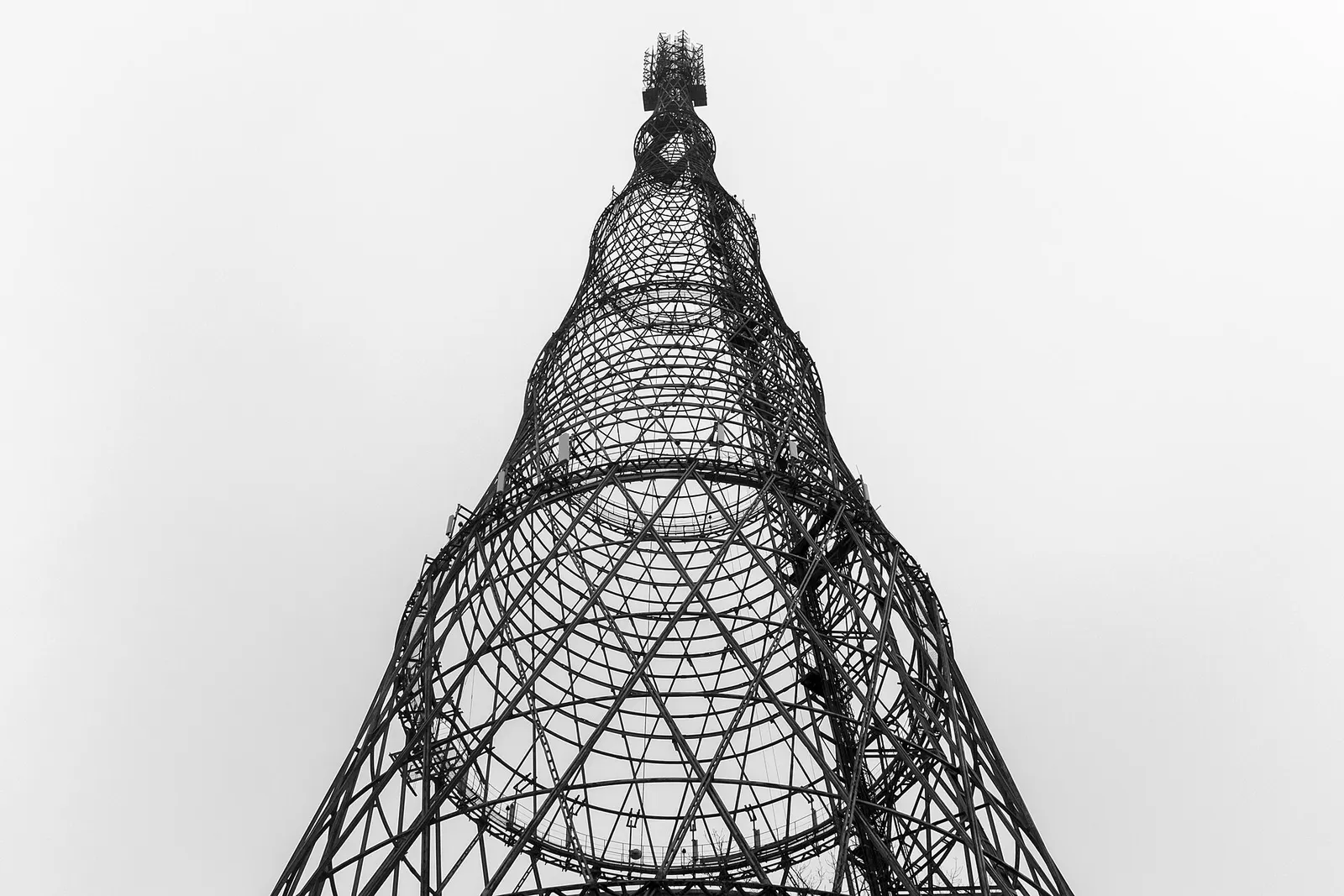
I exited the MKAD onto Shabolovka.
Shabolovka had changed little in seven years. Shabolovka in this sense is a geological constant: when everything collapses, Shabolovka will remain. Same Shukhov Tower (under protection, peeling, with a plaque reading “historical monument,” with a planned restoration that’s been on the budget for twenty years and hasn’t budged). Same trolleybus No. 15, which was discontinued in 2021 and which nevertheless every fifth babushka in the neighborhood still pines for. Same building with my studio apartment, which in 2026 I’d come back to every Friday, and which I now come back to every day, because two years ago Kira moved in with Lia, and I moved the mug with the chipped handle into the cabinet above the sink as a gesture of historical continuity.
(Strictly speaking, the mug with the chipped handle is now a family relic. Nobody in our home touches it. Kira drinks from her own. Lia from a cup with a bunny. Schrödinger Junior drinks from my puddle, but he’s a bridge-keeper by status, so he’s allowed.)
The elevator was working.
I looked at it the way an engineer looks at a suspiciously functioning reactor. A working elevator in a Moscow nine-story building from 1974 is, based on my own long-term observations, a bad omen. Roughly equivalent to your morning coffee tasting good. When everything works, it means something is compensating. In our building there was historically nothing to compensate with, which is why the elevator didn’t work: it wasn’t broken, it just didn’t want to. And, in the Soviet way, that was proper behavior for an elevator.
Now the elevator was working. Smooth, even, almost Swiss. I got in, pressed four. The elevator grunted and went. I stood and waited for it to stop between floors and tell me something important. It didn’t. Stopped at four. Door opened. I got out.
(I think by this point I’d ceased to be a full citizen. A full citizen rides an elevator, plays on his phone, and doesn’t expect the elevator to speak to him. I expect it every time. This is a professional symptom. The symptom is called excessive attention allocation toward the inanimate, and there’s no treatment for it. The way out is either to quit being a bridge-keeper or to make peace with it.)
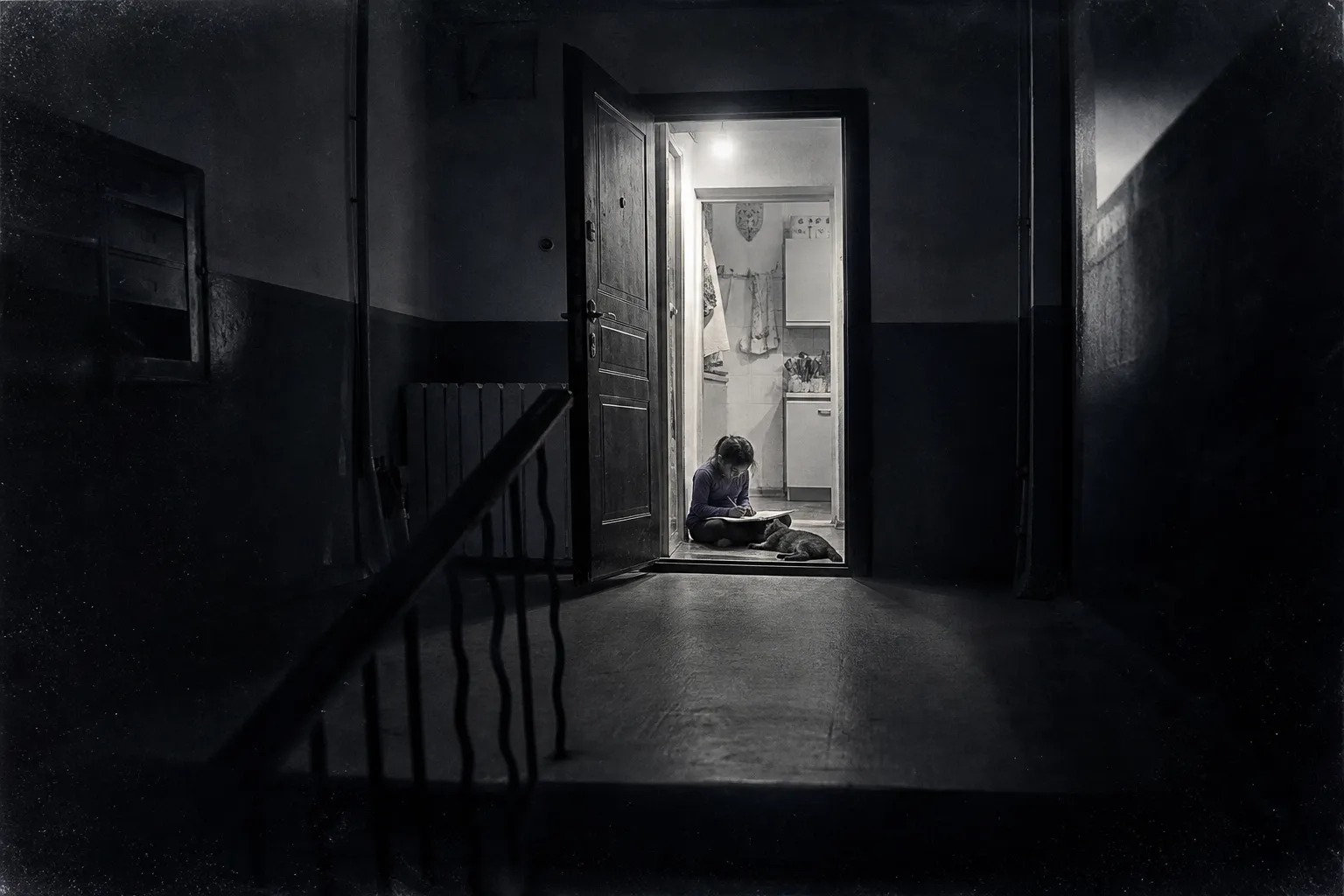
Lia was sitting on the threshold.
Right on the threshold, the door open wide, cross-legged, in rocket-patterned pajamas, with a notebook on her knees. Schrödinger Junior lay on her legs. Both stared at the door from inside. Meaning she’d opened the door, sat on the threshold, and waited.
— You’re early, — she said. — I thought you’d be seventeen minutes.
— I drove faster than usual.
— Yeah. Because of Grandma. I felt it too.
She said this the way other children say “I ate an apple.” A business report. No drama.
(Here I need to explain one thing about Lia to save the reader confusion. My daughter has been reading since age three. Not syllable by syllable. Whole sentences, with intonation, including foreign words she’d never encountered in her environment. Kira and I tested it (we’re scientists, we test everything; a child who reads is wonderful and suspicious simultaneously, roughly like a qubit that behaves flawlessly): books that weren’t in the house — she reads. Books that just arrived — she reads faster than us. Last year Lia, visiting one of my former academic supervisors, opened a volume of Principia Mathematica in English and said: “This is like my bunny book, only harder and without bunnies.” The former supervisor was silent for three minutes.
Kira and I reached an agreement: we don’t accelerate Lia and we don’t slow her down. We accompany her. We have no manual for “how to raise the first naturally-born Architect” — no such manual exists in the world, because before Lia there were no other natural Architects, and all the Architects we personally know were raised in one terrible way or another. Basically, what we do is: respect Lia, don’t deify her, make her sit at the table and eat dinner on time, make her pick up her toys, and if she tells us she sees a “gray thread with a knot” on the neighbor, we say: okay, thank you, let’s go brush your teeth.
That, as far as I understand, is parenting. Its main job is for the child to actually brush their teeth; everything written about parenting in the books is a knock-on effect of this simple but for some reason hard-to-execute task.)
I sat down next to her on the threshold — the way people sit when they haven’t had time to take off their coat: in the jacket, with an unfastened button, having agreed to be in this minute before being in their own body. Kira was somewhere deeper in the apartment, deliberately — she knew that Lia and I have our own first minute, and that the ritual mustn’t be broken, because Kira has great respect for rituals, almost like elderly Chinese men respect the tea ceremony. Our ritual with Lia goes like this: for the first minute after I come home, nobody talks about anything important. Usually we just sit, and Schrödinger Junior shifts from her legs to mine.
Today the cat didn’t shift.
Today he was staring at something behind my back.
— What’s there? — I asked, without turning around.
— A thread, — said Lia. — Yellow. Going up from you.
Pause.
I closed my eyes. Opened them. Looked at my daughter — seven years old, dark hair (Kira after the rewrite, so genes), notebook with rockets, serious eyes. And understood two things at once.
First: my daughter can see my mother’s signature directly, without intermediaries, the way normal children see the color of walls.
Second: she told me about it. Calmly. Like the weather outside.
She’s seven. The same age I was when I told my father about Mom. Father didn’t understand.
(Father didn’t understand — not in the sense of “didn’t hear.” In the sense of: heard and didn’t give the words permission to exist. For twenty-one years this sat inside me like permafrost: words about Mom could be spoken, but they couldn’t be heard. Spoken — into the void. Heard — by no one. That was the contract between me and my father until 2026; that November the contract was voided by two words — Father said “I know,” and that was the final settlement. Now in my apartment there’s a daughter who’s seven and who is about to enter a different contract with me.
I don’t yet know this contract. I’m standing on its threshold. Literally.)
I turned to my daughter. Schrödinger Junior was still staring past me.
— Lia.
— Yes.
— Have you ever asked Mama about this? About the threads?
— I asked. Mama said not to tell you.
— Why?
She thought. Seriously, the way seven-year-olds think — brow furrowed, tongue poking out a bit, left eyebrow raised. That’s her pause for “I’m deciding how to explain.” Inherited from Kira. Kira does the same thing, only she raises the right eyebrow. This, for the record, is our decade-old domestic dispute: left or right. Kira says women in her family always do the right. Lia apparently chose the left as an act of teenage rebellion (at age seven; too bad there’ll be nothing left to rebel about at seventeen).
— Because it makes you sadder.
Pause. Schrödinger Junior shifted his gaze from whatever was behind me to Lia herself. Approvingly. (A cat. Seven years old. He’s younger than me. And yet he’s the one who’s the chief observer in the room right now: none of us knows where to look, but the cat does. Cats have the occupational hazard opposite to mine — they have nothing to lose, and so they’re always on the threshold. Cats need to be studied. I’m serious. The Academy has a dedicated course on feline perception, but I haven’t enrolled yet, because I think it would ruin my personal relationship with Schrödinger Junior.)
— Am I allowed to tell you? — I asked.
She nodded once, by half a millimeter, — the way people nod whose every movement is double-checked by an inner chronometer.
Seven hundred years. Four generations. And one nod from a seven-year-old that means more than all my conversations with Wei Lin over eight years.
I can’t explain what exactly happened in that nod. Maybe nothing happened. Maybe everything. Maybe in the moment when my seven-year-old daughter gave me permission to tell her about things I’d hidden for twenty-eight years, the part of Mom’s signature that had been welded in my chest for twenty-eight years shifted by half a millimeter. Now it’s not welded. It’s tied. Those are different constructions. Welded holds by its own mass. Tied holds by whoever is holding the other end of the rope.
The other end of the rope is now in rocket-patterned pajamas, and in half an hour it will be eating syrniki, at nine brushing its teeth, at ten asleep, and tomorrow it goes to daycare.
(In the notebook — I read it later, without asking; forgive me, etiquette editor, but I’m a father — in the notebook there was one entry after our scene: “Papa said I can. Now I can.”
One hieroglyph of meaning. A child’s handwriting. The answer to a question I hadn’t known how to ask for eight years.)
Kira came out of the kitchen a minute and a half later, with a towel on her shoulder. She’d just put something on the stove that smelled like onions and tomatoes, at least on the first floor — on the fourth it smelled like something else entirely, but that’s our family perk: kitchen smells in our apartment sometimes arrive with a delay and sometimes from the next kitchen over (I suspect our neighbor through the wall, Valeria Ilyinichna, also slightly awakened around 2029 or so, but we’ve never discussed it; our relationship is strictly about watering her cucumbers when I’m away).
Kira looked at me. Saw something in my face that isn’t usually there. Silently.
This ability of Kira’s — to see in my face what isn’t usually there — is one of the things I love about her most, and about which I simultaneously have a slight complex (because in her face I can read a maximum of four states: hungry, full, angry, calm — that’s it). I compensate for this asymmetry, as a man, with cooking: Kira cooks twice a week, I cook the other five, and this spares us both the feminist discussions for which I have neither the energy nor the vocabulary after 2026.
— Grandma? — Kira asked.
— Four hours straight, — I said. — Won’t let go.
Kira nodded, turned her eyes to Lia, Lia looked back at Kira, — and in that one-second exchange of glances of theirs was packed far more information than in my entire bridge-keeper workday. Kira to Lia: you feel it? Lia to Kira: yes, I already told Papa. Kira to Lia: good. That was the entire family conference, soundless, in two point four seconds (I timed it later on my internal clock; occupational hazard).
— Syrniki in ten minutes, — Kira said aloud, for my benefit. — Go change.
I got up. Went to change.
(In the hallway, on the way, I remembered something Wei Lin had said to me nine months ago. Verbatim: “A bridge-keeper doesn’t carry messages. They pass through him on their own.” At the time I filed it as an aphorism and did nothing with it. Today I understood that my daughter is beginning to be another bridge-keeper. Also a two-ended one. Except my bridge connects the Academy and the institute. And hers connects me and Grandma. And if the first construction is held together by my biography, the second is held together by a seven-year-old child. That, sorry, is an architectural nightmare.
Although, come to think of it, the most durable bridges in history also held up not because of the architect but because someone walked across them. A stone nobody walks on quickly overgrows with lichen and crumbles. A stone people walk on — wears down, but holds.
My daughter is already walking. So the construction works. So my job is not to interfere.
The task is simple, and in thirty-five years I haven’t had a harder one.)
I pulled the gray sweater out of the closet — the one Kira bought me in March, the one I wear around the house year-round, — threw it on and went to the kitchen, where Kira was just starting the second batch of syrniki.
In my back — a yellow thread. I could now, in retrospect, make it out: thin, it lay in the body and was simply there.
Mom was calling. I was on the line.
For the first time in seven years — on the line.
Lia sat on her chair with the bunny backrest. Looking at her plate. In the corner, her notebook — closed, ballpoint pen on top, neatly.
(Later I would read it — and forgive me, etiquette editor, but I’m a father.
In the diary she’d added one more line to today’s entry:
“Papa today is not alone.”
Three words. For the first time in seven years she saw me with connection. Before that, apparently, she saw me without. This is also information for me. It means that all these years she considered me a lonely man whom someone else’s grandma calls. Now she considers me a son. For her this is a change in the directory: Papa moved from the “alone” category to “with connection.” For me — roughly the same as a transfer from “dead” to “alive,” only retroactively and without registration.)