05
So As Not to Be Surprised
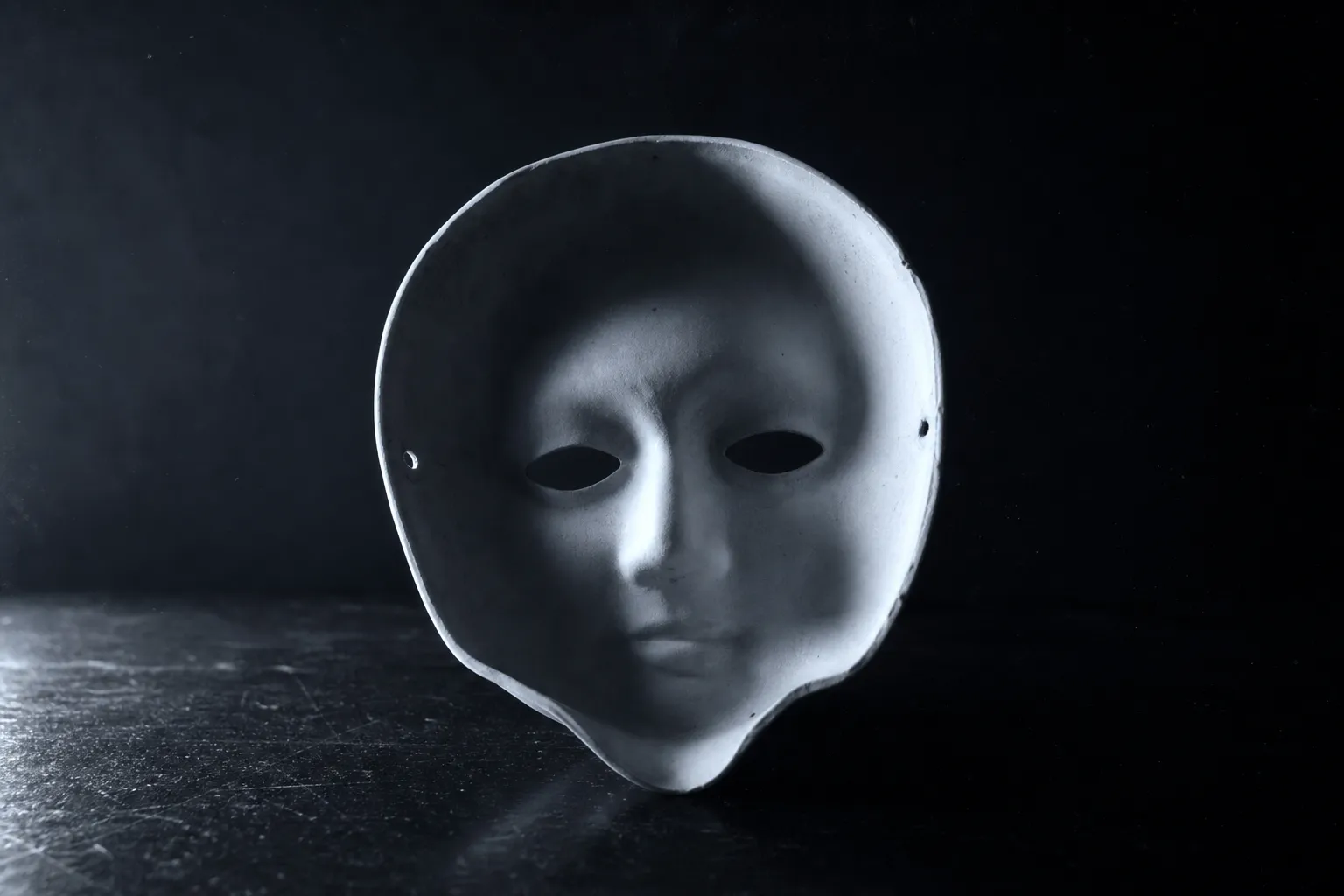
Take a carnival mask, turn it with the inside towards you and have a proper look at that concave plastic shell in which the nose goes inwards, the cheeks sink in and the face is turned inside out like a glove pulled off a hand.
Now step back a couple of metres.
The mask is convex. An ordinary face, nose outwards, and on top of that it slowly turns to follow you as you walk sideways, although half a minute ago you were holding this shell in your hands, know absolutely everything about it and can say aloud that it is concave with the same firmness with which you say your own name.
Knowledge is utterly useless here, because the illusion works equally reliably on the professors who study it and on the students who glued the mask together out of cardboard half an hour ago, and it lasts as long as you are prepared to look at it.
The reason is indecently simple: your visual system has a conviction, accumulated over a whole life and confirmed by millions of faces, that faces are convex, and against this background the information now arriving from the retina looks like the testimony of a chance passer-by against a three-volume dossier, so the court, naturally, believes the dossier.
The idea that seeing is an inference was put forward by Hermann von Helmholtz back in the eighteen-sixties, who called it unconscious inference, and for a century and a half it rested on a single consideration, which, for that matter, has not been refuted to this day.
The consideration is this. A flat patch of light falls on the retina, and reconstructing from it what object exactly cast it is impossible in principle, because one and the same patch is produced by a mouse up close and an elephant far away, by the shadow of a branch and a crack in the glass, and a problem with infinitely many equally legitimate solutions is never solved by honest processing of the input data.
That being so, the system is left to guess: to put forward a hypothesis about the outside world that is fast, automatic and entirely beyond your control, and what you complacently call “I saw” turns out to be the winning hypothesis, while the retina is left the modest role of supplier of evidence.
For a century and a half all this looked like elegant armchair philosophy, right up to the moment when anatomists counted the wires.
Tras la compra
Este capítulo forma parte de la edición completa
Los primeros capítulos son gratuitos. El libro completo está disponible tras la compra y queda en tu biblioteca.
· · ¿Ya lo compró? Inicie sesiónUn correo cuando salgan capítulos y experimentos nuevos
Como mucho una vez por semana. Sin registro; baja con un clic.