17 experiments
Experiments
Experiments from the books that run right in your browser: a slime mould lays out a network, photons cross two slits, a qubit lands the same way fourteen times in a row. Each one leads to the chapter that explains what you are seeing.

The Celestial Code
A slime mould lays out a network
Jeff Jones’s model (2010): nine thousand particles sense the trail ahead, turn toward the strongest and leave their own. The algorithm Burchett and Elek used to recover the filaments of the cosmic web works the same way.

The Celestial Code
What it costs to erase a bit
Landauer’s limit: kT ln 2 for every erased bit, where k is Boltzmann’s constant and T the temperature of the surroundings. Bérut and colleagues measured it in 2012 with a single glass bead in a double laser trap.
The Celestial Code
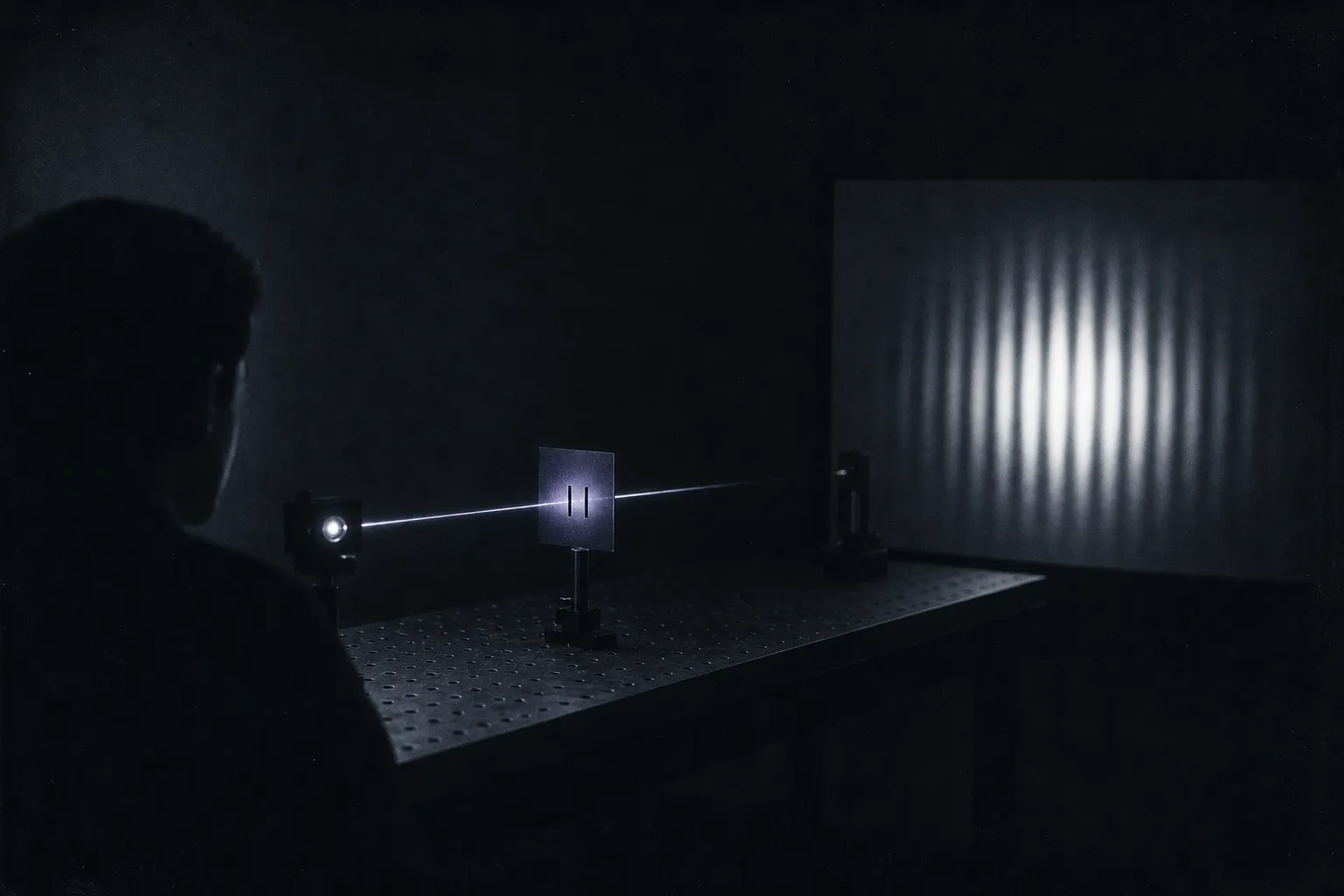
Two slits, one photon at a time
Each photon leaves a single dot on the screen. Without a detector the dots follow the square of the sum of two amplitudes, with fringes; with a detector at the slits, the sum of two probabilities, with none. The setup is simplified; the probabilities are the textbook ones.
The Celestial Code
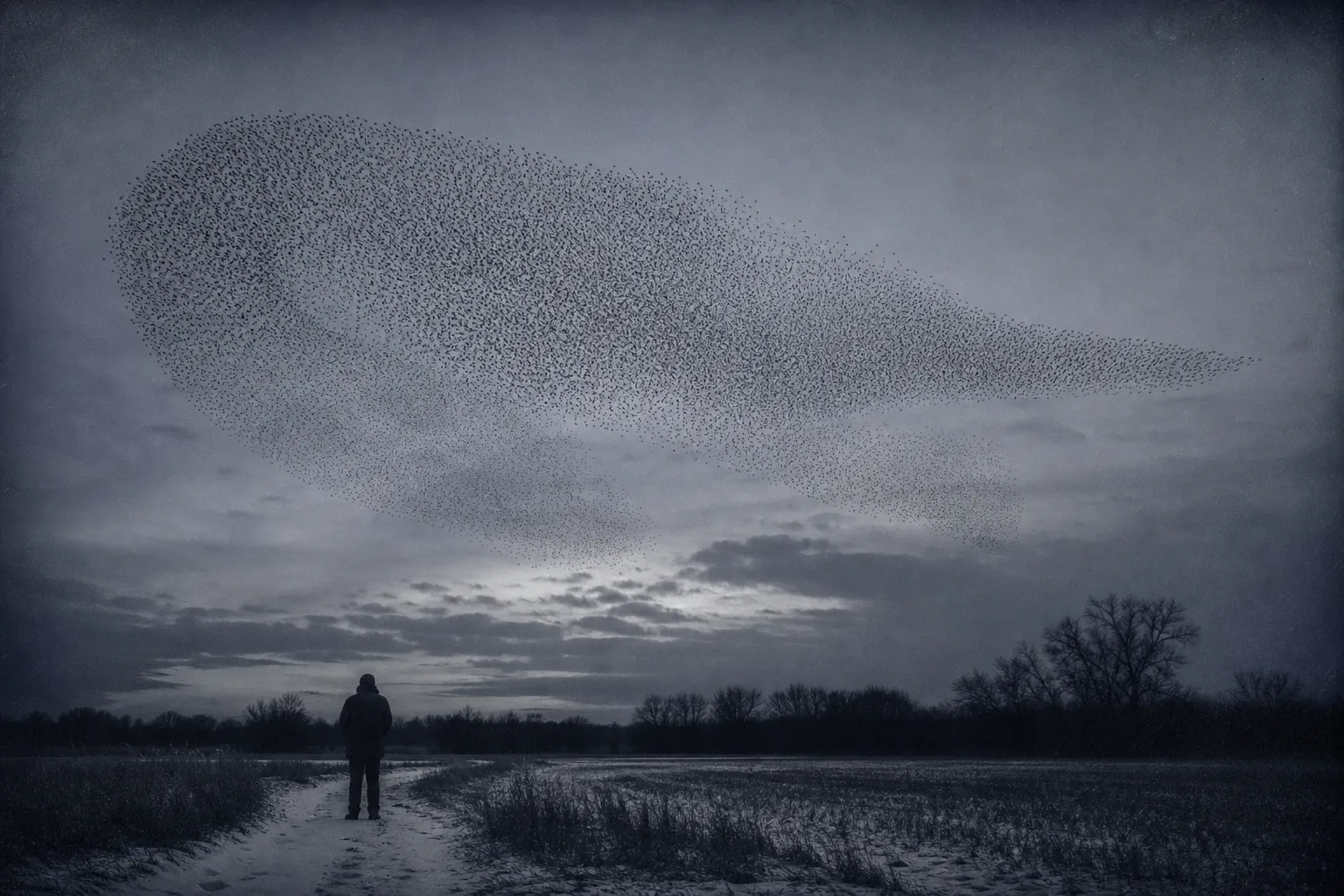
A flock from three rules
Craig Reynolds’s model (1987): three rules and no leader. Real starlings, Ballerini and colleagues showed in 2008, track about six or seven nearest neighbours, however many birds are close by.

The Celestial Code
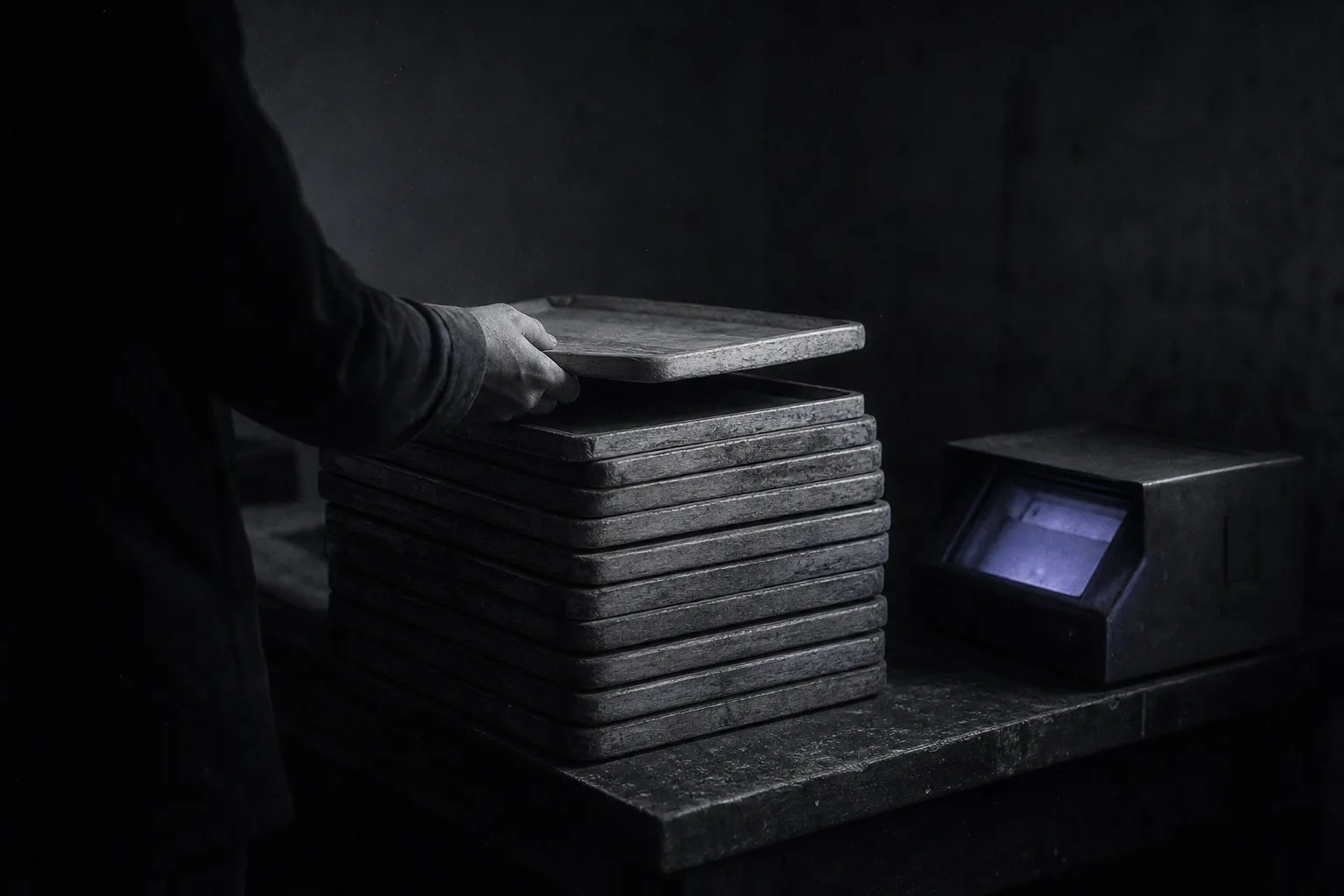
Cut the worm
A diagram of the experiment, not a simulation. Colour shows the bioelectric pattern: which end becomes a head. Every worm has the same genes; only the pattern changes.
The Celestial Code
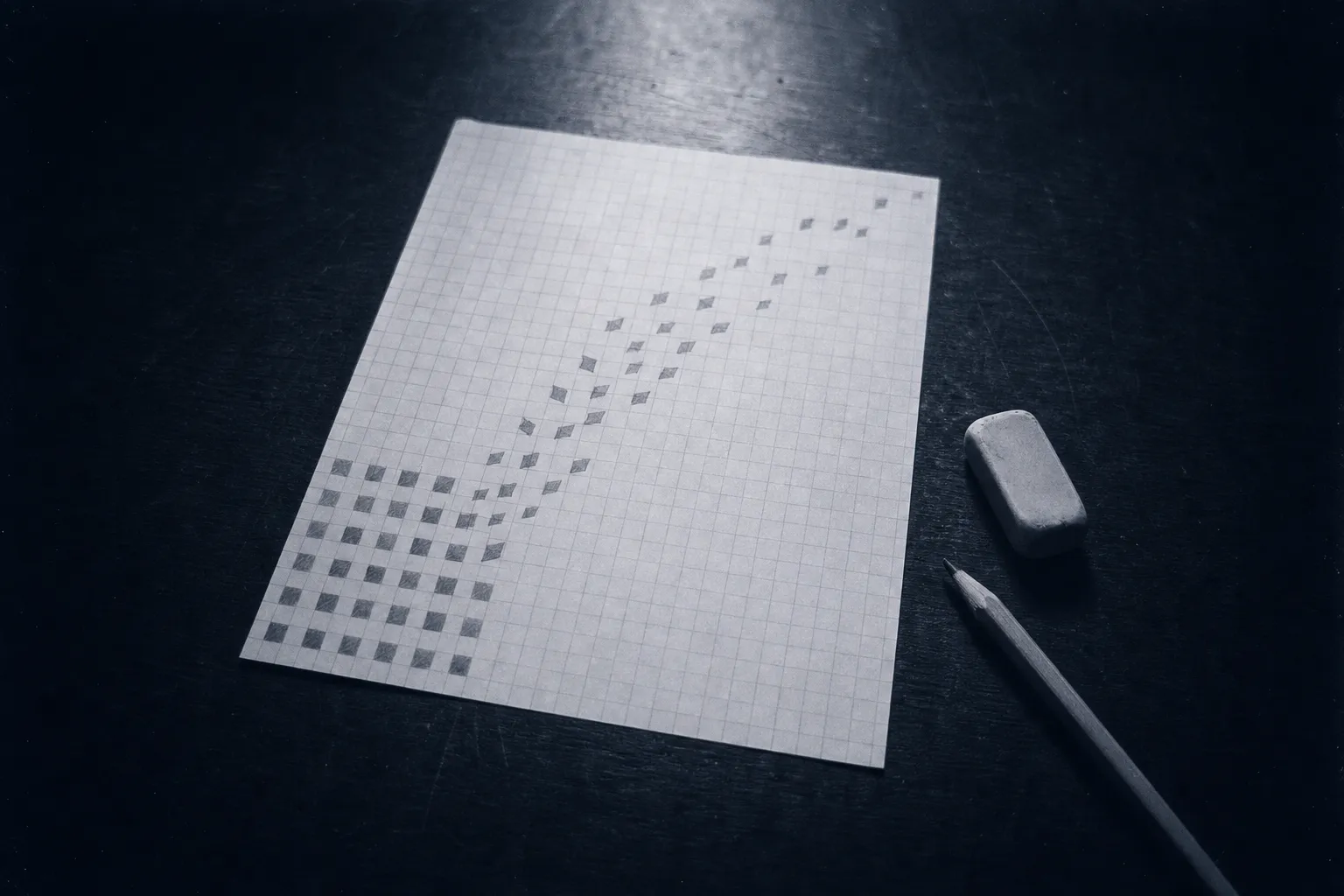
Sixth in your pocket
A pocket version: the stack words and the substrate words from LANGUAGE.md, with nodes numbered from one as in the real Sixth. The rung programs come from examples in github.com/neuralcosmology/sixth, which also holds the full Racket implementation.
The Celestial Code
Conway’s Life: four rules
Gosper’s glider gun (1970) was the first pattern found to grow forever: every thirty generations it fires another glider. Conway had offered fifty dollars for such a pattern, and paid.
The Celestial Code
All 256 of Wolfram’s rules
A rule’s number is its eight answers read as a binary number. Rule 110’s universality was proved by Matthew Cook, who worked for Wolfram; the proof was published in 2004.
Conscious Selection
Seven questions, one painting
Yarbus’s experiment on Repin’s “They Did Not Expect Him”, with a cursor in place of the suction cap on the eye. Ask yourself a question, look for twenty seconds, then take another and lay the paths over each other. Nothing is sent anywhere.

Conscious Selection
Find your blind spot
The spot lies about fifteen degrees from the point of gaze, toward the temple. Edme Mariotte first described it in the 1660s: at that place on the retina the optic nerve leaves the eye.
Conscious Selection
One word in the question
Loftus and Palmer, 1974. The original subjects watched real driver-safety films of crashes; this is a diagram. The bars are the paper’s mean speed estimates, converted to km/h.
Conscious Selection
Heated molecules lose their fringes
Hackermüller and colleagues, Nature, 2004. The visibility curve here is a sketch following the chapter: fringes survive up to about 1,500 K and fade out by 3,000 K.

Conscious Selection
Assembly index by hand
The chapter’s rules: letters are free, a step joins two pieces already built, and whatever is built stays in stock. For words up to sixteen letters the index is found by search; if the search runs out of budget, an upper bound is shown with “≤”.
Conscious Selection
Seal a prediction
SHA-256, the same fingerprint as in the attestations/ledger.txt log of the Sixth repository. The text and fingerprint stay in your browser.
Bugs Academy
Fourteen times in a row
An ideal qubit, with no noise or drift. Fourteen identical outcomes in a row at θ = 90° is one chance in 16,384: the “one in sixteen thousand” from the chapter.
Era of Architects
Decode the Wow!
A printout from the Big Ear radio telescope (Ohio State University), 15 August 1977. The 6EQUJ5 column is genuine; the surrounding digits here are generated.
Era of Architects
Karl’s module
Karl’s module is invented; the sound is real: five detuned oscillators, a resonant filter and slow modulation, all built in Web Audio right in your browser.