12
Four Ways to Be Wrong
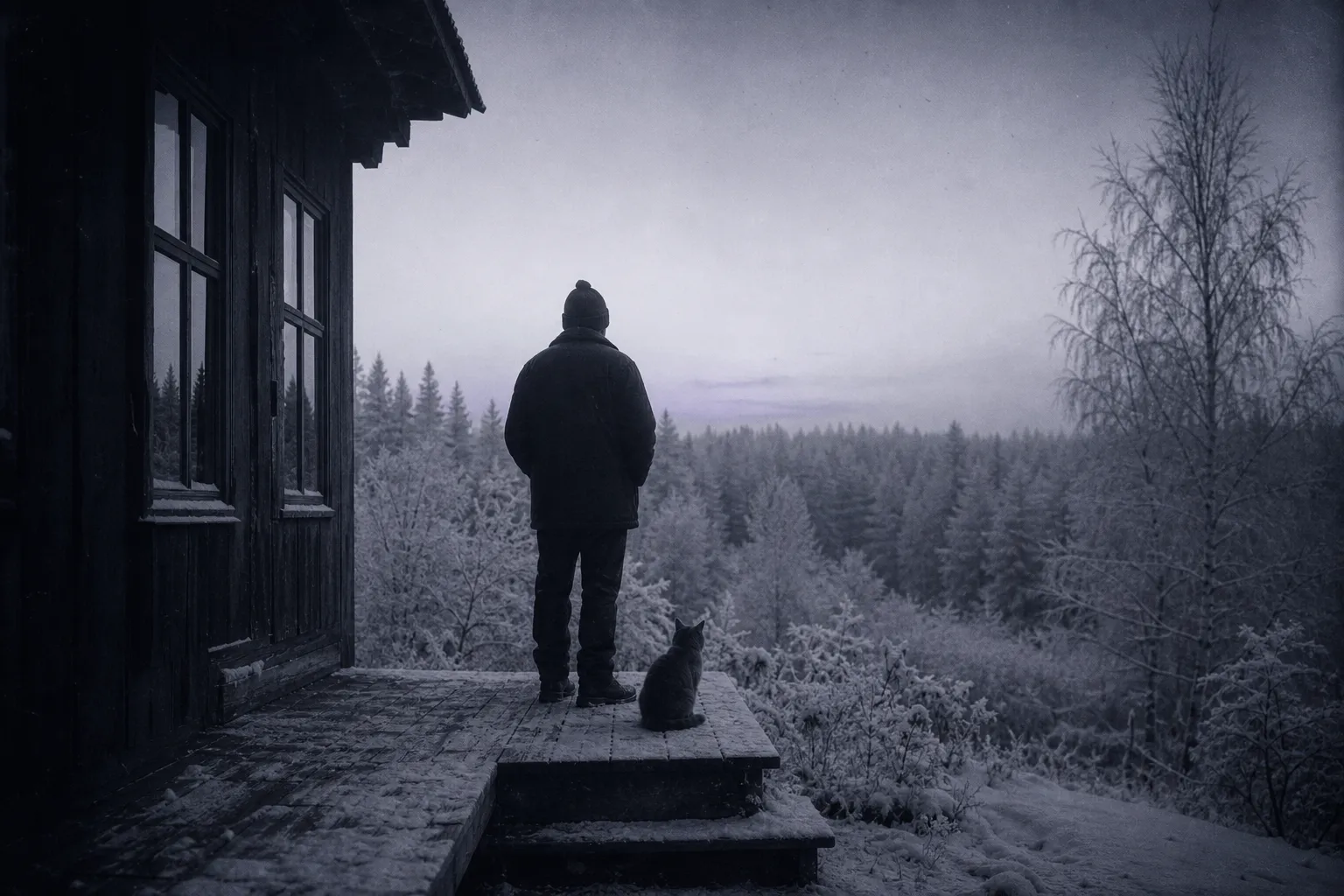
On day eleven, I saw her for the first time.
Not in the sense of meeting—there was a meeting. I stepped out onto the porch that morning (habit: every morning, stand on the porch, look at the forest, breathe air that smells like something Russian doesn’t have a word for—roughly “cleanliness,” if cleanliness were a scent)—and she was standing by the fence. Same thin coat. Same notebook.
And in that moment, in the single figure by the fence, two figures that until this morning had lived in separate folders inside my head finally clicked together: the girl from the November square who handed me a notebook three weeks before the Academy—and the quiet woman at the far chair across the table, whom my vision had been sliding off for ten days running, like a stone off the surface of water. I stood on the porch and couldn’t understand how, after ten days in one building, forty shared breakfasts, and a dozen joint lessons, I had failed to fold those two acquaintances into one face.
Zoya had been at the Academy since my first day. Sat at the table. Slept in the next room. Drank tea from the same mug Olga brought every morning. I’d seen her—and simultaneously—hadn’t seen her. My gaze slid off. As if off wet glass.
(Later I’d understand: that’s her property. Not invisibility—people don’t walk through her, don’t bump into her in the hallway. But they don’t register her as a figure. A built-in background object. Part of the furniture. Part of the air. Zoya—until she decides to manifest—is not separated from the place where she is.)
This morning she decided to manifest. So I saw her. Same thin coat. Same notebook.
Not a new notebook, though. The first one was under my pillow, next to Mom’s photo and the stuffed Professor. (Kidding. There’s no Professor. But if there were, that’s where he’d be.)
—Hey, she said.
—Hey, I said. As if this were normal. As if people show up every day at the fence of a Moscow-region dacha that exists in a place marked on zero maps. As if we were old friends, not two people who’d met once in a park and exchanged twenty sentences, seventeen of which were strange and three of which were impossible.
—You’re not surprised, she said.
—I stopped being surprised on day three. Saves the nerves.
—I told you that.
—Then I’m a good student.
She smiled. That half-smile of hers—not happy, not sad. Absent. As if she were smiling at something she saw over my shoulder. (Or over my stack. Or over my life. With Zoya, it was hard to tell exactly where she was looking, because “where” is a first-floor coordinate, and Zoya, I suspected, didn’t quite live on the first floor.)
—Does Wei Lin know you’re here? I asked.
—Wei Lin always knows.
—Is that an answer?
—That’s a fact. The answer is different: I’m here because it’s time.
—Time for what?
—For what you were all brought together to do.
Tras la compra
Este capítulo forma parte de la edición completa
Los primeros capítulos son gratuitos. El libro completo está disponible tras la compra y queda en tu biblioteca.
· · ¿Ya lo compró? Inicie sesiónUn correo cuando salgan capítulos y experimentos nuevos
Como mucho una vez por semana. Sin registro; baja con un clic.